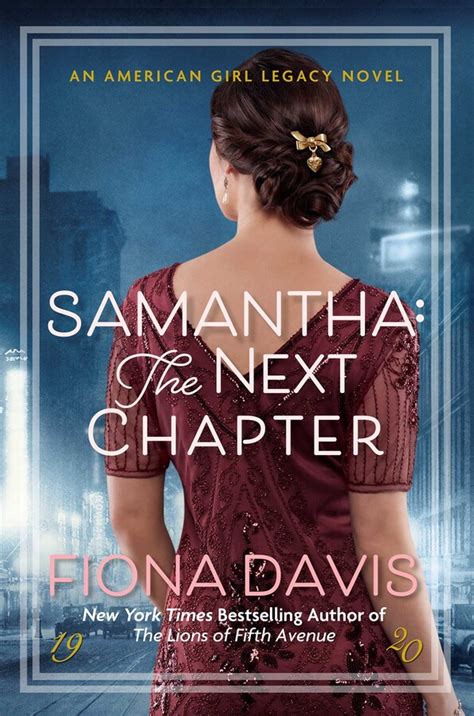
It’s 1920, and 25-year-old Samantha Parkington is working hard to educate women in New York about suffrage and encourage them to vote in their first presidential election that fall. But when Samantha’s large inheritance, including her childhood Mount Bedford home, is stolen in a shocking scheme, she goes from socialite to shop girl overnight and experiences a very different side of New York City living in a boarding house. Searching for clues regarding the theft of her inheritance, she infiltrates the business of a notorious criminal in New York City. Determined as ever, Samantha will do whatever it takes to find answers and save her family’s legacy.
I received this ARC for free from Davis’ agent in exchange for an honest review. Spoiler free
Dear America, take note, this is how you celebrate a anniversary. Not with new covers, but new books.
Davis already has a steller reputation in crafting compelling historical narratives from the point of view of women, so I was eager to see how she’d tackle Samantha Parkington all grown up. Spoiler alert, she did well.
The beginning of the novel brings back a sense of nostalgia, literally, as Samantha returns home for the summer to care for Grandmary while Uncle Gard/Aunt Cornelia go away to the Far East. It’s a nice beginning as it immediately hones in on th nostalgia the reader must feel and eases them into this novel fitting the original series’ cozy atmosphere.
It is this indulgence that makes it hit much harder when Grandmary begins to have memory problems and the subsequent days increase Samantha’s caretaking. It’s a full circle moment as Samantha gives back all the love and care Grandmary gave to her when she was an orphaned girl, and maybe it’s because my grandfather also died this year in a similar circumstance (and he basically raised me like Grandmary did with Samantha) that was very emotional. Readers who also care about their relationship will be moved by the grief and loss Samantha feels in the days after.
But Samantha is heartened that she does have the rest of her family behind her, until the estate is contested. As the summary states, the contested estate leaves her assets frozen until the matter can be resolved, leaving Samanthat to fend for herself as an independent woman.
Davis does a great job of making the stakes serious albeit realistic. Readers understand that this is going to be a temporary loss until Uncle Gard comes back to the country, Samantha is never going to face destitution like Nellie did in the original series. But she makes the point hit that this loss is an emotional blow to Samantha. After losing Grandmary, losing her home and the money she planned to use in Grandmary’s name, it compounds her grief. Plus the lawyer’s insistance that she wait until her Uncle comes back because she’s just a woman and can’t possibly help the legal matter adds to her helplessness.
But the Samantha we know wouldn’t stand by when Nellie was sent to an orphanage, and she’s not going to stand by her when men tell her to wait. I enjoyed how Davis kept these vital traits of her while fueling them to adult solutions, using the years she has spent organizing for suffrage groups, her New York connections like Agatha, and her education as a teacher to find a position for herself and get close to the lawyers who swindled Grandmary.
Samantha’s time in New York is informational and fun. Samantha was never as class-conscience as her Grandmary and that open-mindness to talk to everyone, and uplift them allows her to trasverse between social classes from working in undergarments with primarily immigrant women to taking in the sights with old Mount Bedford elite, Davis is able to touch on how different women viewed suffrage depending on their class, and race, the exploitation of working class and department store culture, and corruption during Prohibition era.
My one cavet is the scene regarding Samantha confronting her white woman suffrage bias at Sunny Beaumont’s. Sunny Beaumont is a speakeasy featuring Selma, and Porter, Black performers that AG fans might recognize as Claudie’s fellow boarders. Love a good crossover. While the scene is necessary as Davis points out the flaws of intersectionality in early suffrage, it was so “check off the box” that it took me out of it. I thought the latter conversation where they discuss Angeline Grimke’s play Rachel to be a more organic segue into that topic.
Other familiar characters that feature are Samantha’s family, and her friend/cousin, Agatha, who grows to be a delightful aspiring actress. As far as I could tell, they all retained their essence while being all grown up. New characters include Samantha’s getting a love triangle in the form of Richard Strickland, the Mount Bedford golden boy, and Tommy, the bad boy muscle for bootlegger, Mr. Mallory.
A flaw in the book would have to be that I found the love triangle is predictable. Just as I clocked in the reason why Grandmary’s estate was targeted early in the fifth chapter. That predictability didn’t erase from the journey as Davis makes compelling reasons for Samantha to feel comfortable with each boy while laying signs for why Tommy is the better partner for her in all ways compared to perfect on paper, Richard.
However, I do applaud that Davis subverted my expectations on the who behind the estate theft, and the final confrontation between Samantha and the betrayer. She emphasized the original message of Samantha’s series in “Actions Speak Louder than Words,” and how Samantha continually grows and uses her actions (and her privilege) to advocate for a more just world. She draws timely parallels to the constant change of the modern era to the excitment and fear of change in the turn of the century, how independent women help lead the cultural changes, and the importance/challenges of voter enfranchisement.
I do feel that this novel was geared more YA than Adult because even though Samantha is 25, and does get into a near-fatal brush with bootleggers, there are few curses, or references to other adult matters. Not that you need to add scenes of smut or a “fuck” on every page to make a book adult, but it did not feel as the book could have as gone as deep as it could in addressing adult topics that were relevant like women advocating for suffrage in order to bring about reforms against abuse/domestic violence, or alcoholism because of Prohibition etc. Then again, Samantha is still a sheltered upper-class woman and such topics would not be brought up around her, and it would have felt like Davis was pushing it for the sake of shock than the narrative.
Maybe if it was Julie’s story in the late 70s, or Kaya’s as she would not have been shielded from such injustices. But that’s a different topic for another day.
Overall, it was a charming book that American Girl fans will enjoy adding to their collection. Davis immerses readers in old New York, the dialogue is not anachronistic, and keeps the essence of the characters that readers love. I certainly hope they continue the series. They say they may continue with another Samantha book, but I do hope they highlight other historical girls like Josefina or Rebecca.
5 stars


Leave a Reply