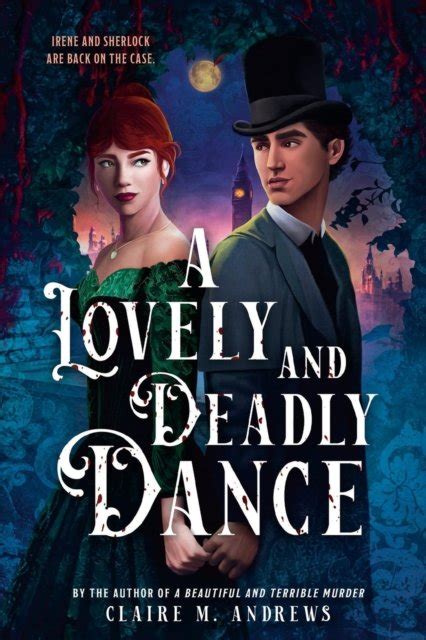
Irene Adler and Sherlock Holmes were both sent away from Oxford’s All Souls class after uncovering a murderous plot on campus. But now Irene’s deductive skills have called her back to England. Someone is killing off the queen’s closest allies and leaving mysterious messages at every crime scene.
The people of London are frightened, and growing angry. Could the murders be Queen Victoria’s fault, or is she the one in the most danger? With Sherlock’s help once more, Irene will follow leads that bring her deep into the secrets held by England’s richest families. The spark between the pair ignites and burns ever hotter all the while.
But the closer Irene gets to finding the killer’s identity, it becomes clear that it’s not a truth she wants to face. To prove herself an Adler, not a Moriarty, Irene will need to overcome the worst betrayal of her life. Can she endure true heartbreak if it’s for the greater good?
This is a sequel, but the premise looked so interesting I had to pick it up. Luckily, there’s enough context clues to catch up what happened in the first novel. Irene Adler recently found out that she’s also the daughter of Richard Moriarty (who killed her mother), she has a half-brother, James aka Sherlock’s archrival and they all knew each other in Oxford when she disguised herself as a man to join classes. In a rare ending, the bad guy wins where James becomes the new Dean of Oxford, took credit for solving the murders, Sherlock is disgraced and Irene went to America.
All caught up? Great. Now Irene’s back at Queen Victoria’s behest to solve a new suspicious string of murders with the incentive of elevating the Adler name back to its lordly status, ad hopes to bring her mother’s killer to justice.
The mystery itself was full of red herrings due to Irene’s internal struggles. She’s at war with her fear that she may be too much like a Moriarty which makes her hold back her more scheming, deceptive impulses. Not good for a detective who has to snoop in places where she’s unwanted. Then the antagonists taunt her that she’s grown soft after her retreat to the Americas, sowing further doubt in her instincts.
Andrews’ prose shines in immersing readers into Victorian London from the curtained corners of debutante ballrooms, and gentlemen clubs to the overworked clustraphobia of seamstress shops, the grimy jail and the cacophany of the racetrack. It’s an assualt on the senses and one can vividly see the characters in front of them like a movie.
The mystery was well-done, combining the class politics of the era as well as the superstitions and casual indulgence of mummy corpses to increase lifespans (Victorians were repressed freaks y’all), and I enjoyed seeing Sherlock, Irene and Watson utilize the but I did have some questions about how the murderer was able to get away with their crimes. The “who” plays into the overarching theme of Irene being blinded by the recent trauma of her life but how the relatively sheltered person learned how to cover up her crimes with forensics and do the murders, stretched plausibility.
As for Irene herself, she was a complex heroine which I loved. She’s in the middle of a lot of things. Part Adler, part Moriarty. Grew up working-class but has rich parentage. Is able to walk through balls but doesn’t have the breeding that grants respect from the upper-crust. She has the brains and independence to crack mysteries but her sex prevents her from being educated in the field (and again, respect) so she disguised herself as a boy. She has a lot of secrets and regrets that she surpresses, but without processing those fears, she isn’t able to utilize her intellect to the full extent. She has shades of “not like other girls” but given her unusual upbringing, it makes sense she isn’t trusting of the male or female sex.
While Irene is aware of her abilities, the recent events have sowed doubt in them. She is blinded by her desire to not let the Moriarty name to hurt her again. Nor Sherlock. It’s a case where the personal gets in the way of her professional stance. In many ways, it would have been an easier adventure for Irene if she leaned on Sherlock at first chance, but that’s not human nature. She was hurt by his carelessness and coupled with the era’s rampant sexism, she has an overcompensating need to prove herself as a woman. While the mistakes can be frustrating, it was necessary for character growth and that’s what I enjoy most in stories.
Sherlock was well-done too. For all his deductive reasoning, the Sir Conan Doyle stories portrays the detective’s social cues were lacking. He’s so focused on his work (and his opium) that his disinterest in social norms make him appear like an asshole. Andrews pays homage to that original characterization, this one is kind of an asshole. The drinking he indulges doesn’t help. Yet he is still brilliant and infruriating and it makes for sizzling chemistry. These two are so stubborn and independent and prideful, and similar that they make a great pair but horrible communicators, adding to the tension of the piece. Also when they kiss, it sets the book on fire.
I’m not as familiar with how the original Moriarty is portrayed, but I’m assuming the aging-down of the character influences Andrews’ depiction. Because of this, Moriarty doesn’t feel like a criminal mastermind but a rich, privileged douche and sociopath. Not even the menancing kind, simply the annoying one. Every time Adler monologues about the reach of the Moriarty clan and how dangerous they are, I don’t feel the threat. His henchman is more menacing than he. I was more curious about Augusta Moriarty and her Godfather-like grip on the London Underground which I hope will be explored in a third book.
Other characters like Irene’s friend, Geraldine provide foils to Irene’s struggle between the classes and her sense of morality. Watson provides the voice of reasoning and has some great moments of his own when he asserts his intellect to Irene, pointing out that he may not have the brilliance of her or Sherlock, but he is useful in his medical and forensic specialty. I also enjoyed how Andrews’ inclusion of elements from the original A Scandal in Belgravia by showcasing the meeting of Irene with the King of Belgravia, and her acting/showhall background.
I do think there was a missed opportunity regarding the murderer’s motivation as well as the red herring of the reporter who takes hostile umbrage at the elite’s smuggling of mummies and aesthetics from their colonial countries without regard to their culture’s sacredness. It could have added some more depth about the topic of stealing artifacts in the past and the fetishization that is still felt today. Nonetheless, it’s a compelling mystery that brings a new take on favorite characters while honoring their origins.
4 stars


Leave a Reply