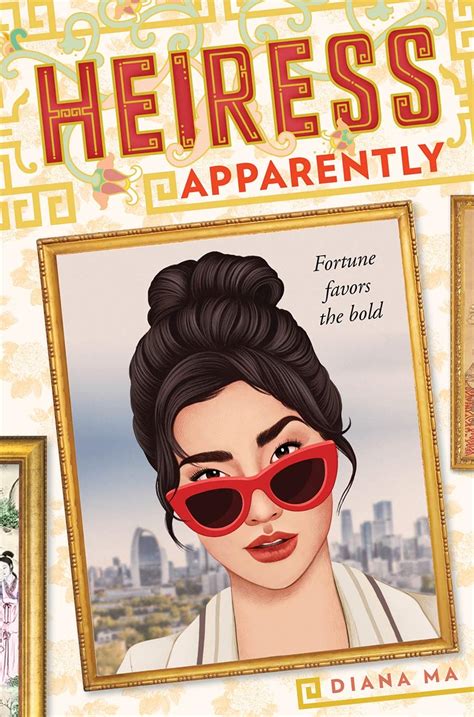
Gemma Huang is living the dream: she’s a rising starlet in Hollywood, navigating auditions and red carpets. The only problem? Her “dream” life is completely fake. She’s not the glamorous, wealthy heiress her social media suggests. She’s actually broke, crashing on couches, and one terrible audition away from giving up.
When a deep-rooted family secret surfaces, Gemma is whisked away to Hong Kong to meet the powerful, traditional family she never knew she had―a family descended from the last imperial dynasty of China. Instantly, she’s thrust into a world of incomprehensible wealth, ancient expectations, and competitive, diamond-encrusted cousins. She is the Heiress Apparently, and everything is suddenly real.
As Gemma tries to find her footing in this demanding new dynasty, she must contend with a ruthless, politically-charged social scene and the charming, yet totally off-limits, boy who seems to be the only person seeing the real her. But the deeper she delves into her royal lineage, the more she realizes that her family’s wealth comes with serious dangers.
To claim her place and understand her history, Gemma must untangle the truth about her past while facing the threat that her new life―and her family’s legacy―might crumble around her.
For fans of Tokyo Ever After, and Crazy Rich Asians, Ma brings the glitz of modern day Beijing as Gemma makes her movie debut with the intrigue and dark past of China’s communist history.
Firstly, I enjoyed Gemma as a protagonist. She’d kind, bold yet insecure and nervous about her first role and when she should pick her battles, and when she should push for more. Out of the movie and out of the new family she apparently has.
In regards to her role in the M. Butterfly adaptation (based on the play which is different from the opera), Ma/Gemma is able to comment on Asian roles in film. Not only in how few they are, but how this one continually reiterates negative stereotypes of Asian people as submissive, or evil, and in the case of men, sexless. Plus it eliminates the obvious queer subtext of a cross-dressing man, or in this case, woman. Of course, there is some conflict as Gemma is a new, untested actress, so she doesn’t feel like she has the power to push back against the director, but it keeps readers’ attention.
I only wish there had been equal weight given to this storyline as Ma glosses over weeks of Gemma’s filming. Although acting is supposedly Gemma’s passion, so much that she goes against her parents’ wishes for college and takes a gap year to pursue her career, I don’t feel it because it is not shown as much. Readers don’t even get to learn the audience reception to it.
I guess I can’t believe Ma as most of it is focused on Gemma’s abrupt, world-shattering revelation that not only does she look like elite Chinese celeb-influencer, Alyssa Chu, but she’s her long-lost cousin. Ma keeps a tight hand on the secrets involving Gemma’s family with titillating clues to what her mother may or may not have done to get banished from the family, her grandfather’s role in betraying the Liu family and how it all ties together. Like Gemma, readers will be frustrated to know more. Unfortunately, due to the language barrier and Gemma’s filming, there is not much action on Gemma’s part to find out as she has to rely on the supporting players before she can. It made the pace feel very slow in the middle.
At least the supporting characters are fun like party-girl Alyssa who gets very little page-time that I had to suspend my disbelief at her/Gemma’s quick pivot to sisters. Then there’s the Lius, Eric, and Mimi. They were much more fleshed out especially Eric as the swoon-worthy love interest.
Plus, like any good foreign vacation book, Ma spares no expense when it comes to describing the sights with all its splendor and the neon clubs, and the food that makes one’s mouth water. I also learned a simplified version of the Communist Cultural Revolution, and queer identity in China. As most know, the US tends to take up space and attention in the world, positioning itself as the biggest, progressive bastion of democracy.
But Ma asserts that the view that China is still stuck in the 50s when it comes to queer identity is untrue. Yes, the government is against it, but public perception is different from the government’s mandate. Just as the US has decriminalized same-sex marriage but there’s a lot of homophobia anyway. It forces readers to pause and rethink their perspective and also nicely ties in with the queer themes of M. Butterfly.
Besides the slow pacing in the middle, the romance between Eric and Gemma is stalled by the obviously to-be-dumped boyfriend which was interesting because it showed some non-abusive red flags of a boyfriend to be dumped, but also could have been taken out all together. Additionally, there was a lot of times that I felt Ma was skipping over boring parts to get to the good ones, which okay, that happens. But hers felt not so seamless, if that makes sense.
There was also a moment where Eric gives Gemma a pep talk about she having to realize that she’s worth it. Which is nice, but I never got the sense that Gemma was insecure. Confused about her identity, worried about her talent as an actress. But that she was worthless? That came out of no where.
Nonetheless, I’m invested now and will be looking for the sequel that promises to be about the mother’s side of the story, and I do love a good historic fiction.
3 stars


Leave a comment