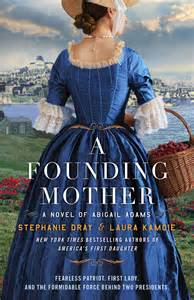
In the heart of revolutionary Boston, Abigail Adams raises her children amid riots, blockades, and the outbreak of war. While her husband, John Adams, rises from country lawyer to nation-builder, often away for years at a time, Abigail builds her own independence—managing their farm, making lucrative investments, amassing savings, battling plague and loss, and defending their home. Unafraid to speak her mind, she famously offers fearless political counsel, urging John to “remember the ladies” in the new government. Through it all, she becomes his most trusted confidante and indispensable ally.
When peace is secured, Abigail steps onto the world stage—exchanging ideas with Thomas Jefferson in the French countryside, navigating court life as the wife of the Minister to Great Britain, and presiding over the parlor politics of the early American republic in New York, Philadelphia, and Washington, DC. Even after her husband’s presidential administration, she continues battling political foes and working behind the scenes to advance her family, secure independence for the women in her life, and ensure a better life for the next generation of Americans.
From war-torn streets to the chandeliered halls of power, A Founding Mother is the unforgettable story of a woman ahead of her time—one whose voice, vision, and valor still resonate powerfully today.
The latest book by Stephanie Dray and Laura Kamoie asks readers to think about the foundations of US democracy, a woman’s place in it, and the strength of motherhood.
So often we present the founding fathers as mythical figures. Or alternatively, outdated figures who’s ideals and faults are removed from today’s time period.
However, Kamoie/Dray show that history is circular, beginning in 1814 as the Adams fear that the burgeoning nation they fought for might fall to the British in the War of 1812.
Split into four parts, the first part understandably covers the Revolutionary Era from the Boston Massacre and Boston Tea Party to Yorktown, emphasizing Abigail’s forward-thinkingness and seeding the self-sacrifice she possessed for her country. Some history-lovers or (1776 fans) may remember pertinant parts like Abigail writing her husband lots of letters while he was away with the Continental Congress, for melting pins to make bullets and sheltering refugees and soliders on the farm, but the authors make this feel real. Abigail isn’t always fearlessly looking forward to the patriot cause. At first, she’s more concerned about her family’s safety than making a stand. She doesn’t enjoy being alone at Braintree for years at a time. She mourns her daughter and makes incorrect judgements of who is a friend and who is a foe.
Yet there are moments of hope and readers will appreciate Abigail’s forwardness and pragmatism during the uncertain period of war, becoming a merchant on her own right, taking over financial accounts and seriously advocating for women’s rights, and dealing with disappointment when her enlightened husband doesn’t view it with seriousness. They will understand the excitment of the new time as the possibility of a new nation and democracy takes fruit and that there will be a chance for more freedom for all.
In doing so much for democracy, sacrificing time, effort, the chance to be a whole family (as one or both parents are gone for periods of time), the Adams can be prideful. Both do want glory because they truly believe in the ideals of what the US could be, and in being so rigid in their moral righteousness, their chance for power is often misconstrued and attacked by the Democractic-Republicans. While they, foten John, say they know that doing the right thing often goes unrewarded, they’re still bitter from lack of recognition.
John and Abigail are flawed, sincere human beings and was compelled to read partially for their relationship. They are true intellectual equals, but John’s pursuit for political glory and America often puts Abigail on the backburner. Love can be difficult, and in part 2 where John is away for nearly eight years in Europe as a diplomat, Dray/Kamoie emphasize the strain of time, Abigail gaining more confidence as an independent woman, and the daily struggles of balancing motherhood with politics.
Part three takes place during the Adams presidency and Part 4 afterwards, where the Adams marriage is put on the backseat as Abigail’s maternal arc. Throughout the story, she has been separated from her kids. By marriage, by them being overseas, through hardship and eventually death (the scene where they cut out her daughter’s breast cancer is brutally graphic), and Abigail’s stance on motherhood is ever-evolving as she tries to figure out how to do right by her children, give them better lives, and also deal with the heartbreak of separation.
The timeliness of the first years of American democracy are hauntingly familiar from the fight between states rights, and federal overreach, censorship, corruption, familial scandals, fear of innoculations, petty grievances of ambitious, overegoized men, the unequal treatment of black people in democracy, and of course, feminism. We’re still dealing with these issues! I don’t know if it’s supposed to be comforting or resignation that we may never have the answer to these problems.
If you’ve read Dray and Kamoie’s previous collaborations, readers may appreciate the references to seeing familiar events from a different perspectives. It helps that the social circles of Jefferson, Hamilton, Lafayette, etc. are always spinning around each other, and are constantly getting into each other’s business.
As a novel tackling a large amount of Abigail Adams’ life, I felt informed about lesser-known aspects like her stance on abolitionism and the action she took to support female servants, relatives, and others in her sphere, but some might feel frustrated by the slowness in the beginning and the blunt reiteration of the novel’s themes. But I was kept engaged by the familial aspects and the political intrigue.
Perffect for getting a more three-dimensional human look of the founding figures on America’s 250th birthday.
4 stars


Leave a Reply