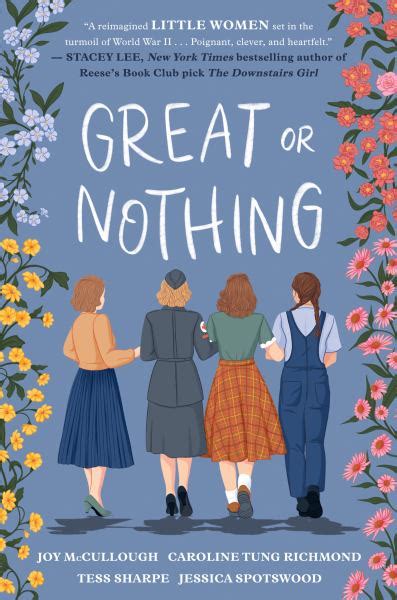
In the fall of 1942, the United States is still reeling from the attack on Pearl Harbor. While the US starts sending troops to the front, the March family of Concord, Massachusetts, grieves their own enormous loss- the death of daughter Beth.
Under the strain of their grief, Beth’s remaining sisters’ fracture, each going their own way, with Jo nursing her wounds and building planes in Connecticut, Meg holding down the home front with Marmee, and Amy living a secret life as a Red Cross volunteer in London-the same city where one Mr. Theodore Laurence is stationed as an army pilot.
Each March sister’s point of view is written by a separate author, three in prose and Beth’s in verse, still holding the family together from beyond the grave. Woven together, these threads tell a story of finding one’s way in a world undergoing catastrophic change.
This was an interesting remix of the classic Little Women story where the authors not only transported the cast to the 1940s, but also focused primarily on p2 of the original novel. You know, the part after Laurie’s ill-fated proposal to Jo, Beth’s death, etc. The March sisters are already split up in the beginning of the book, emotionally and soon physically, and adds to the uncertainties of the war years they’re experiencing.
I’ll go character by character, and start with the surprise that everyone’s favorite heroine, Jo March, had the least interesting story arc. While I applaud Sharpe for focusing on Jo’s depression in the wake of her sister’s death, and how her guilt and loss of friendship with Laurie leaves her even more unmoored, but it is not fun to read. She doesn’t have the writer’s ambition or temper that makes her engaging (except in a few spats with Amy) and her later arc of falling in love with a female journalist felt predictable considering the number of Jo March-lesbian subtext academic theories there are. Additionally, she is also the most isolated out of the family, and there is an implied hope she’ll find her way back to that family support but no satisfaction of reading it.
McCullough had the unenviable task of depicting the late Beth March’s voice. In this case, she put her in poetic form after every chapter, reflecting and commenting on her sister’s lives. It’s a creative technique, but I’m not a poetry person, so I wasn’t interested in her POV. They felt more like riddles.
Much like the Greta Gerwig movie, Richmond’s Amy has the clearest arc from aimless girl to aspiring Red Cross nurse. Partially driven by guilt that she wasn’t there for Beth, partially because she’s tired of being seen as spoiled, Amy decieves her way into the Corps. Richmond does a good job depicting London and France in wartime, the fun nights off with soldiers and the harrowing, last minute training because they need more nurses stat. Plus Richmond delves into interesting political implications when Amy wishes to speak out against the suspicion of Japanese Americans and their internment but is conflicted when her new friends have relatives or siblings who died at Pearl Harbor.
And yes, there is the Laurie-Amy romance, but Richmond makes it tolerable with her steady pace of Laurie seeing her beyond a annoying little sister, and them trauma bonding when he gets injured and she nurses him to health.
Finally, Spotswood’s depiction of Meg at the homefront was nuanced and subtle, demonstrating the constant pressure of trying to carry on with normal duties, and helping with the war effort with the anguish of missing male lovers and relatives, long-distance relationships and feeling that one can’t complain because you are not truly suffering. Meg’s grief over Beth is confronted as Spotswood expands on Marmee and Meg’s relationship, and ties in into reaffirming her love with Brooks and that she is strong enough to withstand the uncertainty of what will happen after the war.
All the authors creatively transplant the familiar characters of Concord, Massachusetts to the historical realities of the time period, adding appropriate dialogue, interests and the additional struggles confronting the people of the time period. The story sheds a new perspective of the March girls growing up and becoming young women with clear visions of their hopes and futures.
However, because only half of the POVs were compelling, I’ll have to give this 3 stars.


Leave a Reply