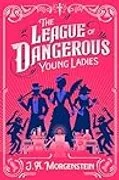
It’s 1909 and Rose Moriarty—teenage daughter of Sherlock Holmes’ greatest enemy—has made a name for herself fighting monsters and solving crimes. But that was before Rose met the one mystery she couldn’t solve: the disappearance of her headmistress. Now, her school has shut down, her classmates have scattered, and Rose is on her own.
On the very day Rose receives word that an old friend is dying, the shadowy Count Christoph and his ward Clara show up at her door. Rose has already figured out why they’re here (to hire her) and what’s in their bag (an ancient orb with incredible powers), but questions remain:
Can Rose convince these strangers to help save her friend’s life? What are the grotesque, bug-shaped stalkers that plague their every step?
And how can Rose pursue this adventure while avoiding a particular boy from her childhood? The only thing certain is that Rose is no longer alone, because danger forges strange alliances . . .
. . . and Professor Moriarty wasn’t the only famous villain to have a daughter.
Morgenstern plops you right into the story which has its pros and cons that are noticeable throughout the novel. While putting readers into the action allows for the plot to move quickly and to introduce the major players, I felt like I was playing catch-up right until the third act.
As I read, I was trying to figure out the relationships the characters had with each other, their ages and their backstory. Although this can be part of the drip-information technique, allowing readers to slowly piece the backstories themselves, Morgenstern glosses over some of these plot points in order to get to the next.
That and the fact the story switches POVs at random moments made the story even more confusing to me.
A major fault would have to be Rose’s depression and guilt after the disappearance of her headmistress. We are informed of their deep bond, how Headmistress Hina was a mother figure and gave her somewhere to belong with the other villainous offspring, but as a brand new reader, I didn’t feel it. I barely knew who these characters were, so I couldn’t get invested in their bond or Rose’s loss.
Unlike Rose, I was able to get into Seffy, the daughter of Dr. Moreau, whom he was as cruel to as his other experiments. Her backstory was introduced in full with flashbacks and everything, but her pain about her father’s cruelty and experimentation on her, was only relevant to certain chapters and then forgotten.
Nikki Tesla, the sole living teacher, felt all over the place as a character and plot device, where her importance only came through in the final chapter.
That’s another flaw of the novel that major emotional beats (especially one with Rose’s mom. Another Sherlock character which makes an interesting pairing.) were brought up, and then forgotten when another action scene came about. There’s so much to explore like Rose’s desire to be perfect combined with her idolization of her father whom we know as dastardly, but she knows as Dad. What does she think of his deeds beyond annoyance at Sherlock hunting him? What about her friendship with Elizabeth who is Sherlock’s daughter, but remains off the page for the whole book. Was there tension there? Her mother acts like a Catwoman-esque anti-hero, and Rose is wary of her, so how did they come to bond so quickly?
They were plot devices and was missing the emotional growth of the characters, their motivations and their desires. It all felt very flat. It was a lot of tell, not show.
Perhaps this is because, as Morgenstern writes in the acknowledgements, that this started as a script. Then it starts to make sense. There’s quick exposition, and lots of action scenes- that is where Morgenstern shines, and emotional beats have to be quick enough for readers to get a sense of what the characters want before they move off to the next location. But as I was expecting a traditional novel, I was lost and missed the getting-to-know the characters and their world.
It’s a shame because the premise is super interesting. The daughters of famous villains like Morierty, Dr. Moreu, Dracula, and others coming together to form a superhero society is so cool. But without a real undertsanding of the character’s dynamics or interiority, it eels like I missed a crucial first episode to a potentially exciting series.
2 stars


Leave a Reply