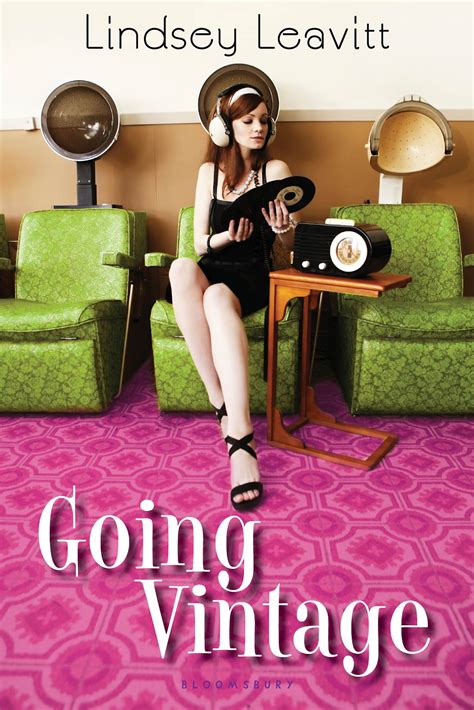
When Mallory’s boyfriend, Jeremy, cheats on her with an online girlfriend, Mallory decides the best way to de-Jeremy her life is to de-modernize things too. Inspired by a list of goals her grandmother made in 1962, Mallory swears off technology and returns to a simpler time (when boyfriends couldn’t cheat with computer avatars). The List:
1. Run for pep club secretary
2. Host a fancy dinner party/soiree
3. Sew a dress for Homecoming
4. Find a steady
5. Do something dangerous
But simple proves to be crazy-complicated, and the details of the past begin to change Mallory’s present. Add in a too-busy grandmother, a sassy sister, and the cute pep-club president–who just happens to be her ex’s cousin–and soon Mallory begins to wonder if going vintage is going too far.
Most girls when they get dumped, eat ice cream and maybe block the ex from their accounts. Mallory’s techno ban was crazy yet impressive even though I found it hard to understand her deep aversion. But that was the point as even she realizes her tech ban may be an extreme reaction to being tech-cheated on and is too embarassed to explain it to others.
Readers may be initially confused by the catalyst for the break-up. Not the cybercheating, but that it is all due to a sims-inspired game, and the ensuing drama and public shaming in the Myspace comments. I know Myspace was a thing when I was a child, but it went bankrupt or disappared by the time I was 9, so I was pretty confused what it was. From what I understand it was like Facebook for teens.
That aside, Mallory’s choice to go tech-free not only stems from cybercheating trauma but becomes part of a deeper prolem of Mallory idealizing her Grandmother’s past. She envisions being a teenager in the sixities as something quaint and trauma-free because there are no mean comments to read.
I enjoyed how Leavitt deconstructs this idealistic view by highlighting the pros (Mallory becomes more proactive of doing things outside the house, doesn’t get sucked into social media) and the cons (inconvience in communicating with family, homework, social scene updates).
Same with her romanticization of the sixities as Mallory’s younger sister pushes back on the lack of women’s rights, and opportunities, professionally and romantically. The reveal of her grandmother’s big secret is a wonderful example of Mallory’s short-sighted which she acknowledges. It’s a nice lesson about the elasticity of history that every generation had its own troubles because being a teenager is hard. Being a human is hard, and there’s never been a “simpler time” no matter how far back you go.
From Leavitt’s Princess for Hire trilogy, the author has a fondness for vintage and she puts it on full with display by having Mallory shop out sixities dresses (I now know what a seersucker dress is, and they’re pretty cute), rotary phones, and jokes about beehives. It’s a shame she didn’t get into the music or movies because some of them can be cheesy fun.
Another point in the book’s favor is the care paid to Mallory’s family dynamics. Her parents’ passionate yet rocky discussions on money come into play when her mother’s internet sneaking leads to a hurtful betrayal. Plus Mallory has an interesting relationship in having a naturally prettier, more athletic, sociable younger sister that has shades of jealousy but never veers into too much bitterness. Ginnie was my favorite for her saneness, and I liked seeing the sisters support each other even if they made mistakes along the way. Primarily from Mallory’s side.
Mallory’s grandmother was suitably cool and enigmatic, and had an interesting story of her own.
When it comes to the romance, I had some concerns because Mallory falling for Oliver, her ex’s cousin does seem a bit tricky. It’s not like dating a brother, but it can be weird. It’s weird for Mallory too, but the connection was so sweet and real that I ended up rooting for it. Oliver was such a gentleman, and helped Mallory come to some necessary realizations when it comes to her character.
Mallory’s determination to complete the list starts off as a way to get over Jeremy, but ties into her desire to have her own thing. So much of her had been tied to Jeremy and his social life that the List is a suitable way to find hobbies. But it also lets her gain confidence, no longer comparing herself to her talented little sister, her dynamic grandmother or the cool girl her ex cheated her on. She becomes her own person, and it’s not predicated on what she had with Jeremy.
Additionally, Leavitt does a relative rare choice of portraying Jeremy as not simply a cheating jerk. He has issues which allows Mallory for some understanding and closure that his cheating has nothing to do with her being lacking, but a symptom that their relationship wasn’t as solid as she thought. Plus Olivr’s words of closure and letting go were powerful. The whole book is Mallory realizing the relationship wasn’t as rosy as she thought nor it’s what she wants anymore. Even so, the break-up is hard on her even though she knows if she’d been on the outside she’d wonder why the girl would cry over a jerk like that. It felt realistic.
Sometimes Mallory’s strictness in regards to her tech ban felt ridiculous which was the point, but can be grating to the reader. Same with the romantization of the sixities even when her grandmother is telling her it was not that great. That may grate on some readers. But the romance between Oliver and Malolor and the mid-book betrayal by her mother will keep readers going.
4 stars


Leave a comment