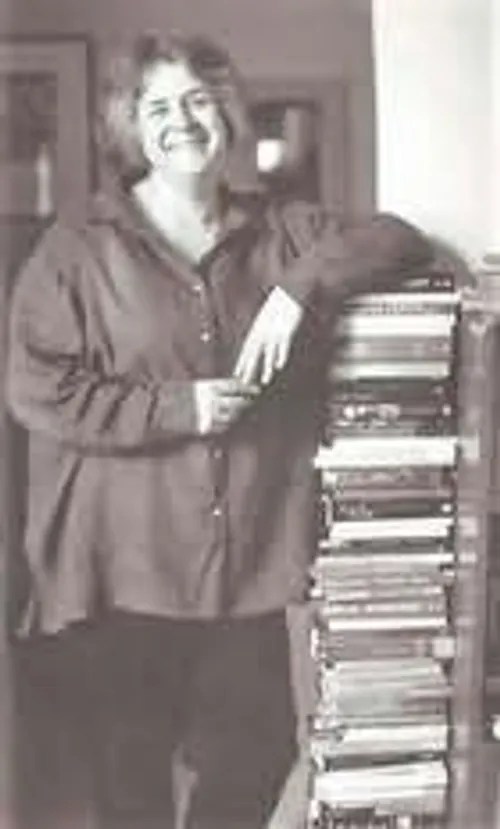
Jenny Pausacker is one of Australia’s most prolific children’s authors, academic and essayist. From 1975 to 2007, she wrote 72 books in almost every genre. She graciously took the time to answer my question about her boundary-breaking books, queer literature and what she’s currently doing in her retirement. Enjoy!
- You really developed a passion for writing after your father’s death-how did the grief channel your creativity?
I’d been telling stories from early childhood and sometimes even writing them down. I still have a copy of one of my first stories, which goes, “Once there was a dog and a cat and a pig. And they went. And they lived happily ever after. The end.” Then my father died and I felt no one understood what it was like for me … until I read J.R.R. Tolkien’s account of Gandalf’s death in The Fellowship of the Ring.
After that, I knew there was a community of writers and readers out there somewhere and I wanted to be part of it. (And I wasn’t surprised to find out later on that Tolkien’s father died when Tolkien was very young.)
- You’ve been noted for your books breaking stereotypes (Role Your Own: A Book About Women’s Liberation for Fourth Form Students; Hands On: Trade and Technical Careers for Girls and Women), did that come about organically or partly influenced by your time in the counter culture movement?
I was volunteering at the Women’s Centre in Melbourne and one day I noticed an ad for a feminist children’s book group, so I went to a meeting, to see what it was like, and ended up writing two picture books with them. 1975 was International Women’s Year, so the Children’s Book Group applied for some government funding and I wrote Role Your Own and a countersexist booklist.
After that I had some other educational projects commissioned and eventually I was able to declare myself a fulltime freelance writer. But my first experience of being published was as part of a collective and I still really value my time in the counterculture.
- Most of your works were written in response to a gap in the market (What Are Ya? about sexual identity, Mr. Enigmatic about a boy writing teen romance, Getting Somewhere against the greed is good mentality); In writing books that challenged the norm, did thy also challenges your own perceptions?
Yes! It’s easy to think, “There should be books that challenge the stereotypes,” but much harder to come up with an alternative.
At the time when I wrote What Are Ya? lesbian characters in novels tended to end up being tragically killed, often in a car crash. It wasn’t until I was editing What Are Ya? that I realised that although my lesbian main character survives, she actually witnesses a car crash in the course of the novel. So I hadn’t got as far away from the stereotype as I thought.
- You’ve written several historical fiction novels like A Tale of Two Families for Scholastic’s My AUS Story, detailing a split in the family regarding Women’s Liberation and Vietnam, was it partially inspired by your own time in that era?
The family in A Tale of Two Families (also published as Sisterhood and Secrets) isn’t my family, who were all activists in the 1970s – my mother in the anti-war movement, my brother in the ecology movement and my sister in Gay Liberation. A novel needs some conflict, so I gave Jan a few conservative relatives and neighbours.
I’d lived through that period, so I thought it would be easy to write about. But I ended up doing as much research as I did for an earlier book, Can You Keep a Secret?, which was set in the 1930s Depression, the time of my parents’ childhood.
- In your essay about Gender Construction, Teenagers, Sexual Identity and Teen Named Blake in 1999, you discussed how Australian literature doesn’t have defined female identity to write against/subvert compared to the Australian male, and most feminist role models came from American/UK/NZ idioms. Do you think this has changed in the decade since, and did your crime fighting detective Blake contribute to that landscape?
Sadly, the publisher of the first two Blake mysteries was taken over by another company, so there was a long gap before the third book came out and the series didn’t reach the audience I’d hoped for.
But even without Blake’s help, I think there are a lot more feisty girls in Australian children’s and young adult fiction these days, which is great.
- You admit that you don’t have the same ear for writing for the stage than novels, but did some of the experience for the Australian Performing Group and Troupe modified your writing when you returned to kidlit with Reading Rigby?
I definitely write better dialogue than I would’ve done if I’d never tried writing for the stage. There’s nothing like hearing an actor trying to deliver a badly-written line to make you pay attention to the natural rhythms of the way people speak.
- In 2015, you rescued over 80 titles of pre-1980s queer literature from being forgotten as well as their misrepresentation by critics, was there any reaction or prompting for more research into the sub-genre?
I wish! The Australian literary critic Geordie Williamson wrote a book called The Burning Library about how Australia tends to forget its literary past and sadly the children’s literature scene is no exception.
Although having said that, I should add that there are a lot more openly gay writers of young adult fiction these days – Erin Gough, Holden Sheppard and others. So something brought about those important changes and I like to believe I was part of it.
- You’ve gone through so many genres, and demographics, do you feel your style or your approach to writing evolved through the decades?
I’ve done the same job all my life but there’s been a lot of variety within it. I always like trying new things – although I may have gone too far with my last young adult novel Going Overboard, which I saw as a short history of Australia, centred around a girls’ militia. The only publisher who was prepared to consider it said it might be the great Australian novel, but they didn’t think there was a market for it, so I settled for putting it up on my website!
- You retired when the publishing industry began to push out midlist writers, and tighten their funds, forcing writers to handle their own marketing and publicity. Something that seems to have gotten worse with the advent of writers focusing as much energy on Tiktok as with writing. What are your predictions for the industry today?
I don’t understand AI, but I find some of the ideas behind it scary. When I was starting out, I took any writing work I could get – at one stage I edited a manual my chiropractor had written, on how to crack dogs’ spines – and I learned something from every job.
If writing like that is all outsourced to a computer programme, there will be fewer opportunities for writers to learn and to support themselves by their writing. And the increasing popularity of creative writing programmes – in Australia, at least – means there’ll be more would-be writers scrambling for fewer jobs.
I have to admit I’m feeling pessimistic at present, both as a writer and a reader – but as a lifelong Dickens fan, I’ll channel my inner Mr. Micawber and hope ‘something will turn up’.
- Any news you’d like to share?
My partner and I just collaborated on an article about Australian novels with main characters over 60, in which we noted that young adult literature was a response to the then-new social category of ‘teenagers’ and wondered why there isn’t an old adult literature for all the people who are living longer than their parents and grandparents expected to live. So maybe my next move will be to write old adult fiction. . .
You can learn more about Jenny, her books, and her academic articles on her website: https://jennypausacker.com/


Leave a comment