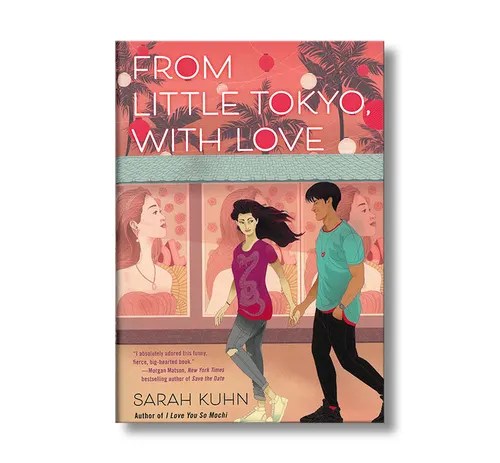
If Rika’s life seems like the beginning of a familiar fairy tale—being an orphan with two bossy cousins and working away in her aunts’ business—she would be the first to reject that foolish notion. After all, she loves her family (even if her cousins were named after Disney characters), and with her biracial background, amazing judo skills and red-hot temper, she doesn’t quite fit the princess mold.
All that changes the instant she locks eyes with Grace Kimura, America’s reigning rom-com sweetheart, during the Nikkei Week Festival. From there, Rika embarks on a madcap adventure of hope and happiness—searching for clues that Grace is her long-lost mother, exploring Little Tokyo’s hidden treasures with cute actor Hank Chen, and maybe . . . finally finding a sense of belonging.
But fairy tales are fiction and the real world isn’t so kind. Rika knows she’s setting herself up for disappointment, because happy endings don’t happen to girls like her. Should she walk away before she gets in even deeper, or let herself be swept away?
This hit all my favorite tropes. Tough girl who thinks she’s impervious to all the shitty things people say about her only to find love, and crack those walls down. The love being a wholesome, unapologetically good guy who works on healthy communication. Love even more!
Kuhn does a wonderful job selling the fairytale atmosphere. I mean the original dark fairytale atmosphere as Rika reminds her sisters that the originals were dark. Besides she’s more of a nure-onna folklore fan. That’s how she sees herself, and while she first finds it aspirational as nure-onna’s anger is strategic while hers blows everything up like a kaiju, the story deconstructs the armor she built for herself.
This is a love story between Rika and Henry for sure. But it’s also a love story to Rika herself who has internalized so much shit about how others view her and vilify her. She’s a biter, a monster, a burden, and can’t control her rage which will bring her family down. She hates herself in a subtle, internalized way that it feels justified. So when Henry comes and loves her so unconditionally. For her flaws, and flipping them into strengths, my heart.
Henry is a sweetie too, but he isn’t just a prince charming. As Kuhn puts it they are both the prince/princess fighting their demons. While Kuhn initially paints it as possible enemies to lovers, it’s quickly nixed because Kuhn shows nuance. Henry isn’t as perfect as his actor facade suggest, but deals with his own insecurities about being bi-racial. He’s constantly stereotyped yet has to be perfect so to represent both sides of himself well while neither community really accepts him. That plus being an actor, no wonder he has anxiety. What I love about their relationship is not only how they help each other up, but are able to bond over their similar difficulties of being biracial.
Rika also comes to realize that she’s not alone in not fitting in. Not just in finding a community of biracial Asian-Americans, but that her supposedly perfect-sister/cousins don’t feel completely accepted in their community. Nor does her best friend. Everyone has moments when they feel that they are viewed as one trait, not a whole person.
It’s a lot of love going around with Rika finding her safe space with Henry, her community and family do stand behind her, and yes, she deserves love. It all helps her to finally believe she deserves it.
This is also a love letter to LA, and Little Tokyo which Kuhn describes in immersive detail. I love how she keeps her fairytale atmosphere too in not only describing the more well-known, colorful parts of LA, but also the secret shadow spaces that have their own unique beauty, and the dirty parts that people ignore. Just as people ignored Rika’s mom out of shame and prejudice which leads to a poignant climax where the community takes some responsibility for their toxic traditional values.
Usually in these books, there’s some admission by the protagonist’s family, but this is one of the few that has the entire community acknowledge their wrongs, so that was cool.
It’s just a moving book. At turns sweet and melancholy like a real fairytale about a girl learning to blend the two halves of herself, and channel her anger into love.
5 stars


Leave a Reply