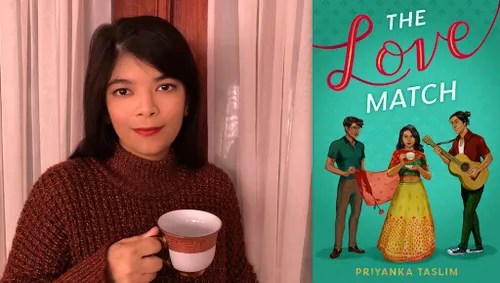
Priyanka Taslim is the author of rom-coms, The Love Match and Always Be My Bibi, featuring swoony Bengali Muslim characters. She graciously took the time to answer my questions about arranged marriages, Bengali representation, and her upcoming adult romance. Enjoy!
1. You got your start writing with fan fiction, what were the fandoms that started it all?
I wrote a lot of obscure anime and Final Fantasy fanfiction when I first started out. These weren’t huge fandoms, which was probably for the best, since I was about twelve and sharing my writing with others for the first time. Eventually, I wrote a bit in the Supernatural fandom as well. I don’t know if anyone suspected my age, but most people were very kind and encouraging and that experience definitely motivated me to hone my craft!
2. What are some of your favorite tropes to write? Or hope to write?
For romances, of course I love many tropes like fake dating and rivals/enemies to lovers, but I’m also partial to forced proximity. One of my favorite things to do while plotting a romcom is coming up with reasons why these two characters must be in the same vicinity, especially if they butt heads at first, especially if they have to collaborate in some way for a shared goal. That sort of situational comedy always amuses me.
Not so much a trope, but I love magic, fantasy, and fairy tales. I’d love to work on something more in that vein one day.
3. When you wrote The Love Match, when did you know it was the one to field queries with?
I actually didn’t get an agent with The Love Match, but I think it felt ready for submission to editors when the characters felt wholly realized, when Zahra’s antics made me laugh and her struggles pulled at my heartstrings. The Love Match was my pandemic novel, and I felt at the time that people needed fun, fluffy romances as an escape from hopelessness.
At the same time, I think it had hidden depth, because settings like Paterson and heroines like Zahra don’t often take center stage. I wanted to write the book for teenagers like the one I was, but especially for the ones who live lives like her even now. Paterson is a working class, predominantly BIPOC city where many teens work to help their families while juggling school, have to decide between furthering their education and earning money faster after high school, and play a part in looking after younger siblings. I believe those readers also deserve to be at the center of love stories, of happily ever afters.
4. You’ve said you wanted the characters to be as dimensional as the Bangladeshi community you grew up with in Paterson, showing the diversity within the community. Did Zahra, Dani, Nayim, Harun come fully formed or did they evolve as you wrote the story?
I usually don’t start writing until I have little sparks in my mind that eventually grow into my characters, so I did have to ruminate over them for a bit before they became more tangible to me. Zahra and Harun, modern Bangladeshi diaspora characters forced to contend with an old school arranged relationship, manifested for me first because I was interested in turning the idea of arranged marriage that we often see on its head a bit. Then, of course, I wanted to complicate matters further for them by exploring the other side of the coin—a “love match” for Zahra.
Her best friends then manifested as foils for her and the B-plot I wanted to explore of what it means to grow up and start to grow apart. They have certain privileges she doesn’t because college isn’t inaccessible for them. While she feels stagnant, they’re excitedly talking about how to decorate their dorms and what they’ll major in. Maybe it’s the educator in me, but I’m a sucker for coming of age stories that touch on things like that.
5. Match-made marriages are often viewed in a negative lens by the Western world, but are a cultural component to many communities. How did you approach the lighter, fun side to this perception?
My parents had an arranged marriage, as did most other elders in my life, and so I grew up hearing about that experience and how genuinely fraught it could sometimes be. It’s something that, for young girls in particular who come from impoverished families in rural parts of places like Bangladesh, can be even more fraught.
But, as I got older and started to experience not only peers getting married but also fielding matchmaking efforts myself, I realized there’s been a huge shift in the way modern arranged marriages happen. For one, it’s very rare for families—at least, the ones I know—to expect their children to be married so young, without the opportunity to pursue an education and career. That was true for me too—a lot of people assume, because of the plot of The Love Match, that I was dealing with the push to get married since I was a teen, which is not true. That’s why Zahra’s financial situation was so important to the story, because the option of her getting a wealthy husband was meant to be a lifeline and a lifeline isn’t really necessary when your ship isn’t in danger of sinking.
People are occasionally confused about the matchmaking plot line in Always Be My Bibi because Bibi’s family is wealthy, but there, unlike it being some kind of salvation for her parents the way it is for Zahra’s mother, it’s meant to be a teachable moment—an “if you touch the stove, you’ll burn your hand” meant to make Bibi realize how lucky she is that the goal post of her life isn’t simply becoming a trophy wife someday. There’s a reason none of the teens actually end up married by the end in any of my works.
Going back to the question, though—when I, with a freshly minted degree and career, did start getting prodded about meeting potential suitors, I realized that the modern arranged dating market is actually a lot like online dating. You make a profile in the form of a biodata, you send pictures, you get the same in return, and you decide if you actually want to talk to them, meet them, etc. Except, instead of it just being you two, you have your entire family and perhaps some non-blood related matchmakers breathing down your back.
There is so much untapped comedy in that, which is often unexplored in favor of always dwelling on the most traumatic forms of arranged relationships. I wanted to touch on some of that with Zahra and Harun—things like getting tricked into “casually” meeting each other, having chaperones accompany you on dates, etc. I thought it’d be fun to play around with two characters trying to sabotage the set up from within. Like any other relationship and any other meet cute—or meet ugly—it may work for some, it may not work for others, but I was interested in showing the flip side of arranged marriages.
Both of my books also take loose inspiration from Austen’s works and I’ve always felt that the social nuances of Regency era romances have similarities with modern—though shifting—South Asian courtship, which makes them, to me, a better vehicle to explore contemporary Austen reimaginings.
6. Always Be My Bibi is a fun romance, but also touches on class discrimination and colonial exploitation and its continued effects. Why do you think it’s important to include these topics in what some would consider just a rom-com?
With Always Be My Bibi, I wanted to be able to do for Bangladesh what I did for Paterson and make it come alive in an enchanting way, because most depictions of Bangladesh are not only rare but usually negative. The tea gardens in the book are absolutely stunning to see, like a little piece of paradise left on earth, but then when I started delving into their history, I realized that like a lot of other beautiful things in South Asia, tea is inextricable from things like classism, casteism, and colonization. I think it would do a disservice to all the people who still work in places like the tea gardens of Bangladesh, seeking things like fair pay and education, if I solely focused on the glamorous lives of the most wealthy and ignored the cost of that wealth.
I hope that, like Bibi, readers come away appreciating places like Bangladesh more—since the majority of travel romances either take place in Europe or simply center white characters visiting a more “exotic” backdrop—while also taking some time to reflect how they—and that includes more privileged diaspora Bangladeshis like myself—play a part in cycles that exist there. For example, drinking tea is part of so many writers’ brands, but how many know about how tea came to become part of that identity? It could, again, be the teacher in me, because as I write, I sometimes think about how I would use the way ABMB explores these topics as a vehicle for further education. The teens I’ve done school visits with are very smart and pick up on these topics too, which leads to insightful conversations.
7. What are three words you’d use to describe the protagonist of your next novel, From Mumbai, With Love?
Yearning, stubborn, guarded. She wants love—platonic and romantic—pretty desperately, but due to the way her life has been, navigates that desire like a tourist suddenly dropped into an unfamiliar city, which is exactly what happens to her in the book.
8. You’ve said you’ve always been drawn to romance. Why did you decide to start with YA romance? Is your process different for your adult debut?
I think being a high school teacher made me want to write books for teens, mainly because when I was a teenager, there were no books like mine. Someone who looked like me could never be the object of desire, could never get the happily ever after. As the shift towards having more representation began, a South Asian character might pop up as the funny, nerdy friend, but before that, if there were books about a South Asian or Muslim character, they mostly had heavier themes of navigating bigotry. I didn’t have any interest in reading about that because I dealt with it enough in real life and reading was meant to be my escape. As an adult, I started teaching in a community that also had many Bangladeshi students…and still, there were no lighthearted, romantic books they could see themselves in, not for years to come. That’s why I decided to write YA romances, and there’s nothing I love more than getting to do school visits where students are excited to talk to me about my books because they resonated with them in some way, where I get to advise future writers on how to break into an industry that felt so inaccessible to me at their age.
I do think the process is different with my adult novels, especially my adult debut. For one, romance is a key element of it, but I don’t consider the book a romance. I never want to shy away from difficult topics with my teen readers—hence, themes of class in TLM and ABMB—but I like the idea of suspending my disbelief more for YA, because I feel like young adults need hope—need the parents who learn to accept them for who they are, need the love stories that can be tied up with an only sort of lopsided bow, need the outlandish comedy of errors. My adult debut also ultimately has a happy ending and lots of fun moments, but things are more complicated in certain ways. Families and partners are even more flawed. The bows are even less tidy.
9. With the growth of representation thanks to initiatives like We Need Diverse Books and #OwnVoices, how do you hope the industry will continue to improve?
I am very grateful to initiatives like We Need Diverse Books and all of the authors who forged my way before me, as well as my peers who continue to light the way, for making it possible that we are where we are. If I told my younger self who spent all of her time in libraries thinking, “Maybe you have to be white to be published? Or maybe you just need a pen-name that sounds like you are? Or characters who are?” that I published a book with Simon & Schuster where all three characters of a love triangle are Bangladeshi, that I actually followed it up with another set in Bangladesh, I know there’s no way she’d believe me. It was utterly unfathomable at a time when the first Bangladeshi character she saw in western media was a taxi driver played by an Iranian actor simply so one of the white lead characters could have an inside joke with the audience about how ugly Bangladeshi women are.
We’ve made so many strides and I’m incredibly proud of them.
At the same time, I think publishing has a tendency to buy books by authors of color, starring characters of color, and not supporting them in the way that they do books by white authors or ones where authors of color heavily center the status quo in some way. That is where I’d like to see the industry improve, now more than ever. Until those systemic barriers are removed for authors of color, real, lasting change is still just out of reach. It’s wonderful that you have more books by BIPOC authors than 10 or 20 years ago, but are those books getting the same marketing budget as their white peers? Is your promotional team pushing them as enthusiastically? Do they get sent to the same influencers? Have you made the effort to find out how to reach their communities so more people know these books exist? Do they get to do the same kinds of events and opportunities? I think these are some important questions for gatekeepers to ask instead of simply patting themselves on the back for just publishing these books.
10. Any upcoming news you’d like to share?
I am very excited to share more about From Mumbai, with Love soon! There are some elements within it that I think just scream Priyanka Taslim, for those who’ve previously read and enjoyed my work, but it also felt like a very different journey for me, so I am excited to invite my readers in and see how they engage with it!
The paperback of Always Be My Bibi is also available now, for anyone who loves Austen reimaginings in the vein of Clueless, travel romances a la Crazy Rich Asians, or just wants to learn a little more about the history of tea in a fun way!
To learn more about Priyanka and her books, visit her website: https://priyankataslim.com/home/ and all relevant social media.
 Rachel Reads & Reviews
Leave a comment