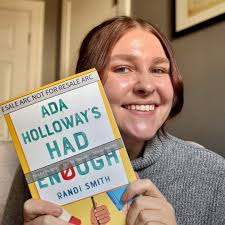
Randi Smith is a librarian from Kentucky, although you may know her from her Substack work and tiktok where she discusses her work, and other thoughts on reading. This month, her debut YA Ada Holloway’s Had Enough came out, and she was kind enough to take the time to answer my questions on writing, book bans and what’s coming next. Enjoy!
1. When did you begin writing?
I’ve written off-and-on since high school, but it was my senior year of college when I really began exploring writing for fun (and consistently). I minored in creative writing at Belmont University, and I joined clubs to meet other writers and grow my confidence. After college, I found myself writing ADA HOLLOWAY and haven’t looked back.
2. Favorite tropes?
I am a sucker for enemies-to-lovers done right, preferably when the romance spans multiple books. It can’t be beat!
3. Are you a plotter or a pantser?
Plotter all the way! If I even leave smaller details up to chance, I get stuck and overwhelmed by possibilities and making everything “work.” I need a roadmap or else I will never open my laptop, even if that roadmap changes as I go.
4. How did being a librarian coincide with your writing journey?
I had just finished the first draft of ADA HOLLOWAY when I was hired on part time at my local library. So even though the plot of this book isn’t about a specific library or community, a lot of the finer details came from the patience and guidance of my manager and coworkers. There was so little I understood about how much libraries truly offer (beyond just books, even though that’s amazing in itself), and I credit them for making the Freeport Public Library come to life on the page.
5. With your personal experience, can you expand how book banning has affected you?
Although I do not speak for my library at all, I can say that as an employee, there is a lot of hateful sentiment directed towards librarians. They are seen as “indoctrinating,” and this insult completely misunderstands the job of a librarian and the purpose of a library. We’ve experienced name calling, we’ve heard of threats received by other libraries, and it really makes it scary to come into work some mornings.
That’s why I hope ADA HOLLOWAY can spark empathetic communication—libraries are refuges that should be protected, and librarians simply direct you to books you already want. We don’t have an agenda to press. We are couriers, in a sense.
6. How does Ada get involved in the book banning fight?
Accidentally, of course! She has one essay left before she graduates from high school, and she knows it has to be about her small town. Instead of doing something easy, Ada decides to write about the mysterious town founder, Everett J. Washington. Unfortunately, the very book Ada needs has just been pulled from library shelves, so when her best friend suggests a book club at the library so Ada can read the book anyway, she can’t refuse. This starts her journey of activism and fighting censorship.
7. Four words to describe Ada and her journey, and why?
Activism, honesty, purpose, and voice. As this story unfolds, Ada learns that these four things go hand-in-hand. And in her case, they are necessary to discovering and embracing who she is and what place she can hold in her family and community.
8. What are the greater consequences of book bans?
The greatest consequence of book bans comes at the family level. Parents alone reserve the right to decide what’s best for their children. Book bans impede a parent’s right to connect, communicate, and educate their children at their own time and pace.
9. What do you hope readers will take away from your novel?
I hope readers understand the unique place libraries have in our country today—a completely free place where people can exist with no expectations. I also hope this novel sparks a conversation about censorship and inspires positive action against book bans that protect our First Amendment rights.
10. What is coming next for you?
Many things I hope! I’m currently working on another young adult novel, and while this one isn’t about book banning, I do hope to continue that conversation and spotlight other issues affecting teens around the world.
You can learn more about Randi’s work at her website: https://www.randismithwrites.com/ and all relevant social media.


Leave a comment