Now we’re throwing it back to the. . . well, before the 20th century again. Dickinson has a fondness for three vastly different eras: The Georgian (named after King George, yes the King George from Hamilton and 1776, the one the US broke away from); the English Civil War, and Victorian. So let’s get to it.
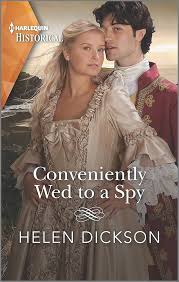
Imprisoned during the French Revolution, English spy Lord Laurence Beaumont is finally rescued—by the courageous, beautiful Delphine St. Clair. Back home in Cornwall, Laurence has no interest in the convenient marriage offered by a local landowner—until he discovers the bride is Delphine! With intense memories of their liaison dangereuse in Paris, Laurence knows theirs will be an unconventional union…but can he keep his promise never to be a spy again?
This was another historical romance that overlapped with romantic suspense. Delphine’s work as a smuggler is coming to an end as the revolution winds down, giving her some more time to finish the mission she really wants-finding out if her father is still alive. However, Laurence’s work as a spy is never truly complete, so it is at odds with Delphine’s wishes for one last adventure before settling down to a less heart-racing, more cozy lifestyle of hearth and home. She just wants to feel like her life’s not in danger 24/7, and who can blame her?
I admired Delphine’s resiliency and strategic mind as much as Laurence did, and although the third act break-up did feel predictable, I liked how it related to the very serious issue of how their life is going to move forward with Laurence’s spy career. One can understand why Laurence didn’t reveal his whole mission to Delphine even though it did affect her life, and her own mission. But one will also clap at seeing Delphine take the reins to remind Laurence that she knows how to execute espionage under pressure.
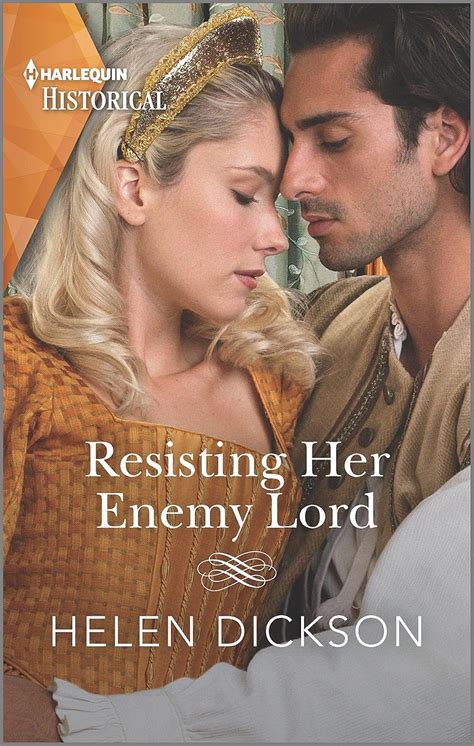
Despite her unhappy marriage, Catherine Stratton had defended her husband’s castle for six years while he was at war. Now widowed, she must travel with John, her late husband’s cousin, who’d fought on the opposing side. Facing danger at every turn, she’s stunned by the heat burning between them. Is this just lust, which will pass…or is this enemy lord a man she can trust with her life and her future?
I’m starting to sense Dickinson has a thing for writing strong, resilient women. Survivors as they’re often called. Then again, they are living in wartime. Catherine is much more reserved and stoic than Delphine, keeping John on a guessing game in their attraction. They lust for each other, but John is unsure whether she even respects him.
Catherine was the real star of the novel as Dickinson shows a guarded woman, unwilling to put in a position where her life will be dictated by others, and her dependency on a strange man that her father chose for her. She is brutally honest about a woman’s place in that era. John who well-meaningly calls her brave for going through with the arranged marriage, and a loyal daughter. She reminds him the reality is that she was sixteen and had no other choices available to her, but obedience. So her big struggle is not mourning her dead husband (whom she never liked) and feeling guilt over falling for his cousin, but fear of losing control and autonomy.
It also ties together with what seems to be a classic women hating women scenario between Catherine and her very-young stepmother, Blanche, but ends up becoming much more nuanced than that.
John seemed like a nice guy, but his own tragic backstory of mourning the loss of his family during the war sort of faded to the background as his grief became consumed with love for Catherine. Also it felt very exposition heavy, but that may be because of the more formal style of speaking back then.
Still my favorite out of these three.
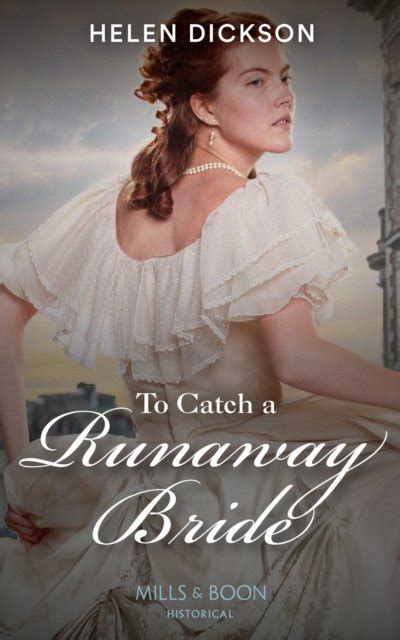
Moments away from becoming a viscountess, Marietta Harrington realizes that she cannot marry the man her father has chosen for her. Wedding guest Edmund Fitzroy whisks her away from the church…and as she gets to know this virtual stranger, she’s drawn into a delicious courtship. When Edmund mysteriously disappears, Marietta faces a terrible choice. Should she trust the man she loves or submit to another arranged marriage?
I know, it took a while for me to get to the classic runaway bride trope. Set in the Victorian era, Mariette is a typical society daughter. Sheltered in the women’s sphere and no decision made for herself. Her stern, money-obsessed father rules the roost, but her first step of rebellion ends up changing her life, and his illusion of control for good.
Mariette had some shades of rebellion earlier like her wild horse ride that provides Edmund his first glimpse of the layered girl underneath the veil. But overall, she is very prim, sheltered and unaware of the wider world. Makes sense for her era, but hard to read about as I want to shake her and tell her not to automatically believe what the obviously scheming antagonists are telling her!
Plus it dives with that trope of the all-knowing guy telling the virgin how sex works. Again, I know it’s historically accurate for high society women in that era, but I personally don’t enjoy it.
Edmund did not make me want to shake him as he had an interesting backstory, being impoverished in his youth (despite his title) because of his father’s drinking and gambling. However, not much is shown beyond him trying to push the memories down and informing his beef with his uncle (and the cousin Mariette was originally engaged to marry). Near the epilogue, this is expanded that it has made Edmund a kind man, willing to give to the society’s poor and contribute fundraisers since he remembers what that was like, but I wish we got to see that side more in the story proper.


Leave a comment