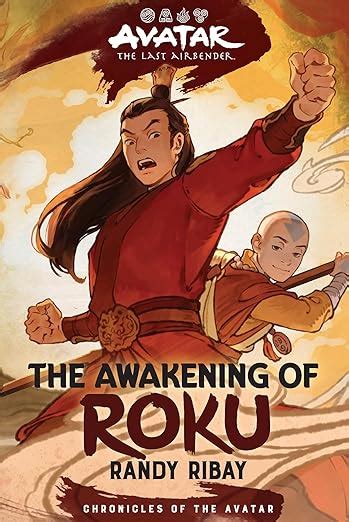
Three years after the mess on Lambak Island, Roku has finally mastered airbending and is on track to become the Avatar the world needs. But when he encounters a mysterious illness on his way to Agna Qel’a, he delays his journey and the next phase of his training to prevent the situation from worsening.
As Roku ventures deeper into the North and nearer to danger, he soon realizes there’s more to the malady than meets the eye. With the assistance of his good friend Gyatso, a gifted Waterbender named Makittuq, and others near and far―including from his past―Roku races to contain the crisis before the disease can ravage the North . . . and beyond.
It was nice to return to the Avatarverse, and this was interesting as Ribay picks up three years after The Reckoning of Roku. The other duologies picked up months later, so this was a vast amount of time to skip, and it shows in the characterizations.
Roku is far from the impulsive, and pardon the pun, hotheaded young man we first met. He is in a much more balanced space. However, his adherence to Fire Nation loyalty and his inability to let go of the past has been replaced by indecisiveness. The events on Lambak Island, and the death of Malay has him questioning his ability to read people. He sees the best in people, but with the illness striking animals and threatening the North Water Tribe’s resources, and greater trade, he can’t risk trusting the wrong person.
Sozin has also changed in the intervening years. He still has insecurities regarding his father’s faith in him as heir, but he also grown more into his darker inclinations, his shortsightedness and focus on showing might.
Their stories continue to be parallel journeys in leadership. Roky struggles with the isolation, seeing his role as Avatar as dependent on his certainty when making decisions, bearing the burden of the world on his own. However, he comes to realize that this would be a detrimental way to live, and lead. He has companions, and connections that can help him when he needs it most. Relying on certainties closes your mind to the whole menu of solutions and possibilities.
This nicely dovetails with his training in Waterbending, and learning to embrace the push-pull nature of the element. It is ultimately about balance, and he comes to learn to “go with the flow” and realize he’s not the ultimate arbitrator of everything. He’s not alone, and by forging connections with others across nations maybe they can bring about positive change.
Sozin, of course, takes the opposite view, that he must bear the burden of leadership alone, and his decisions are always right because he’s thinking of the collective good for the Fire Nation. Of course, that allows him to justify all his decisions as the Fire Nation’s interests are one and the same as his interests because ruler is god in his view. Readers will ominously recognize the seeds that will kick off the Hundred Year War.
As for the other characters, they are all well-rounded and vibrant. Ribay gives enough insight to the individual journeys of Gyatso and newcomer, Makittuq that readers will appreciate the two coming to connect and embrace the vulnerabilities. Ta Min is the unexpected third-POV as the Fire Nation emissary to Omashu/Sozin’s spy, connecting the plot spanning the Earth Kingdom and Water Tribe. Not only does she tie the plot together, but readers get to know the ambitious, insightful, hopeful diplomat-in-training and can understand why the adventurous Roku fell for her.
The villain of the piece was another stellar example of Avatar’s line of antagonists who are “off-balance,” the backstory sympathetic, but the actions horrendous, illustrating the grey morality of people. Without too many spoilers, I think people might see Atka as a variation of Hama.
The Eastern-styled philosophy and Inuit-inspired traditions that characterizes the Avatar world brings more depth to this point of the North Water Tribe’s history/expansion. It melds well with real-life analogies regarding trade expansion, overhunting and exploitation of natural resources driving traditionalist of the tribe to the fringes, and risking their spiritual center all together.
It’s another wonderful entry to the universe. Were there some flaws? Yes.
Most of the story, Sozin blindly clings to his own individual morality, and in the final chapter he realizes that this was foolish of him, and he starts conflating his individual morality to that of the Fire Nation. I think Ribay is missing one chapter connecting the jump. Roku’s meditation on the beauty of the tundra, and his journey alone to the capital, giving him time to connect to the element of water, felt more told than shown. Or at least more like a montage, and I wished we could have sit with it more.
Otherwise, readers will not be disappointed by the conclusion to Roku’s story and further insight to the Avatar world.
Now I’m hoping the next duology is Kuruk’s!! After six novels of him being mentioned or highlighted, we need his side of the story. We’ve yet to have the Avatar come from the Water Tribe, and learn to master earthbending.
4 stars.
 Rachel Reads & Reviews
Leave a comment