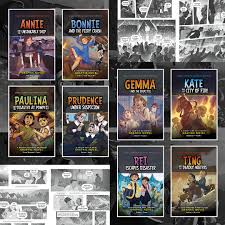
I’m sure everyone thought I was done with this series. I was too until a little search brought up that the series has graphic novels. Not graphic novel retellings of the series, but all new stories and historical disasters. The completionist in me had to read them all.
Luckily, 5 of them were events that weren’t covered in the series like the 1666 burning of London, the avalanches of Poland, and the Yagtze River Flooding of 1931.
Those were the ones I read first since I was interested in learning something new. Kate and the City of Fire by Amy Rubinate, Zoe and the Thundering Snow by Julia Gilbert and Ting and the Deadly Waters by Ailynn Collins were solid stories centering on girls helping their families in times of crisis, and the importance of community coming together to find hope and help to rebuild for the future. While I already know about the Salem Witch Trials, I thought Emma Carlson Berne’s Prudence Under Suspicion was very good for its 40 page length in detailing the confusion of the seizures, the hint that there might be malice on part of the girls, and the rise of hysteria in the tiny village. I also enjoyed how they had an older-time font to match the early colonial setting.
Julia Gilbert is a prominent author for the series, and her other graphic novels are consistently good even in this new format. Bonnie and the Fiery Crash covers the Hindenberg disaster, touching exactly on the science that led to the explosion as well as commenting on the foreboding events in Germany. Her other graphic novel was Gemma and the Great Flu, which was interesting as she already did a prose novel Daisy and the Deadly Flu which had slight variations in the concerned protagonist, strict and worried mother, infirmed sister, and dying friends angle that I wondered why it wasn’t a straight-up retelling.
Other novels like Rosie and the Race for Freedom (Dolores Andral) and Annie and the Unsinkable Ship (Amy Rubinate) had events that were already covered within the book series, but they were different enough it didn’t feel like straight adaptions of the books. Still wondered why they chose to do it twice.
Paulina and the Burning of Pompeii (Barbara Perez Marquez), and Rei Escapes Disaster (by Susan Griner about the 2011 Japanese Tsunami) were fine. They weren’t so much character focused. The minimal, basic prose (like I’m sad, I’m scared, etc.) allowed the illustrators do much of the work in selling the emotion of the story. I was disappointed that Marquez’ story doesn’t even detail the aftermath of the eruption and how Paulina must have felt to find out her father’s fate and the fate of her whole city covered in ash. But I suppose that would have been too depressing.
The ones I liked the least were Bailey and the Blaze by Dolores Andral that covers the Burning of Atlanta, and Greta and the Night Fire by Julia Gilbert about the WW2 bombings in Germany. I note that most of this series seems to be aiming for 7-10 year olds, offering a more sanitized, less in depth look of history with a lot more hope, but these were so basic that it was disappointing. Bailey and the Blaze had such basic dialogue that it stalled the plot, no suspense about the burning, and side steps why the South was fighting the North. Particularly egregious when Bailey herself has an enslaved friend who flees to find freedom, and there is almost no pushback from the Confederate soldiers monitoring the track when the family gets on the train.
Actually the fact that Bailey has an enslaved friend is not explained well. Is her family an anti-slavery family in the middle of Atlanta and no one cares? Then Bailey meets another boy who also happens to be anti-slavery. Okay, rationally I know the author just wanted to show kids that Bailey is a good guy, and that she believes no one should be enslaved, that’s a good thing. But it feels so unrealistic when its in the middle of such a pro-slavery state that she would at least know not to spout off her feelings to strangers. Or in other novels, they have the white girl slowly come to realize her pro-slavery beliefs are wrong. It just didn’t feel logical.
Same with Greta who stands up for her Jewish cousin to her bigoted neighbors. It’s a good message, but also unrealistic in that those neighbors would have reported them to the SS. Surely, these kids would have known the consequences of speaking up like that.
Maybe I’m taking this too seriously, but Dear America was also for the 7-13 age range. I think. At least I know I was already 9 when I read them, and they indicated how badly those anti-slavery, pro-Jewish views would have been taken during those time periods and the importance of discretion because that’s historical accuracy. So it just bothers me that these graphic novels couldn’t have done the same.
Especially in the latter with Greta’s cousin being blonde, and no one thinks to just rip off the Jewish star from her coat and pretend she’s Aryan while she hides in the bomb shelter. Like it’s literally the easiest solution, right there!
So yeah, I’d recommend any of these novels except for Bailey and the Blaze, and Greta and the Night Fire.


Leave a comment