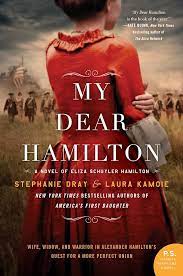
As anyone who got on the Hamilton fever train a decade knows that without Eliza Schuyler, her husband’s sory would never have been known. Literally, because she spent the last decades of her life com[iling his millions of correspondence and batting away the obstacles of his enemies who wanted him to be forgotten and his former friends who blamed him for the dissolution of the Federalist party. Ontop of founding and running the first two orphanages in New York, a free-black education center, an Onedia-Hamilton school for Natives, raising funds for Washington’s statue, soliciting funds for charity, overseeing the the rise and fall of sixteen presidents, twelve whom she personally knew, went on a trip to Illinois/Wisconsin territory in her eighties, and yeah, she packed a lot in the fifty years after her husband’s death.
So it’s about time someone told her story.
Prominant historians, Stephanie Dray and Laura Kamoie come together for their sophmore novel about one of America’s founding mothers and wife of the (no longer) forgotten founding father, starting with what they view as one of the pivotal moments deonstrating her character.
No, not the choice to stand by her husband after the publication of the Reynolds Pamphlet about the humilating affair. Though it’s a big event.
The moment when former President James Munroe comes to her door, asking to forgive and forget.
Unless he apologizes, he can go see the door. And he does.
Though many see Eliza Schuyler as the saintly one, she knows she’s no saint. She’s her husband’s avenging angel although she loves and hates him in turn.
That got my attention and I’m sure it got yours too.
This novel is not only am in-depth look into the many brave men and wome who made up the great American experiment, and the rollarcoaster of living through the founding of anation that seemed poise to break apart (and still does, let’s be real) due to the faceless, illiterate mob feeling that states should have more rights than the federal government and greedy politicians making choices and betraying collegues in order to maintain their status instead of serve the peope. Eliza’s life was full of highs and betrayals and the duo give her room to feel all the conflicts of war and emotional battery.
For even though Eliza and Hamilton have a sweet winter courtship, it is undercut by the suffering and near-mutiny of soldiers dying in bitter winter because Congress is unable to agree on funds, supplies or anything really.
Eliza’s love for Hamilton is tested from the beginning as she tells him that his lineage and lack of status doesn’t matter. Just him loving her, it would be enough.
And yes, she does get tired of his need for flory, his suicidal idealiation, and inability to let things go, that his bright ambition is at the cost of their privacy, home and family.
But as the book goes on, and ELiza maures, she also reflects back that as much as she resented Hamilton’s public stature (especially as public service in politics seemed to garner vitrol and death threats making his desire to work even more and not spend time with her feel masochist), she also comes to realize that she did enjoy flying high on his ambition and success. That maybe Hamilton’s desperation to have a legacy and be someone was in answer to her unconscious desire that he rise from his circumstances though she says she’s fine with it. After all, she’s a soldier’s daughter, she wants her husband serving loyalty and fighting for glory. Maybe she is driving him to it?
See, she’s no saint.
Not only that but Eliza must not only contend with the early flaws in her marriage but the flaws in herself like her evolving views of slavery as the country’s fight for freedom makes her realize that it is not truly free, if they continue to hold half it’s population in bondage. Her feelings of motherhood in the face of miscarriage, Phillip’s death and her daughter’s madness. She slightly rustles at the comments from husband and sisters of here saintly, good nature but as the Hamilton become more involved in the political manuevering of Philadelpha/New York, she begins to question if she is truly too trusting that her husband is treating her like a fragile wife instead of an equal to confide in.
Does Hamilton truly love her?
That’s another struggle she has as she shares so much of Hamilton with the public and throughout their marriage, she feels she never truly breaches the inner wall he holds in regards to his past. Of course, the Reynolds Pamphlets breaks this question down but it re-emerges after his death as well when she uncovers more secrets in his correspondence. And much like her conflicting feelings about the current state of her nation run by her husband’s political enemies who mock and dismiss his legacy, she must judge how she feels about the man and the America he helped to build. Will she continue to stand by him after he betrayed her in the basest and most brutal of ways?
Well, we know the answer to both of these questions but Dray and Kamoie are excellent in plumbing the depths of Eliza’s patience, Christian forgiveness and grude-holding as Eliza decides who to love, who to trust, and who to forgive. Who will tell Hamilton’s story, what will her role be because even she put her role as Hamilton’s wife at the forefront, forgetting how much she contributed to the man’s legacy and how much she had helped found America too by knitting for soldiers, soliciting money for charity, inoculating smallpox and managing husbands.
Hamilton was a difficult man, a passionate one who inspires passion in others whether love or hate, usually both. But Eliza can’t regret what they created together just as she weighs the good and bad of America and hopes it will be better for her grandchildren.
Honestly, I’m summurizing the depth of work Dray/Kamoie went through in creating an immersive Eliza Schuyler story set firmly from her point of view when others share it between her and her husband. This one felt like a vicarious reading experience and at 620 pages, I felt like I lived as long as Eliza from 1777 to 1837. And with so much talk of Eliza and Hamilton, I would be remiss to mention the prominance of Monroe, not Burr who posited himself as Hamilton’s rival and foil in the musical. Since Burr was primarily the pain in Hamilton’s side, not Eliza, he is in the periphary after their friendship fades although Eliza brings and wins a campaign to have him tried for murder. The Schuyler motto is Semper Fidelis after all.
Here, Dray/Kamoie returned to Monroe’s presence in Eliza’s life as the other option. What if she had chosen him as they had met all those years ago, the one man who was honorable and kind and delivered a killing blow to their friendship when he carelessness allowed the Reynolds accusation prompt Hamilton’s infamous pamphlet? For it should be noted, Monroe came to ask for a olive branch in the name of their history, not he and Hamilton, signifing they may have had an important friendship to rectify in his eyes.
Madison also plays a prominant role as friend and enemy to the Hamilton with Jefferson’s malovelent presence looming in the shadows as he plays his cronies against Hamilton.
Not to mention the presence of dear Lafayette, Dolley Madison, the noble Washingtons, Knoxes, Gates, Livingstons, Schuylers, even Lincoln. He’s a who-who of American history! I can’t believe other fiction novels felt the need to make-up characters when there were so many colorful, real ones populating their lives and with the sheer length of the novel, Dray/Kamoie paint a comprehensive picture of them all. Even untangling minor matters that I hadn’t understood before about the Hamilton mythos like his disagreements with President Adams, the surprising authonomy of the Schuylers due to their New Netherlands upbringing, the fact that Angelica married Jack Carter who was an alias for John Church in exile and getting to know a little bit more of the Hamilton brood as individuals.
Seriously, if you ever want to read a Eliza Hamilton book, make it this one because it may not be outright romantic but it is real, and emotionally gripping as you see the humanity of them which makes it even more romantic to me when Eliza decides to stand by his side. Not because she’s a saint but Semper Fidelis.


Leave a comment