She Represents by Caitlin Donohue
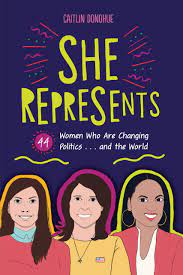
She Represents is a wonderful book written by journalist Caitlin Donohue that provides a brief bio, the policies, the controversies and quotes of each of the 44 women she highlights. I emphasize the journalist part because as she writes in the introduction she hopes this will serve as an introductory course to these political women. She strives to be objective, not idolize these women and so includes women from both sides of the aisle as well as former leaders. She doesn’t agree with all of them (I certainly did) but she presents what they did because all of them inform what people want in politics, and the constituents they represent.
She also includes brief two page spreads for groups of women like Memorable First Ladies, LGTBQ boundary breakers etc.
Girl Squads Sam Maggs
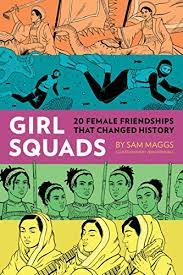
While most of these books highlight how women often make their firsts on their own, Maggs chose to show various “squads” (sometimes just duos) in fields like athletics, the arts and politics. It was interesting as there were some more modern women that hadn’t heard of even though their feats were impressive. Like the Haenyeo Divers in Korea and the Edinburg Seven who became the first group to get into medical school in the UK (and they were harassed a lot) among others. She has an informal voice which makes it an easy read but sometimes adds modern phrasing and such that makes it feel like she’s trying too hard to be hip. She also has written another book focusing on women in STEM entitled Wonder Women: 25 Innovators, Inventors and Trailblazers Who Changed History.
Monster, She wrote by Lisa Kröger and Melanie R. Anderson
This was an addictive read that added more books to my “Want to read” pile. While I never was interested in Scifi or Horror, Anderson and Kröger dove into the history of the genre, curtailing it into neat eras (Victorian, The Occult, Haunted Houses, Pulps etc) and how the genres are innovative ways for women to write and give voice to issues women deal with in everyday life (abuse, feelings of isolation, haunted by jealousy and insecurity etc).
Rad Women Worldwide and Rad Girls Can by Kate Schatz and Miriam Klien Stahl
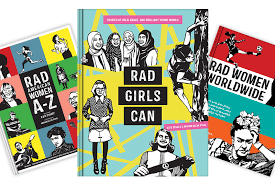
These are great books for middle and/or high schoolers highlighting women from the past and the present. I can’t say much else as they repeat some figures already present in other books I’ve suggested. But the bright colors, and unique illustrations should hold kids interests. It also provides tips and suggestions for how kids can become empowered and try to make their own rad future.
Amazons, Abolitionists and Activists by Mikki Kendall and A. D’Amico
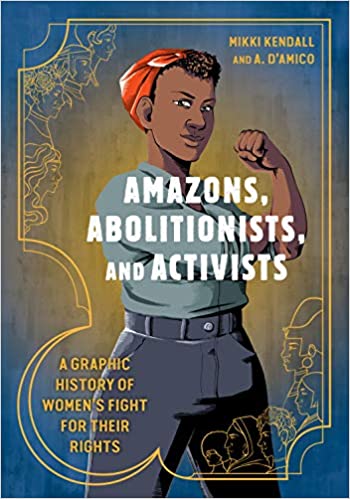
This graphic novel does exacty what it says on the page and for that I applaud their ambition. Definately for high schoolers and above as it tries to explain various feminist/abolitionists movements and intersect them with the minority movements, labor movements, child labor, eugenics, LGTBQ movements, and white surpremacy.
Not to mention they also take time to provide brief bios of important figures (again there are a lot). And for that, I applaud them, but in their eagerness to cover a long history I felt a bit confused and overwhelmed. Its not a linear narrative and in covering so much, it feels like a lot but also still scratching the surface. The segueways between subjects were not smooth like in one page they’re taking about “comfort girls” from Japanese occupation the next they’re talking about the Redress and Reparations movement but don’t provide much in-depth explanation of either.
Also in their zeal to be inclusive, it feels like they had very little modern Middle Eastern representation, and Latinx representation was nil in past or modern history. They didn’t mention any of the major Latinx movements or feminists such as their part in labor organization like Dolares Huerta, or civil rights/Juan Crow like Jovita Idar or in the female warrior section, women like Manuela Senz that helped overthrow Spanish colonialism, or Anacoana, the last Taino to fight against conquistadors.
While I was introduced to many interesting African-American and African (the country), disabled, LGTB, Asian, and indigenous feminists of the past, and modern day, the Latinas were sadly not represented.


Leave a comment