-
Twisted Tales: Cruel Truth Review
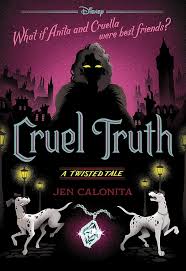
What if Anita and Cruella were best friends?
It’s 1953, and teenage Anita Weatherby and her family have just moved to a booming postwar London. While her older sister settles right in, to the delight of their parents, Anita finds their new school—and her academic rival, Roger Radcliffe—daunting. Nothing seems to be going Anita’s way until a glamorous, confident new student moves to town. Stella De Vil is haughty and aloof—but surprises everyone by taking an immediate liking to Anita.
Swept into the luxurious world of Stella’s high-end family fashion label, Anita soon finds herself the anticipated star of the House of De Vil’s next fashion show, where she’ll be modelling a family heirloom, the Weatherby diamond, and walking the catwalk with two adorable Dalmatian puppies to raise awareness for a local animal shelter. But when disaster strikes and the Weatherby diamond goes missing, Anita will have to decide whom she can trust before her life goes to the dogs.
(more…) -
Book Highlight: Goddesses
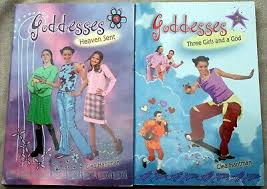
As I mentioned in a previous post that part of quarter-life crisis is finding and reading books from my childhood, this is one I never had read but I remember being intrigued by the cover long long ago. Finally, I have read it.
Three goddesses, banished to earth by their dad, Zeus (yeah, that Zeus)…
Polly, Era, and Thalia are stuck on earth, and to get back to Olympus, they’ve got to prove they’ve learned their lesson. And they’ve got to get through high school in the meantime. Which would be hard enough without the horribly evil Furies threatening to destroy their chances of ever seeing home again….
The premise is interesting, and maybe my thoughts would have been different if I had read it when I was 9 or something. Reading it now. . . it’s meh.
No, that’s a little too harsh. It’s dumb fun.
By that I mean, the Greek mythology aspect is not well-researched. Hantman has a basic understanding of stuff like the Muses are midlevel goddesses, the Tantalos myth, so on, but there’s lots she gets wrong. She has Poseidon and Neptune in the same novel. Neptune is the Roman name for Poseidon. Maybe she was trying to reference Triton, Poseidon’s grand/son but the point is Neptune is not a separate god. She has Apollo being the one whose chariot makes the sun rise and set, but that’s Helios’ occupation. Clio, one of the muses is spelled Cleo.
Then there’s lots of little references that are totally anachronistic for ancient Greece like tennis, Bahamian resorts, leprechauns, Sir Percival, etc. Like choose is this going to be ancient Greece or anachronistic Ancient Greece, you can’t have both. Not to mention she has Hera and the Furies being the most cartoonishly evil like literal lava spills out of her mouth at one point (even though that’s not a power any god has in the myths), they all smell stinky, have warts. It lessens the intimidation one must admit.
But I admit making the Furies the rhyming trio of “Backroom Betties” (ugh so 2000s it hurts) made them entertaining. Honestly, I enjoyed their appearances more than Thalia’s narration sometimes. That’s a big sticking point as Thalia can be so selfish and immature that I wished that Hantman had allowed for rotating POVs instead of just giving Polly/Era only chance in book 2.
Basically, if you’re looking for an accurate primer on myths this is not a place to go.
As for the characters, they are supposedly sent to high school in 2002, but they act more like middle-schoolers, and the character development doesn’t really hit (especially for Thalia) until the last few chapters in the final book.
Which makes sense as it’s for lower-schoolers, but why not just have them go to middle school?
Even so, there are just random bits of inappropriateness that would have raised eyebrows like the characters talking about who’s sexy in their tight pants, minor cursing, who has Amazonian boobs, etc. Although I must admit there is one hilarious point where Thalia explains who Artemis is-“Artemis is Apollo’s twin virgin sis. She takes out her frustration by killing monsters.”
I just found that a succinct yet funny descriptor.
See what I mean, it has the bare bones of research, a mix of immaturity with the early 2000s sexualization, and yet when I turned my brain off, I enjoyed it. The Muses’ confusion and delight over the ultra-modern world of 2002 was funny as well as their hijinks like causing chaos at the Macey’s Thanksgiving Parade or letting alligators loose in New Orleans’ Jean Lafiette park, Apollo stuck in the body of “Dylan from Denver,” the teacher assigning them to make documentaries like The Real World with their video cameras.
Apollo is also extremely accurate as the overly-dramatic, lovelorn god chasing Thalia everywhere just as he did to Daphne in the myths. Same with Artemis who sadly only appears once as the sensible, serious foil to her twin’s antics. The descriptors for Dionysus and his hijinks were also entertaining and made me wish he appeared too.
I just wish she extended that to the Muses themselves. They mention being into the arts with Polly being the best at singing, and Thalia fulfilling the comedic, adventurous role but Era has no relation to her art- the flute – and is just the boy crazy, ditzy one.
Then again, these books were not meant to be about depth. I’m just glad I finally got to read what they were about.
-
The Singular Life of Aria Patel Review
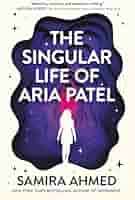
Aria Patel likes stability, certainty, predictability. It’s why she’s so into science. It’s why she dumped her boyfriend before they went to different colleges because the odds were that something would go wrong, eventually. In a life that’s already so chaotic, why obsess over complicated relationships and shadowy unknowns when the scientific method gives you direction and a straight path to avoid all the drama.
But there’s no avoiding anything when Aria finds herself suddenly falling through parallel universes and there’s no formula that can save her. She can’t explain why she’s been waking up in a new reality almost every day, or why Rohan, and a poem from her English class, seem to be following her through every new life.
As Aria desperately attempts to find a way home, she eventually ends up stuck in a parallel world very similar to her own. She cherishes this new version of her family, and she finds herself unable to deny the yearning she has for Rohan…but it’s not her life or her Rohan. It belongs to another Aria, another girl, and unless Aria can get back home, she’ll have taken this happiness away from someone else forever. And she may never find her own.
Ahmed makes a departure from her stirring, personal is political works to have a journey through a multi-verse. Now time-traveling stuff hurts my brain especially as she brings in physics and quantum mechanics into it. She tries to explain it within text, but it still goes over my head. No matter, the science of the universe is a blip to the adventures of Aria Patel.
(more…) -
The Charlotte Years
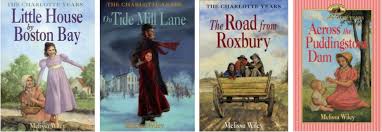
I did it! I did it! Yay, yay, I did it! Finally finished the Little House books. So proud of myself.
And that’s pretty much the most exciting thing I can say about the quartet. Much like The Martha Years, four books over the ages of 5-12 is not enough time to see dynamic growth. Rather the excitement comes from external events around Charlotte like the War of 1812, cholera and new siblings rather than Charlotte herself.
It’s funny but Martha, Charlotte’s mother was the scene-stealer for me. As a grown women, Martha retains her quick temper and love for storytelling but it’s interesting to see how she has matured as a woman and a mother to her kids. It makes me wish once more to know what happened between the years in Scotland and immigrating to America. Especially as in the story, she hadn’t been in contact with her siblings due to the lack of mail back in the 16th-17th centuries. The reunion between her and her brother, Duncan was especially sweet in that sense. I wonder if that actually happened.
Charlotte is interesting too. While Martha is headstrong, Caroline is maternal and a homebody, and Laura is spirited and into adventure, Charlotte is the most feminine. She’s into sewing, embroidery and hopes to become a teacher but retains her own wanderlust that weaves the generations together.
And that’s about it. I apologize if this isn’t an in-depth look into the quartet or reflections on the differences between time periods as I did for the original Little House/Caroline/Rose series, but there light and quaint.
-
Beacon Street Girls
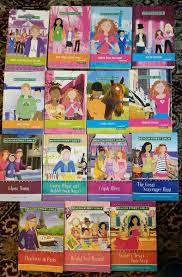
As I hit my quarter life crisis or point, whatever you want to call it, I decided that I should finally read the book series I have at this point always skimmed-the Beacon Street Girls!
Just as the tagline says “They’re real, they’re fun, they’re just like you.” Each book presents a slice of life at the Abigail Adams Junior High School through a close-knit group of five, Charlotte, Maeve, Avery, Katani and Isabel. The series tackles the typical milieu of middle school problems such as making friends among disparate personalities, rivalries in a class election, parents separating, healthy eating and so on.
According to wiki, it was created as a wholesome alternative to what the publishers saw as obscene and exploitative children’s literature of the early 2000s. You know, the time when everyone was focused on Hillary Duff’s virginity when she was 16 so I understand where they were coming from. I liked they brought up common topics in a natural way like living with an autistic sibling and showing various female role models in nontraditional and traditional roles like housewife, mechanic, fitness instructor, model and so on.
And moreover, I believe they succeeded in showing the ups and downs of seventh grade in a way that didn’t feel too preachy (though some points were obvious when the girls talk about how it’s uncool to talk about someone else’s weight or drinking is not fun) and focused more on how the girls’ personalities bounced off one another and the natural conflicts and adventures that would occur.
(more…) -
Sarah Masters Buckey Interview

Sarah Masters Buckey is the author of several mysteries in the American Girl historical line, and the stand-alone History Mystery series. She graciously took the time to answer my questions about the historic fiction genre, working with the American Girl brand and what’s coming next. Enjoy!
1. What first drew you to writing? More specifically, the historic fiction genre?
I was lucky to grow up in a house with lots of old books – a Hardy Boys collection that had belonged to my father, my mother’s editions of Kidnapped and Treasure Island, and even a set of Dickens that was given to my grandfather, as a reward for rescuing a man from drowning.
At the time, I didn’t know these stories were historical fiction– — I just loved reading them!
2.You’ve covered many different eras from the War of 1812 to Roaring 20s. Do you have a favorite era you like to revisit, or does it depend on the book?
It depends on the book. I love immersing myself in a historical period, and every time I do, I find that the history is more intriguing and full of contradictions than I could have imagined.
For example, in researching the Roaring Twenties, I learned there are still lots of hidden secrets from the Prohibition Era. We may think of people a century ago as being more law-abiding than today. But during the 1920’s, a huge number of people were illegally importing/making/selling/ drinking alcohol – and sometimes earning vast amounts of money from it.
3. You primarily write for American Girl. How did your partnership with well-known brand begin?
I’m working on my own projects– I’ve begun a historical mystery series for adults. But I enjoyed working with American Girl for many years. I started writing for them when my older daughter was nine years old. She was a huge fan of American Girl Magazine’s stories.
So, one Christmas, I wrote a historical fiction story as a gift for her. Later, I sent the story to American Girl to see if they might be interested in publishing it in the magazine. They politely declined.
But AG kept my name on file, and, when an opportunity came up to write a Samantha story for the magazine, they contacted me. I had a lot of fun creating a story for Sam – and I was thrilled when they accepted it. My daughter was amazed to see my story in the magazine, too. Later, I started out by writing the first book in the American Girl History-Mystery series, The Smuggler’s Treasure.
(more…) -
Book Highlight: Farrah Noorzad and the Ring of Fate
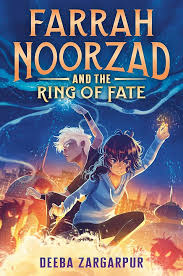
Friend suggested I read this, and wow, what a ride. If you’re a fan of Percy Jackson or want to learn a new mythology, this is the book for you.
Farrah sees her father just one day every year—her birthday. But this year, her wish to bring them closer goes wildly awry when Farrah discovers she is a half-jinn…and her father is one of the seven great jinn kings. Her wish traps her father inside a legendary ring, and the other six jinn kings will follow unless Farrah can rectify her mistake.
Pursued by menacing shadow jinn, Farrah’s quest takes her to a floating mountain range. Joined by Idris, the jinn boy whom she inadvertently freed from the ring, and her newly discovered half-brother, Yaseen, Farrah must find a way to navigate the mysteries and dangers of her new world in order to save her father and face the most devious jinn lord of all.
The premise and the set-up is pretty typical chosen-one material with Farrah being told that her father’s mysterious absences from her life are due to cultural restrictions rather than anything supernatural. So naturally when she makes a wish for her fate to be rewritten and find her place in her father’s world, she doesn’t expect him to be sucked away into another dimension. Not to mention the rest of her family thinks she just has an overactive imagination when she tells them what happened.
While the beginning starts out predictable, where Zargarpur shines is in detailing the magical jinn world and hierarchy. It truly is magical, and you can see the colors and sparks flying as she blends legend with fantasy. Moreover, she excels in the character relationships like Farrah’s feelings towards her maternal family whom she loves, but also feels pressured to become less dreamy, more sensible. But she comes to see they are not so different from her. Her mother’s pragmatism comes from self-preservation and trying to protect Farrah.
Her new friend, Idris, has an interesting dynamic (which I suspect shall become a ship in later books, just got the vibes) from reluctant allies to friends. Her oldest and best friend, Arzu is fun and is surprisingly able to contribute a lot to the last third of the book even though she’s only a human. She’s also based on the author’s best friend from childhood which I thought was so so sweet.
Farrah also finds out that she has a half-brother who’s full jinn, and doesn’t trust humans at all. Obviously, this brings up confusing feelings for Farrah as she wants to connect with Yaseen, but is hurt by his prejudice and the fact that her father (who obviously fell in love with a mortal woman to have her) encouraged these feelings of distrust. Is that how her father truly feels about her? She already felt weird in the human world, is she not to be accepted by jinns either?
It doesn’t help that she has the big bad, Azar, creeps into her thoughts and biggest insecurities, tempting her to betray her father and new friends for the sake of power. I gotta be honest, I love the evil guy voicing the character’s dark desires as a trope so I loved the push-pull between Farrah and Azar.
And her father. . . her feelings towards her father is the most complicated of all. I enjoyed how Zargarpur doesn’t make the obvious choice of Farrah immediately accepting her father back into her life. Rather, she is still unsure she wants him in her life even to help her with her newfound jinn heritage/powers. But I suppose we’ll have to see it develops in the sequel.
Overall, this was a fun book with quick pace, lots of action and complicated family relationships for readers to devour.
-
The Martha Years
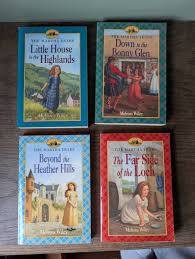
Well, I’m almost done with the entire Little House series. This is the second series by Melissa Wiley (who also wrote the Caroline Years) about Laura’s great grandmother, Martha Morse. It’s interesting to know that she was rather wealthy, being the daughter of a lord (or laird as Wiley tries to write most of the words with a Scottish bent) Funny when you think about Laura Ingalls’ humbler upbringing. But it fits in the overarching story about each women in the family being a pioneer. While Wiley doesn’t get into Martha’s journey to early America, you can tell she has the adventurous spirit of her descendants.
Instead, Wiley contributes her usual research excellence in imbuing the reader into the culture and traditions of the Highlands in the 1700s like the superstitions associated with Hogmanay, and christenings; Celtic fairy tales and songs, and the many duties and cultural expectations of being a lord’s daughter.
And honestly, that’s about it for my thoughts. I enjoyed the fairy tales that the family shared around the fire, as well as bits about family history like her grandfather dying in Bonnie Prince Charlie’s war but otherwise, the series was rather slow and forgettable. It starts when Martha is around 4 and ends when she’s 11, so there’s not much change or development on her part.
Knowing that she’d grow up to marry the blacksmith’s son, and move to America with practically nothing, I’d much rather see that journey especially since the series is about the different sorts of frontiers and pioneers in the family.
-
Top 5 Nathan Hale’s Hazardous Tales
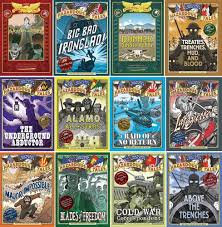
Thrilling, daring, and downright gruesome stories from American history, in graphic novel form.
- Trenches, Treaties, Mud and Blood: This one gets number one spot for sheer ambition in retelling the foundational history of WW1. All in the form of animal mascots. It sounds silly, but it did help differentiate all the countries and show how the Great War really spanned the globe and changed modern warfare. It does so in a way that gives you a good grasp of major events and battles, and the sheer hell of war, while also pointing out that this is just a little peek into the theater of WW1. And like any good historical fiction, it made me want to learn more.
- Alamo All Stars: Another book about epic battles. Yes, I say battles because even though everyone remembers the Alamo they may not realize it’s because the battle of the Alamo was such a failure that the next battle is where they said their famous cry. It delves into the Mexican side of the story, why Davy Crockett was such a beloved hero and was a rollicking good time.
- Cold War Correspondent: A lot of these books get into the top 5 by virtue of introducing me to something new. In this case, I learned about Marguerite Higgins, one of the first female war correspondents, and the Korean War which tends to get buried between WW2 and Vietnam.
- Lafayette: I’ll admit, I hear the Hamilton rap every time I see the title. But that aside, like Hamilton did for Alexander, this book dives into the Marquis’ life, highlighting his flaws, his glories and how this orphan was desperate for a family and soon found one with his Revolutionary comrades. He made this ultra-privileged French noble from centuries ago feel human.
- The Underground Abductor: This one gets into the top 5 by virtue of being the first one I read and thus getting me into this epic series of American History. Not to mention introducing me to the greater story of Harriet Tubman. I mean, not just the part about being the most successful conductor of the Underground Railroad but like everything that came before and after-her real name, Aramanita Ross, her husband, being hit on the head by a brick which gave her narcolepsy and visions that aided her work, freeing 800 slaves on a plantation, and so much more. We’re always taught that Harriet Tubman is a hero and role model, this story helped hit it home.
-
Ranking Feminine Pursuits
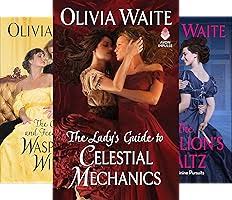
To continue the journey of historical romances with non-traditional leads, Waite’s Feminine Pursuits trilogy celebrates women loving women, and the their fight for rights and respect in their occupations. It’s also interesting as these can be read as stand-alones rather than a trilogy. Sure, characters pop up from other books but it is not very noticeable. Plus it’s very supportive women helping women which we love to see.
- The Hellion’s Waltz: The final book in the series may be the shortest, but it’s the sweetest and has the best balance of character arcs. Maddie, the slightly amoral weaver sticking justice to con-men, and Sophie, the straitlaced, modest pianist are darling together. Both have big hearts, but Maddie almost becomes a martyr for her cause, not seeing that she can depend on her friends instead of protecting them all the time. And Sophie doubts herself, her judgement, her beauty, her talent, but her time with Maddie not only opens her eyes to the fact that sometimes you must resort to swindle to obtain justice. But that she is wonderfully talented and should seize her chance to shine. It’s perfectly romantic, and gives wonderful insight to London’s industrial age and how it started the mistreatment of the labor force (especially the female labor force in weaving which is considered unimportant even though WE ALL WEAR CLOTHES) by capitalists. Also custom-designed instruments are surprisingly interesting.*
- The Lady’s Guide to Celestial Mechanics: The first book in the trilogy stuns as it focuses on the widowed Catherine St. Day’s invitation to one Mr. Muchelney to translate a work of astronomy for London’s scientific society. Mr. Muchelney is dead, but his daughter, Lucy, who did most of the calculations for his work is eager to take the job. She needs to take her mind off of her girlfriend marrying someone else. This book worked in delving into Catherine’s complicated feelings. Her husband was emotionally abusive and she has no interest in putting herself under the thumb of another in marriage so a fling with Lucy should be easy. No financial constraints or contracts to bind them, but love gets in the way. The conflict is interesting as Catherine is so insecure about not having a talent, and being placed second to someone else’s scientific pursuits. Just in general, feeling inferior because she’s more of an artistic brain. So it was wonderful to see her overcome these fears as well as her fears about being a good partner to Lucy and coming to their own arrangement that solidifies their love for each other even though they can never be open. But it is second because Lucy’s arc is more vague. She has to stand up for herself against the all-male scientist brigade but Catherine undoubtedly gets more depth in their relationship. Also there is a point where Lucy states that her feelings for Catherine are different from her ex-girlfriend because she (the ex) was selfish, expecting Lucy to revolve around her. But it comes out of the left field as we don’t get much insight to their relationship beforehand. I will say that Lucy schooling the scientists at the end was a big “You go, girl” moment.
- The Care and Feeding of Waspish Widows: Much as above, the widowed Agatha Griffin gets the bulk of interesting character development from finding second love after the death of her beloved husband to her maternal struggle of fearing for her radical son’s future and his love life. Also learning to live again as she used her work as an engraver to push down her feelings of loss and grief. Perhaps it’s because Catherine and Agatha are older (and you so rarely see middle aged romance protagonists) but they’re in different places in their lives compared to young heroines and have different challenges. It’s just interesting! Penelope is almost middle aged, happily married to her brother’s lover (whose conveniently away on a waler with said brother) so she can freely bee-keep and sleep with whomever she wants. But even though she’s content, she’s lonely not inspiring the same level of love. Perhaps she isn’t capable until Agatha. Much like Lucy, her arc feels less-defined. There’s a bit about learning to stand up for herself but eh, Agatha was just more fascinating as a character. I do appreciate how Waite has her novels are set within months instead of the space of days or a few weeks. It makes Agatha and Penelope’s friendship to love more real. This also has the most atmosphere as it deals with the timely politics of a small town fiercely involved in the divorce of King George and Queen Charlotte and what it means for noble women in divorce. It touches on censorship, morality brigades, and the hypocrisies of rich white women feminism. Plus lots of technical research on bee-keeping and print-engravings. It made the town come alive, but also slowed the book so it felt longer than needed even if I enjoyed the Christmas Eve ghost story. So this comes last. Also the cover for this one is atrocious. It’s like bad photoshop, the model on the cover looks like she belongs in a modern day office, not a regency romance!
*Sidenote. There is a reoccuring character, Mr. Frampton who is a scientist that is basically inventing the future computer. I think he’s an expy of Charles Babbage. Much like Babbage, he is having trouble figuring how to compute it. Naturally, I thought by the third book with Maddie’s weaving skills and punch-card system and Sophie’s musical technique, they’d give him the idea of how it could be done. Much like how Ada Lovelace did that for Babbage in real life. But it didn’t happen! It felt like a set up with no follow-through. Then again, it was a minor part of the book, but it bothered me.
Now on a semi-related subject. I realized as I was reading this series is that it’s all bi x lesbian. Makes sense as Waite says she’s bi. But I think all of the queer books I’ve read (which take with a grain of salt is like four authors.) it’s always bi woman x lesbian. This trilogy. Ashley Herring Blake’s Bright Falls trilogy. The only lesbian x lesbian I’ve read was Herrera’s An Island Princess Starts a Scandal.
On the other side of the coin, in the mlm, Alexis Hall’s Paris Ballincourt and Boyfriend Materials is all gay x gay men. Two out of three couples in Seducing the Sedgewicks is gay x gay man. Only one bi man x gay man.
If I put my little social psychology cap if I may, I have a theory.
Let’s be honest, a majority of romance readers are straight women, me included. Correct me if I’m wrong, that’s like the first thought when it comes to the demographic. So perhaps the bi woman x lesbian is popular because even though it’s not the point of the book, the bi woman is more palatable. Like she could be interested in a man which makes her relatable to readers even though it’s not the point of the story.
But if that’s the logic, why wouldn’t there be more bi men so the readers can imagine the protagonist is still interested in woman even though it’s not the point of the story.
Well there’s a phenomena of women fetishizing gay men just as men objectifying lesbians. Something I simply don’t understand when it comes to either gender. It’s gross to me. But back to the point, maybe it plays to the wider perception that bi women are palatable and bi men are rare or a “stop to gay town.”
So comment below. Should there be more bi men in romantic fiction? More bi man x man, bi woman x bi woman, bi x bi in general? (Lyla Lee made an adorable bi guy x bi girl couple in I’ll Be the One)? Are there more lesbian in fiction than I realize?
Well it’s pride month in June so it’s some food for thought. Comment below!
-
Subscribe
Subscribed
Already have a WordPress.com account? Log in now.
 Rachel Reads & Reviews
Leave a comment