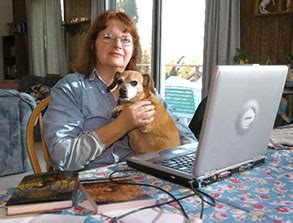
Nancy Springer is the author of thirty-plus fantasy and mystery novels. Most may recognize her as the author of the Enola Holmes series, adapted by Netflix with Millie Bobby Brown. She graciously took the time to answer my questions about her major influences, research and of course, the movies and what’s coming next. Enjoy!
- Let’s start at the beginning, when did you begin writing?
I had a case of what they now call “maladaptive daydreaming” all through my teen years, and in my early twenties I decided I’d better do something about me, thus: if I offloaded my obsessive fantasies in the form of a novel, would that free me to become a more normal human being? Not even realizing how much I didn’t know, I blundered my way through writing a manuscript, sent out query letters in the same novice way, and, amazingly, found a publisher. I was twenty-eight years old when my first book came out, and in hindsight, I wish I could revise it. A lot.
2. What were some of your major influences?
During college, I fell in love with the poetry of William Butler Yeats, researched the Celtic mythology that informed it, and ended up writing mythic fantasy. (It helped that my father was Irish.) Also I was influenced by the wonderfully lyrical writing style of Evangeline Walton, who based her novels on the Mabinogion, the Welsh national epic. (By the way, my mother was half Welsh!) As I was an avid reader and an English Literature major, I’m sure there were myriad other influences.
3. That brings me to how some of your early works focus on girls taking place in famous, primary male classics (Robin Hood, Arthurian legends, Sherlock Holmes)- what drew you to including them in those worlds and how it would affect it?
The word “early” startled me, so I looked at my edition list, and yes, I’d published thirty-some novels previous to those. I must have been middle-aged, and it had taken me a while to become that much of a feminist! As I recall, what caused me to turn my mind that direction was, my literary agent had told me that a secret of marketing success was the use of a “classic chassis,” meaning basing one’s novel on some well-known work in public domain. As I was supporting my family with my writing, making more money was important to me, so I listened to my agent.
4. Are there any particular traits you admire from each or any of your protagonists?
Right from the childhood start, my dreams have been all about true friendship, a special kind of loyal, valiant, visionary love. Most of my early, fantasy novels are about paired, youthful male protagonists who share that kind of comradeship. In fact, it took me a decade or more to realize I wanted to write strong female characters.
Oddly, when I made that switch, I ended up not with paired protagonists, but with single women who were usually trying to find that sort of heroic love, and they often found it within themselves. I have never had much use for romantic love in fiction. I admire my female protagonists for their courageous individuality.
5. Most of your books take place in an era very different from ours, what is your research process?
I tried hard to write in the here and now, to avoid doing much research, and about half the time I succeeded. But the “classic chassis” approach led me into scads of research.
Of course I read truckloads of books and spent a lot of time looking stuff up, whether in libraries or on the internet, but I also took every chance to go hands-on, begging horseback rides by way of research, trying on corsets, firing pistols, getting myself hooked up to a polygraph machine, handling snakes, whatever I needed at the time. And of course I kept “bibles” for each book I was writing, and – this is my secret – I researched by coloring.
I discovered that, if I could find line drawings or coloring books related to what I was writing, by applying my Prismacolor pencils to them I could internalize detail like nobody’s business.
6. The last book, Enola Holmes and the Gypsy Goodbye, was published in 2010, and a decade later, the first Enola Holmes movie was released. Was this simmering behind the scenes the entire time? Did you have any input in the movie?
They’ve changed the title of that book, because “gypsy” has become pejorative. It’s now called Enola Holmes and the Disappearing Duchess.
To answer your question, ha! No, nothing simmered. Actually, I was having a very rough patch. None of my books were selling well, several new manuscripts were rejected by publishers, and I felt as if my career was dying, not with a bang but a whimper, as T. S. Eliot put it. My most popular books were the Enola Holmes ones, so in a last-ditch effort I wrote two more of those – but they were rejected!! Black Barouche and Elegant Escapade were not released – by a different publisher – until after the first movie was a hit.
That movie was a huge windfall for me, and it happened because Millie Bobby Brown, who was barely a teenager at the time, glommed onto my Enola Holmes novels, the original six of them, and spearheaded the whole project. Yes, I did see the script, and I back-and-forthed a bit with the scriptwriter, Jack Thorne, and I was delighted to meet the director, Harry Bradbeer, but I don’t think that my little bit of input made much difference in the final film.
Once eight Enola Holmes books were published, I wrote Mark of the Mongoose, and finally, after a long pause, Clanging Coffin. And now I am finished. I swear.
7. Would you like to see any of your other books come to the screen? Personally, I think Rowen would make a cool action-adventure.
There was some interest in making a Rowan Hood movie at one point. I remember hearing the music that was written for it, and I was very enthusiastic. But the script didn’t sell. During my fifty-year career, my agent negotiated a handful of movie options for various novels, but they all fizzled out. When the Enola Holmes deal came along, I had learned not to hope, so I didn’t take it very seriously at first.
8. Then you released three new books in the series! What was it like returning to Enola Holmes’ world?
Four, now that Enola Holmes and the Clanging Coffin is published. It was a lot of fun getting back to Victorian England, although it was sometimes frustrating to do more research and discover something that I could have used before. I wish I had known Florence Nightingale kept fifty-some Persian cats before I wrote Cryptic Crinoline, but I was able to give her a clowder of kitties in Clanging Coffin.
9. Did you feel any pressure when returning to the books or expectations from fans who were familiar with the movies first?
Only Mark of the Mongoose and Clanging Coffin were written after the Enola Holmes movie came out, and no, I felt no pressure, no worry about fans’ expectations. I did, however, experience a little bit of trouble fully remembering MY Enola after having watched the movie version!
10. Any upcoming news you’d like to share?
Only that the third Enola Holmes movie will be released on Netflix sometime this summer of 2026!
You can learn more about Nancy and her books on her website: https://www.nancyspringer.com/
 Rachel Reads & Reviews
Leave a comment