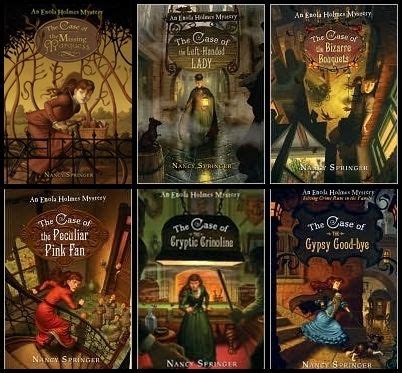
Made even more popular by the Netflix adaptation, I read this series back in middle school and as implied by the title, it follows the disgraceful, very late in life, younger sister of Sherlock Holmes. Upon her mother’s abandonment, and the threat of boarding school, Enola runs off to London where she unintentionally gets up in the family crime-solving business using her unique skillset.
I dearly enjoy Springer combining deep research into the mores of Victorian England (its superstitions, beliefs, class system, etc.) with a clever heroine who embraces her strengths.
This will primarily focus on the original series and not the two later sequels. Mainly because I couldn’t find them even though the library said it had them. Also I wasn’t sure if it continues the original series or takes off from the Netflix show. Maybe someday I’ll review them. (And maybe one of them will have her bump into the former Ms. Adler. I mean come on, if Springer can have Enola briefly bond with Mrs. Watson, surely she can somehow sneak in Irene once)
On to the rankings-
- The Case of the Left-Handed Lady: This combined all of my niche interests of Victorian London like Jack the Ripper garrotes, mesmerism, historical beginnings of anarchy so it gets top spot. I especially enjoyed how Springer included the superstitions and beliefs of the day such as left-handedness being a sign of evil, the dual personality, and a great demonstration of why Enola can solve mysteries that Sherlock can’t. He may be versed in jujitsu and deduction, but is completely clueless as to the importance of hats, the meaning of flowers, and postage positioning.
- The Case of the Bizarre Bouquets: A winding, crazy mystery (pun intended) that gives special attention to the often underrated Mrs. Mary Watson. Plus the mystery acts a parallel to Enola’s own feelings of resentment and yearning for her mother. Love when the plot mimics the character’s emotional states and the lessons they need to internalize.
- The Case of the Cryptic Crinoline: Again, I like historical fiction, and thus historical domain characters like Florence Nightingale are a treat to me as Springer weaves in the role of nurses and spies in the Crimean War with Enola’s personal stakes in the case for a part political intrigue/part kidnapping mystery.
- The Case of the Missing Marquess: I’ve always said in my rankings, unless it wows me straight out the gate, the first book usually ranks middle or last. It has to set the stage, making it a slow beginning introducing the characters and their relationships. Plus this is one where Enola stumbles on the case or sort of makes it up as she goes along. Not the intentional pragmatism she displays in her other cases so it’s lower for me. Bonus points for Lestrade though. Funny that she has a better opinion of him than Sherlock.
- The Case of the Gypsy Goodbye: Unfortunate that the final mystery ranks lower but I think it primarily suffers too much of antagonistic Mycroft, and focusing on two mysteries at once. It might have been more poignant if it focused primarily on their missing mother and what happened to her.
- The Case of the Peculiar Pink Fan: Sometimes having repeat characters can be exciting but the return of Lady Cecily was primarily disappointing to me as it uses the forced marriage plot once again, and we never get to see Enola and Cecily interact one on one after she rescues her for the second time, just feels like a missed opportunity. Then again, Enola does stand for “alone.”
 Rachel Reads & Reviews
Leave a comment