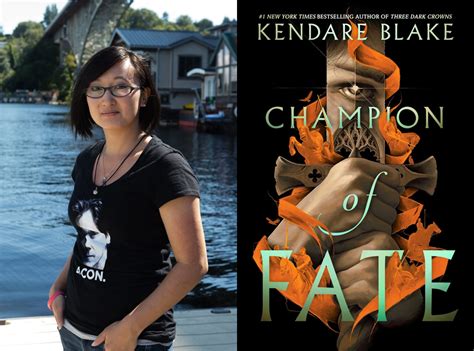
Kendare Blake is the author of the Three Crowns trilogy, Antigoddess series, Anna in Blood, and so much more. Traversing from horror to fantasy, Kendare took the time to answer my questions about her influences, favorite seasons of Buffy and what’s coming next. Enjoy!
1. When did you begin writing? What are some of your influences?
I started writing in Middle School. I scratched out a novel in a notebook. No idea how I did that, as these days my hand cramps up filling out a greeting card. And then I wrote horror stories in high school. Copying the styles of my favorite authors as best I could. For the practice. The handwritten novel was about horses, because as a child I read The Black Stallion. But by seventh grade I was mostly reading Stephen King and Anne Rice. Hence the horror.
2. In interviews you’ve often said that the characters evolve and change the narrative, but what about your extensive world-building. Do you create each world from the onset or is it also a seat of your pants situation?
It depends on the world, but yes, to some extent it’s always a seat of my pants situation. I know about some things going in: some of the rules, some of the geography, but the bulk of it I learn as my characters walk around. I’m like a tourist. Which is why I like to write about fictional places rather than actual. I’d be bound to get something wrong if I tackled a real place.
3. Your books are also noted for its building intensity as the series progresses. How do you deal with the pressure to deliver in sequels and conclusions?
The story tends to handle that for me. Everything that’s been set out from the beginning, all those threads and details, every time the plot twists they all cinch tighter. I find writing endings exhausting–truly like fighting a great battle–but also it’s loads of fun.
4. In your Antigoddess series, you follow a teenage Athena and Hermes. With so many interpretations and retellings of the Greek gods in modern times or aged down, how did you set out to make your own gods?
Greek gods have been interpreted and reinterpreted since Homer, so I just had to put that out of my mind. My main source material was the Iliad (and the Odyssey, a little) so I tried to extrapolate modern takes on the gods from that. But there are endless directions that each god can be taken in.
And writing the gods was so much fun. They had so much baggage, and all they wanted to do was argue with each other. Total basketcases. Delightful.
5. In Three Crowns, you draw inspiration and sources from a variety of history/literature (the Mithridatism, elementals, matriarchal societies and mythologies, etc.). While you have a lot of leeway with creating fantasy fiction, were there any particularly interesting or insane bits of research you found?
History sometimes surprises me with how stupid it can be. I was reading a book on the Plantagenets and there was this king or a prince who drowned on a ship in harbor when the whole crew got too drunk to sail it properly. And his death plunged an entire kingdom into chaos. Like, how idiotic was that? If you put things like that in books readers don’t believe them.
6. Why are you particularly drawn to horror?
Why do you think it continues to resonate with the world at large? Horror pushes the envelope. It’s titillating by its very nature and in books at least is a pretty safe space to explore some pretty dark things. My favorite horror is horror with something to say, horror with questions to ask. It’s dark and it’s nasty at times but it’s also not real and that makes it fun.
7. Buffy is such an iconic IP. How much input and/or restrictions do you have in creating your post-Buffy world?
I had pretty much free rein. At the time, there were completed comics series and a few comics storylines in progress, but mine was the only novelization following directly from the canon of the TV show. So I didn’t have to worry about overlapping with anyone else. Of course, the Buffy team gave me some marching orders, like if someone particular had to die, and the main opening plot points. But after that, they turned me loose.
8. Frankie, the latest slayer and protagonist of your trilogy, has unique challenges with her witch and slayer sides. With her relations to Buffy and Willow, how did you envision her foils and similarities to them? Has she evolved from your first pitch to the final product?
Frankie was definitely “What if Buffy and Willow had a baby?” But she also became very much herself. I absolutely adore Frankie. I think she’s ridiculous. But she has that earnest, slayer, do-gooder aspect to her that is just. So. Endearing. Like her Aunt Buffy, Frankie is a hero.
And Frankie wasn’t my pitch. Frankie was part of their pitch. All of the main cast: Willow, Oz, Spike, Frankie, Jake, Sigmund and Hailey, were all part of the Buffy team’s original synopsis. They put the players on the board and then said, GO HAVE FUN IN NEW SUNNYDALE. So I of course decided to bring back all my faves. Giles. Andrew. Buffy, eventually. The 1997 Sunnydale Swim Team. The Fyarl demon. God, I had so much fun writing those books.
9. On a lighter note, favorite season of Buffy?
For overall story arcs I love seasons two and three. But my personal favorites are seasons four and six. Which I know, are less popular. But they have my favorite episodes in them. Hush, Once More With Feeling, the one where Buffy gets stuck in a time loop and has to sell a mummy hand nineteen times, the one where Giles gets turned into a Fyarl demon.
10. Any upcoming news you’d like to share?
Um…nothing for the near future, but my next novel, THE STOLEN QUEEN, comes out in 2027. It’s a fantasy rom-com about a young woman with a god trapped in her body. If you’re a fan of The Emperor’s New Groove, this one’s for you. Also, this year marks the 10th anniversary of Three Dark Crowns, so if you haven’t read those, now’s a fine time to start!
 Rachel Reads & Reviews
Leave a comment