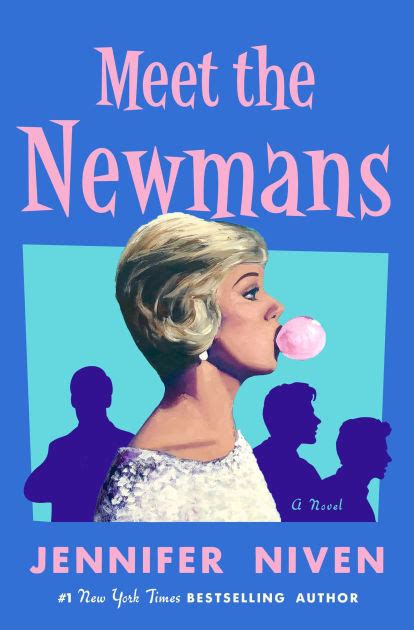
For two decades, Del and Dinah Newman and their sons, Guy and Shep, have ruled television as America’s Favorite Family. Millions of viewers tune in every week to watch them play flawless, black-and-white versions of themselves. But now it’s 1964, and the Newmans’ idealized apple-pie perfection suddenly feels woefully out of touch. Ratings are in free fall, as are the Newmans themselves. Del is keeping an explosive secret from his wife, and Dinah is slowly going numb—literally. Steady, stable Guy is hiding the truth about his love life, and the charmed luck of rock ‘n roll idol Shep may have finally run out.
When Del—the creative motor behind the show—is in a mysterious car accident, Dinah decides to take matters into her own hands. She hires Juliet Dunne, an outspoken, impassioned young reporter, to help her write the final episode. But Dinah and Juliet have wildly different perspectives about what it means to be a woman, and a family, in 1964. Can the Newmans hold it together to change television history? Or will they be canceled before they ever have the chance?
The blurbs said that fans of The Seven Husbands of Evelyn Hugo, and Lessons in Chemistry would enjoy this, and since I enjoyed both, I had was intrigued. Let’s start by saying the blurbs were right.
Much like those books, we are taken behind the scenes of Hollywood. This time the set of 50s-style sitcom, Meet the Newmans. The twist is that the Newmans are not just actors, they are an actual family playing very similar versions to themselves. Most things that happen in real life gets written into the script thanks to the raring head of the family, writer, producer, leading man, Del. They are so wholesome, but they’re not hip and that’s why the ratings are falling.
As with LiC, this book tackles first wave feminism. Unlike Elizabeth, Dinah believes she’s content with her role as housewife and supportive mother onscreen and off until she has take on Del’s roles and realizes how much women are underestimated. The role of blooming feminist comes from Juliet, an aspiring journalist who initially is angered by Dinah whose existence seems to perpetuate and encourage the patriarchy.
I enjoyed the friction between Dinah and Juliet, a literal generational divide, as Dinah takes offense by Juliet laying the problems of patriarchy at her feet, and disturbed by the niggling that she might also be right. She does want more. Juliet learns to not let her preconceived notions and prejudices blind her objectivity and to communicate with a woman with such different life experiences and expectancies and become friends.
Granted, some of the first wave feminism feels trite, covering things most women know in modern times like intersectionality, being harassed, etc. But it is the first-wave, and it is still sadly relevant. I just felt that some of the exposition was like it was a history lesson to readers in case they didn’t know how limited women’s options were back in 1964.
Generally, the arc of their dynamic is predictable as well as their archetypes, but Niven does an excellent job in illustrating the minutia of their ay to day, the fog of Dinah’s waking up to her real dreams. Juliet has a particularly interesting arc as she struggles to leave a man she cares about, but became lost in that relationship. It was a moving tribute to loves that are real, but aren’t right due to time and circumstances, and that Juliet ultimately has to choose herself. I thought it was also a clever gimmick to have that ex to only be referred to as The Musician. It’s like Niven is implying that if we knew The Musician’s name, his fame would override hers, so she keeps him in the background, usurping his power by making him the satellite love interest.
This novel sets itself apart with its varied cast of characters, all lost in a prison of their own making, playing heightened versions of themselves on tv is no longer working. In television nor in their personal fulfillment. Del was particularly interesting even though he’s MIA for a third of the book. He represents the patriarchy at its finest, controlling and pushing everyone into his idealized world. But he’s not a bad guy. He’s just trapped in the past, scared of losing his vitality, and while there is frustration, he eventually comes to accept the change and how his ways were invertedly hurting his family. He just needed to be reminded of what he was working for.
Shep, and Guy’s arcs were fine, tying in nicely with the book’s themes about hiding true selves, breaking through stereotypes and prioritizing their real goals. They just weren’t as interesting as Dinah, and Del’s story.
Funny enough, Niven gives insight to a few minor characters like Flora, the Newmans’ housekeeper, and Kelly, Guy’s paramour, and those insights were intriguing enough that I had wanted more. Niven has a way of drawing you in, and making these supporting characters distinct and interesting.
The conceit was the draw of the book, and Juliet and Dinah’s intergenerational friendship is what made me stay. However, if you are looking for dynamic, memorable protagonists like Evelyn and Elizabeth, you won’t find that here. Rather Niven’s strength lies in the quiet moments of epiphany and connection between the cast of lost souls finding their way in a confusing, changing world.
4 stars.
 Rachel Reads & Reviews
Leave a comment