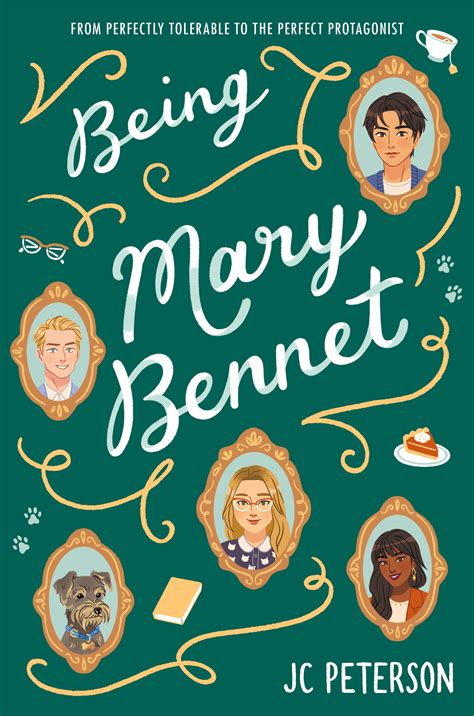
It is a truth universally acknowledged that every bookworm secretly wishes to be Lizzie Bennet.
A less acknowledged truth is that Mary Bennet might be a better fit.
For seventeen-year-old Marnie Barnes, who’s convinced she is the long-suffering protagonist of her life, this revelation comes at the end of a series of self-induced disasters that force her to confront a devastating truth: Marnie has more in common with Mary Bennet—the utterly forgettable middle sister—than the effervescent Lizzie.
Determined to reinvent herself, she enlists the help of her bubbly roommate and opens herself up to the world—leading lady style. And between new friends, a very cute boy, and a rescue pup named Sir Pat, Marnie realizes that being the main character doesn’t mean rewriting your life entirely. It’s about finding the right cast of characters, the love interest of your dreams, and, most important, embracing your story, flaws and all.
Pride and Prejudice is a classic as we all know with the various retellings, and while many have latched on to Lizzy and Darcy’s love story, there has been a resurgence of affection for the forgotten, bookish sister of the Bennet five, Mary. I have seen at least four books already highlighting the forgotten sister running from contemporary to regency as authors give the smart Bennet her time in the spotlight.
However, Peterson takes a different approach. She focuses on Mary’s or in this case, Marnie’s bookish and smart traits which many book nerds relate to. But she also highlights why Mary was considered annoying within the P&P universe. She’s moralizing, self-righteous, pedantic, and jealous. So’s Marnie, to her horror as she sets out to change herself.
I enjoyed how Peterson deconstructs this personality type that some Austen fans disregard as they project their bookish, sensible, solitary personality to Mary Bennet. Marnie is not entirely happy as herself. She’s jealous of her sisters, awkward, defensive, and feels left out of her own family, and she justifies it to herself that they are the ones that are the problem, they’re wronging her.
Her attempts to fit in only work when she allows others to help her and she slowly starts to tear away the preconceived notions she has about her life and the people around her.
Basically first impressions are not the way to go about life. Shocking, I know, and I adore how Peterson continues the main themes of Austen’s works as she peels away the layers of first impressions Marnie has on her love interests, her enemies, and her family.
Not that Marnie is entirely annoying. You can relate to her loneliness, how she retreats to her love of books, and her self-righteousness come as a way of protecting her already bruised ego. Plus when she does let herself relax, she’s sweet and fun. As her friend, Adhira says, she’s fine as she is.
Which brings me to Adhira, such a fun new character who you just want to go out for a cup of coffee. She’s earnest in her desire to befriend Marnie, which only makes it worse when Marnie screws it up. Not that Adhira only serves as her supporting friend as Adhira is dealing with her own friend/trust issues as well. I can’t go to into it as that is spoiler territory but it nicely ties into Marnie’s lovesick idea of Hayes.
Hayes is the Mr. William Collins of the piece. Not a Bennet cousin, but a family friend, and he’s so much worse than the book counterpart. He’s a suck-up to anybody, smarmy, most people see right through them except Marnie. You want to slap the girl for how she makes excuses for him. Her obsession takes a long time to abate and takes away valuable time she could spend with the real love interest-Whit.
Whit is sweet, likes dogs, actually takes the time to help Marnie with her project and likes Anne of Green Gables. He’s almost too perfect, which is what you want in a escapist book like this. Yet Peterson maintains some realism as she has them go on a serious break when Marnie breaks his trust one too many. My one quibble is that he seems to have secret or at least serious trust issues due to his parents’ divorce. But while Marnie confides her insecurities and family troubles to him, he never returns the same depth. It feels like a missed opportunity to expand his character.
I suppose that’s okay as the real highlight of the book is Marnie’s relationship with her family. Lindy and Marnie are my favorite exploration as Marnie sees Lindy as the protagonist of the family who gets everything, their dad’s favorite, and whom she could never live up/will always be compared against when she goes for the Hunt Prize at school. Since there’s a large age gap between them, there hasn’t been much chance to rectify this impression but a reader can clearly tell from Lindy’s side, she cares about Marnie and wants to connect. Their conversation about books dovetailing about their relationship was really heartfelt.
Also during the climax of the book, Marnie gets a small quiet moment with Will Drake aka Lindy’s husband aka the Darcy of this universe, and I never knew I needed them to interact, but I did.
The rest of the Barnes perfectly match the Bennets with Mrs. Barnes being hysterically offensive, dramatic and pushy. Plus she loves balls. I just love how Peterson managed to fit one in. Mr. Barnes is more calm, and less disparaging of his daughters/wife as he is in the original, which I see as due to Marnie wanting his good opinion. Joss, and Kat get little to do, but I think they’re in-character. The youngest, Lola, offers potentially hidden depths which I’ll share tomorrow. Still, makes a nice bookend to Mary’s conversation with Lindy as she realizes she has misjudged her sister’s opinions of her and she may have done the same in turn.
I thoroughly enjoyed this continuation of the Austen characters in contemporary times. Peterson seamlessly portrays them in-character while dropping new people into their world, and enabling Marnie’s growth. My one quibble is that Austen, and Pride and Prejudice is a work within this universe. Marnie obviously draws a comparison between her, and Mary, and Lindy, and Lizzy, but she never draws all the similarities her life has with the rest of the piece. It feels glaringly obvious that I wish Peterson acknowledged it or taken it out all together.
4 stars.
 Rachel Reads & Reviews
Leave a comment