What do a future ambassador, an overly ambitious Francophile, a hospital-volunteering Girl Scout, the new girl from Cleveland, the junior cheer captain, and the vice president of the debate club have in common? It sounds like the ridiculously long lead-up to an astoundingly absurd punchline, right? Except it’s not. Well, unless my life is the joke, which is kind of starting to look like a possibility given how beyond soap opera it’s been since I moved to Lancaster. But anyway, here’s your answer: we’ve all had the questionable privilege of going out with Lancaster High School’s de facto king. Otherwise known as my best friend. Otherwise known as the reason I’ve already helped steal a car, a jet ski, and one hundred spray-painted water bottles when it’s not even Christmas break yet. Otherwise known as Henry. Jersey number 8.
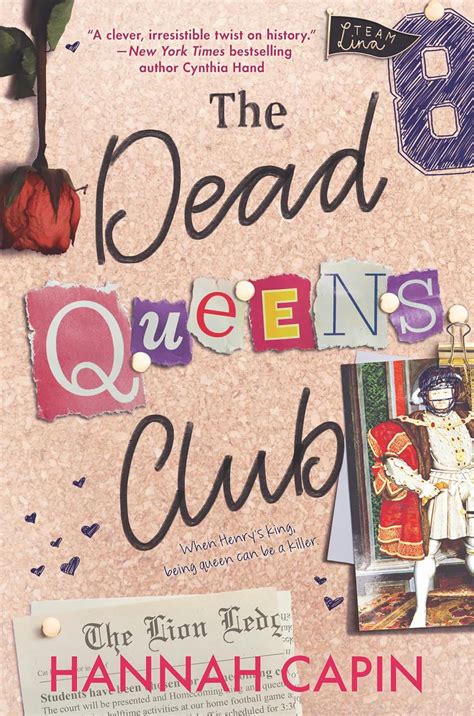
Meet Cleves. Girlfriend number four and the narrator of The Dead Queens Club, a young adult retelling of Henry VIII and his six wives. Cleves is the only girlfriend to come out of her relationship with Henry unscathed—but most breakups are messy, right? And sometimes tragic accidents happen…twice…
The English court is really just a massive stakes, adult version of high school and Caplin proves it. It’s amazing how she stuffs so many historical tibits like Henry’s fake name is Rex ie. Latin for king, the convoluted family ties of Anne Bolyn, Katherine Howard and Parker Rochford (real name Jane but would get too confusing with the other Jane) being cousins, Catherine Parr dating Thomas Seymore, the cousin of Jane Seymore who also dated Henry, fellow students taking on the parts of other nobles who were active players in the Tudor Court. Yeah, she manages to keep all that intact in a high school setting.
All while using apt allusions to the English court with Henry and his girlfriends winning prom court nominations, Cleveland referring to Parker as Catalina “Lina” Aragon’s lady-in-waiting aka BFF, and so on. The history nerd in me really enjoyed the Easter eggs and how she illustrated that big historical events can be universal when you translate it the right way. She captures the nuances and personalities of these figures and made them relatable.
A few years before Six hit the stage, Caplin emphasizes the fact that these women have nuance and deserve more than to be considered Henry’s wives/the ways he ended things with them. Or in this case, reputations as girlfriends. Lina is the perfect Catholic golden girl who everyone loves in the drama of Team Lina vs Team Anne, even though Anne points out she likes to play martyr like her Catholic saints. Anne is considered the seductress, but she also has very intelligent, boss babe in training which attracted Henry to her yet that same ambition scared him. Jane is the goody-goody, possible social climber with a reserved backbone. Cleveland is the cool indie girl who can still stay friends with Henry yet that same friendship and not like other girls attitude almost leads her to betray her values. Katie is sweet, naive and taken advantage of by older men, ending her reputation as a slut. Catherine is the aspiring journalist with high standards for everybody including herself.
And yes, Henry gets nuanced too. He had a crappy hand in life. In the book, paralleling his real life tragedies of dead mom, dead older brother he can live up to, and a father who wanted his other son to live. It screwed him up, giving him an inferiority complex that only he can save the town after his father (the biggest employer of Lancaster) gave up on it, and also a narcissistic ego that can’t handle people viewing him as a wuss or less than perfect. Yet he was also charismatic, a good singer and guitar player, avid sportsman.
People have layers, although in this case, it delivers a timely lesson about the lure of WASPy golden boys, and how one tragic backstory allows people to excuse and enable his bad actions while women rarely get that kind of grace in society if they make a mistake. Their reputations are ruined almost instantaneously, and good luck getting people to remember anything else about them.
Characterization, and plot were good. However, this book could have been 150 pages shorter. Possibly 200 because of Cleveland’s voice. My writing professor once said that sometimes the author gets enamored with the character’s voice and it starts to detract from the story, that’s when you should rein it back. That’s what happened here. Cleveland is an overachiever with no aim in life; smart enough that she’s bored by school, but doesn’t reflect deeply on the events happening around her. She’s the “quirky, “not like other girls,” who at least acknowledges the cliche, but the running interiority felt like it was trying too hard to be quirky. This is especially egregious during antagonistic confrontation scenes where these serious conversations are interrupted by whatever quirky thing Anne is thinking or blurting. Caplin is capable of creating soft moments of friendship like the scenes between Cleveland and Henry, and Cleveland and Katie, so I wished she leaned on those more.
It also diluted the very suspenseful ending by making it confusing, and that everyone sounds like they’re screaming.
Also the last half was padded out by Cleveland absolutely refusing Henry is the bad guy, and grasping conspiracy theories of who is really the murderer framing Henry. It fits with her arc of realizing she really isn’t that special to Henry, and that she fell for her own “not other girls” aesthetic, but it could have been seriously cut down.
That’s why I give it 3.5 stars. The character voice is what keeps it from being truly great. Nonetheless, it’s a compelling, passionate homage to Tudor history, and complicated women in history with a feminist revenge angle that’s cathartic to cheer on.
 Rachel Reads & Reviews
Leave a comment