Harlequin, and the historical romance genre in general may be known for its Regency balls and Western shoot-outs, but Lauri Robinson may be the only introducing exciting new eras that make for interesting twists to classic historical romance tropes. From early America to the sock-hops, Lauri Robinson has something almost for every era.
Saving Marina
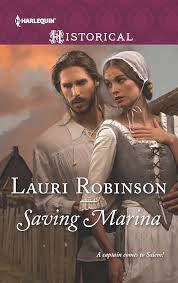
Seduced in Salem Sea captain Richard Tarr must claim his child after the death of his estranged wife. Arriving in Salem, he’s shocked to discover his daughter is in the care of Marina Lindqvist—a rumored witch! This beautiful, gentle woman awakens unfamiliar feelings in Richard. And as the threat from the Salem witch hunters grows, he knows he must protect misunderstood Marina at all costs. Little does he know that with Marina helping him bond with his little girl, she might just be saving him right back…
Like many Harlequin romances, this one has a simple premise of young bachelor travels a long way to pick up his orphaned niece now that his brother is dead and he’s the only family he has left. Then he falls for the woman who has been temporarily taking care of her.
This has one intriguing variation- the woman taking care of niece, Marina, is a suspected witch.
I don’t think I’ve ever read a romance set in colonial America, and the paranoia that has overtaken the town because of the Salem Witch Trials make this more like a historical suspense romance than regular historical romance. As an outsider, Richard, can see the town is devolving into crazed zealots led by a greedy leader, but because of that same outsider status they won’t believe him when he says the town leader they’re following is the one cheating them all.
Marina was interesting too with the ambiguity of whether she was a witch or not. She has prophetic dreams, and in such a superstitious/religious era, she does fear she may be a witch and what that means for her relationship with the rest of the town and other God-fearing people. It was nicely tied together how these two outsiders come to form a family of their own.
The Cowboy Who Caught Her Eye
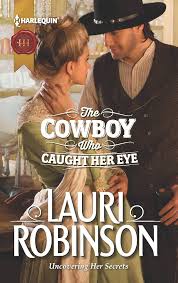
The Shopkeeper’s Shame
Pregnant and unmarried, Molly Thorson knows her livelihood is under threat. The last thing she needs is a distracting cowboy swaggering into view. Especially one who knows she has a secret and still looks at her with desire in his eyes.
The Cowboy’s Secret
Carter Buchanan knows all about secrets. It’s his job to know. And Molly sure has something to hide. But the fear in her eyes touches a place he thought long-ago dead—and now this cowboy can’t help but consider exchanging his pistol for a band of gold.…
This was interesting as a Western combined with old-timey mystery since is a Pinkerton agent on the case. Not much else I can see regarding that. Westerns aren’t my thing as they’re like small-town romances with more rustic appliances and shoot-outs. The Pinkerton agent falling for shopkeeper was sweet, but I can’t say they stood out much compared to the other couples here.
However, I was surprised that Molly was an unwed mother. The father of her child not being dead before claiming the child or her dead husband, but simply out of the picture. I always thought that single mothers in Harlequin fiction were single because of external circumstances rather than sex with the wrong man, but I was wrong. And was totally accepting of that, and willing to raise Molly’s future kid as his own. Which obviously implies he’s the good guy she’d be with, but I guess it means we’re past the 80s tropes Harlequin was known for.
A Family for the Titanic Survivor
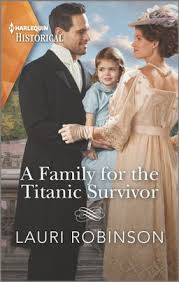
From third class on the Titanic …
…to upper-class bride?
When barmaid Bridget McGowen boarded the Titanic, she never could have imagined the crossing ahead of her. The resilient Irishwoman saves four-year-old Elsie, the niece of New York banker Karl Wingard. Swept into Karl’s world, Bridget feels like a fish out of water, except for the quiet moments she shares with him. As her connection to Karl and Elsie grows, can she break free from the shackles of society so they can be a family?
This one was similar to the first Saving Marina story. Uncle becomes the sole guardian of niece after tragedy. Since the tragedy is the Titanic, it makes automatically ten times more interesting. As Robinson brings up in her author’s note, not many stories tackle what happened after the tragedy of the Titanic and she did a lovely job delving into Bridget’s survivors guilt and the nightmares she experiences afterwards.
Plus Robinson explores the class differences in a real way. Not just in Bridget doing an almost self-sacrificial “I’ll never fit in with his snooty social circle and he’ll be ashamed so I’m going to break our hearts now,” but in Karl’s two arcs. First one is his fight aginats the Commissioners to seriously investigate what led to the Titanic tragedy and making regulations so it’ll never happen again, but in also building up a fund to give to survivors, including the lower-class ones who hadn’t thought about before, but realized as a man of means, he should be helping them.
The second arc is one regarding his mother, and exploring the lack of opportunities she had as a woman/wife in that era, bound by societal snubs and a husband who used money to control her access to her children, and led to ‘s resentment of her as a gold-digger, totally unaware of the real situation.
The one was definitively one of my favorites of her novels.
Scandal at the Speakeasy
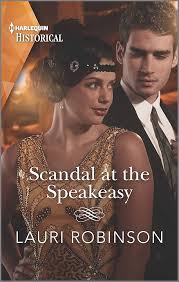
Guilt drives New York cop Patrick McCormick, who promises to reunite schoolteacher Lisa Walters with her long-lost father. Only, Lisa also runs an underground speakeasy! Tough yet innocent, Lisa might be the only one who can help Patrick overcome his past, but she’s on the wrong side of the law. Patrick must remember he’s there to fulfill a promise, not fall in love…
I really love the twenties, so perhaps my expectations were too high for this book. Even though it involved bootleggers and speakeasies, and Patrick is immediately intrigued to the unexpected mastermind of the whole operation, I did not feel pulled in like I thought I would. Such a shame because Lisa is the feisty, pragmatic yet vulnerable heroine I usually love and Patrick is the good cop willing to bend the rules because he’s a soft, family man on the inside. I just couldn’t connect.
The Captain’s Christmas Homecoming
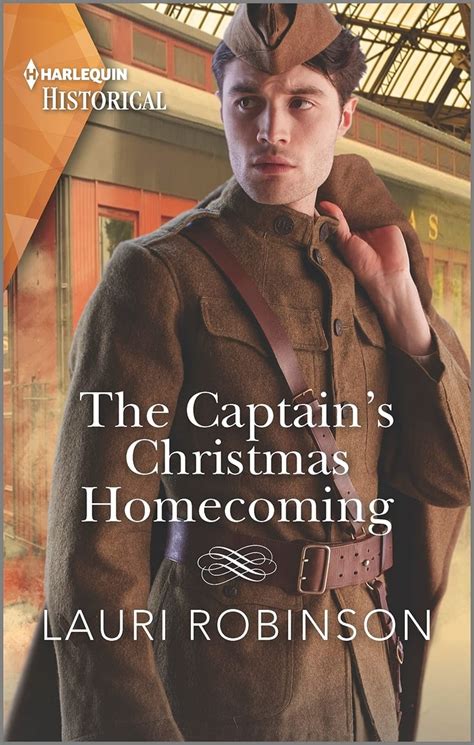
Can real life compare…
To the love in their letters?
When Emma first used a pseudonym to write to Captain George Weston on the front line, it was because she felt responsible for his broken engagement. Yet his letters became a light in the darkest hours, and she shared more of her desires than she ever dared before, never imagining they’d actually meet. Now that he’s home for Christmas, she longs to see him, but that means revealing who she really is…
Maybe it’s because of the slip of the eye when reading I kept seeing George Washington instead of George Weston. Then again, Washington seemed to be an inspiration for George as he strives to be just as honorable in his business and romantic dealings as the man himself. He is just a good, solid guy and you really root for him and Emma to make it work. Their connection is personable and honest even as Emma struggles with the shame her aunt unfairly heaps on her because of classism.
The premise itself was cute, almost like In the Gold Old Summertime, and You Got Mail with the couple exchanging letters throughout the war and meeting for the first time when the book begins. Unlike those movies, they are not antagonistic rivals, so we get glorious chapters of Christmas celebration and fun where the learn more about each other, and see how they really fit together.
A Dance with her Forbidden Officer
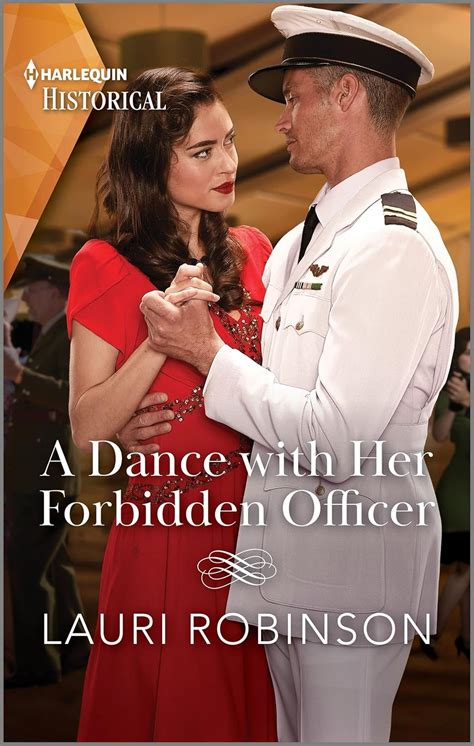
Nurse Wendy Smith promised her mother she’d see the world, starting with beautiful Hawaii. Her promise to herself—to never depend on a man—is harder to keep when navy officer K.T. McAllister jitterbugs into her life. Then Pearl Harbor is attacked and, as Wendy nurses an injured K.T., she learns he too has promises to people back home. Yet as K.T. grows stronger, so do her feelings, and her longing for the forbidden…
For a novel set during WW2, I was expecting a bit more drama. While Robinson does a good job in depicting the relative normalcy when K.T. and Wendy first meet at the dance contest. Swing bands, vacation time feeling since no one suspects that the war is coming to their doorstep. The attack on Pearl Harbor was well-written too with K.T. being in shock and Wendy scrambling to nurse all the wounded.
Then it devolves into K.T. trying to break off with his sorta-girlfriend back on the mainland, and Wendy has her guards up because of her deadbeat Dad, and it’s like there isn’t a war going on. No concern about K.T. possibly getting injured when he gets shipped out? There in Hawai’i, no mention of Japanese neighbors being rounded up for internment? No PTSD from Pearl Harbor at all? I know, Harlequin romances are supposed to be light, but Robinson had explored the deeper psychological elements in her Titanic novel, so I was hoping it’d pop up here.
Marriage or Ruin for the Heiress
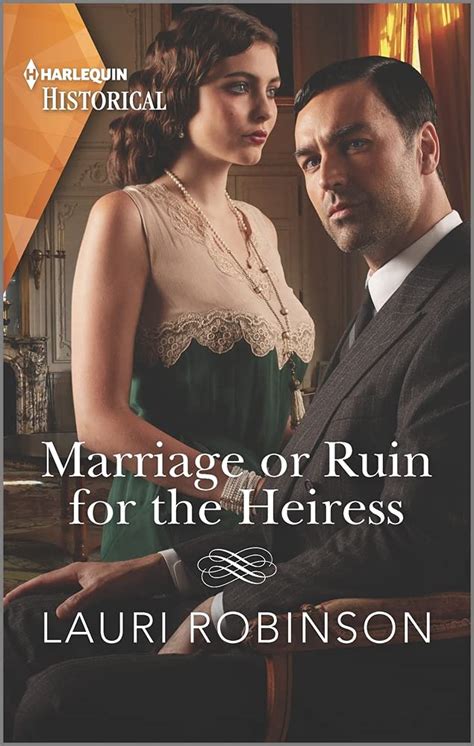
The great depression has left heiress Jolie Cramer’s family destitute! To save them, Jolie must abandon her dreams of independence and marry wealthy Randal Osterlund. Thank goodness Randal only wants a wife to secure a business deal and shares her feelings about love—nothing but heartache! Jolie quickly realizes that’s not all they have in common, but falling for her charismatic husband wasn’t part of their agreement…
With all the arranged marriages in the Harlequins table, this was a new setting which made perfect sense. With the Great Depression looming, there were probably some marriage of conveniences from people desperate to escape poverty or avoid losing the life they’ve known. Here, Jolie and Randal are in the same boat so even though they’re not enthusiastic about the idea, they are willing to work with each other and make a comfortable marriage/partnership, promising real feelings don’t have to come into it.
Of course, real feelings come into it.
I enjoyed Jolie’s initial struggle with the idea of marriage when she had plans of her own to start some sort of sewing or fashion design, even when her mother said such activities are beneath a woman of her stature. Luckily, Randal isn’t one to believe that women should stay at home, and while he’s figuring out how to make his business deals work, she makes a lingerie line that soon all the upper-class women are lining up to buy. She finds a sense of self, and that support and admiration Randal shows for her, starts up real feelings despite their deal.
Just as Randal is unsure of how to navigate business and a wife, a wife who seems to understand him so well. He has gone through his whole life being the runner-up, unable to live up to his father and grandfather, and it’s that insecure that keeps him from seizing all he can. That and a misunderstanding regarding whether providers should only see their wives as dependents, and not the person driving them to do better and be more.
These two had a wholesome relationship, navigating their flaws and flawed perceptions of what love entails. They had their arguments, but in never felt like the overblown, soap opera type, but realistic ones that they were able to fix with communication and their natural chemistry bolstering them forward. They’re hard-working and resilient, a perfect archetype representing the resilience needed to survive the Depression.
The Heiress and the Baby Boom
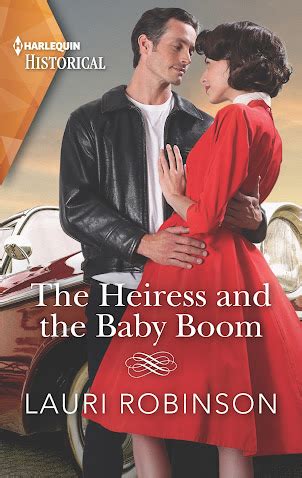
Growing up, heiress Randi Osterlund found the only person who didn’t care who her parents were was penniless Jason Heim—until a bitter exchange left bad blood between them. Now, years later, Randi needs Jason’s land for a business venture, but the self-made man refuses to sell. There was always something burning between them, and when their arguing turns into one unforgettable night, the consequences risk adding to the ’50s baby boom!
The second novel in the Osterlund saga follows Jolie and Randal’s daughter, Randi in the 50s! Another time period that gets little love in historical romance. Just as before, I loved how Robinson immersed readers into the setting of the 50s with sleek chrome cars, exciting innovations like vaccines, the obsession with home ownership, and conquering the commercial airline market.
I enjoyed how this served as a continuation of Randal and Jolie’s story. Randi, like her mother wants to prove herself in the business world. Not taking over mom’s lingerie company, but her father’s aviation work which (its the 50s) everyone sees as a man’s job. So when she gets pregnant, this puts her plans into a tailspin. It also prompts self-reflection as to what she really wants, and just as Jolie and Randal struggle with fulfilling the expectations placed on them to keep the Osterlunds wealthy, Randi comes to realize she’s been too bound by these expectations and finds a different, just as fulfilling path where she doesn’t feel like she has to prove herself worthy to follow in their footsteps.
Jason also has things to prove, being the greaser to this good-girl heiress. Robinson flips the script by having the guy face a classist society and the shame he feels for his reform school reputation and the fears that he didn’t do enough to not trap Randi into this marriage. Granted, they do have feelings for each other, but those feelings that he isn’t good enough clouds most of his arc. Much like Jolie and Randal, I enjoyed how realistic Randi and Jason felt in this second-chance/high school crush romance. They feel a bit more immature than Randal and Jolie in their communication, but the sweet heart underneath was real and I was rooting for them.
And to think, this is only a little bit of Robinson’s prolific catalogue. If you want to try something new in the historical fiction genre with relatable, real romance (well, not wholly there is still a dash of the spectacle we all love in our romances), you won’t go wrong with Lauri Robinson.
 Rachel Reads & Reviews
Leave a comment