In all my historical romances, I haven’t really sat down and read those from the brand that epitomizes the romance genre. Harlequin romance. While it has the expected glut of regency rakes and highlanders in its catalogue, I was surprised to find out that they have a diverse range of historical periods. Moreso than the mainstream choices in Avon and Berkley romance.
That’s why I started with Greta Gilbert whose heroes and heroines all fight and find love in the ancient world.
Forbidden to the Gladiator
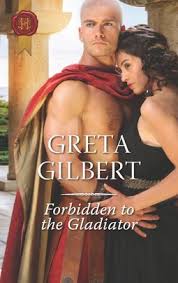
When her father wagers her hard-earned money on a gladiator battle—and loses!—Arria is forced into slavery, just as trapped as the gladiator she blames for her downfall, rugged Cal. She’s furious, yet also captivated by their burning attraction.
Cal’s past has made him determined to die in combat, but can Arria give her forbidden warrior something to live for…and a reason to fight for their freedom?
I suppose you could say that Cal is a Highlander of a different name since he was taken by the Romans from Briton, but semantics. It’s a classic enemies to lovers. It helps that thanks to her father’s gambling, Arria is taken from a position of relative power as a Roman maiden to a slave, giving them plenty of proximity while they serve the corrupt governor.
I enjoyed them seeing past their previous perceptions of each other, and how they circumvent their circumstances so they could communicate to one another and cement their bond. It is that communication that makes for a satisfying not-third act break-up when the governor gives Arria the ultimatum to break up with Cal and inform him he’s going to throw the gladiator match next week (otherwise known as instant death) or else he’ll execute her miserable excuse of a father. Cal is bewildered by her proclamation and instantly suspects she’s being forced. It was such a relief compared to other romances where the guy blinded by their own poor self-esteem believes such an about-face.
As an archeologist and historian, it’s clear that Gilbert did a lot of research to depict the brutish world of gladiator fighting, the hierarchy of Roman politicos and praise/honor given to artisans believed to be gifted by the gods. Each piece informs the characters and their journey. The latter topic with the artisans, allows for Gilbert to sidesteps the messy potential of rape when Arria is promoted to weaver for the governor’s wife and gives her a sense of control and income after a lifetime beholden to her father’s love of gambling.
There were a few small nitpicks like Arria and her father’s name, Atria being so similar. Tripped me up several times. Also Arria’s mother is absent most of the time, and with all the past tense with which she referred to her I was convinced she had been dead, not sequestered in pregnancy, so that was a surprise Otherwise it was a solid book with a new time period I haven’t read.
Saved by Her Enemy Warrior
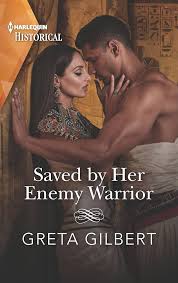
Left to die in the tomb of her beloved Pharaoh Tausret, royal adviser Aya would be silenced forever by those who seek power. But she is not alone! Egyptian soldier Intef is there to steal her mistress’s gold. Now they must work together to escape. This handsome warrior is Aya’s enemy, yet it’s passion not hatred that burns between them. Can their desire withstand the revelations that await them outside?
This one was my favorite story of the three I read. It was another enemies to lovers, but the entrapment in the tomb gave it a slower pace than the gladiator novel. They were truly given the time to learn about each other, to digest, to simmer in the small touches, and get some illuminating flashbacks. The mystery regarding Pharaoh Tausret’s heir was a real twist.
Plus it had some meaningful discussion about propaganda and the differences between female leadership which has historically been recorded as more communal/trade focused compared to male leadership, and how the men try to tear down their images in order to reassert the status quo. Not reflected in the cover, Aya is a mixed-race heroine with darker Libyan features that was not considered desirable then (and probably now) but Intef thinks she’s gorgeous.
The Spaniard’s Innocent Maiden
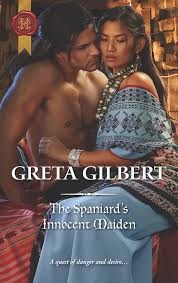
Benicio Villafuerte sailed to the New World to seek his fortune. But his treasure map is impossible to decipher. He needs a guide, and discovering an innocent native woman in trouble is the perfect opportunity. He’ll buy her freedom if she’ll help him on his hunt…
Tula never imagined the adventure Benicio would take her on—for when their dangerous days explode into sensuous nights, she is brought to life. And soon she embarks on her own quest…to capture the conquistador’s heart!
This was a bit iffy as you just know that an pairing with a language barrier and historically, will end with the destruction of the other’s people is bound to be unequal. But Gilbert manages to make it work, I think.
It helps that Benicio is a scientist, not blinded by gold. Sure, he wants it because he hopes to woo Luisa back to his arms after she chooses his rich brother, but it is not his main goal. He’s one of the few disgusted by his fellow conquistadors and thus, doesn’t fully grasp the extent of Cortes’ plans and is horrified when the man goes full on conquistador.
Benicio’s journey of naive scholar to a man scarred by the cruelty and greed of the world was a moving one. He was the most interesting of the Gilbert’s heroes because of that in my opinion. He tries to hold to his morals, so when’s forced to kill and grapple with that, it makes for an intriguing look into the psyche of what makes a civilized person civilized, and who is the decider of what those terms mean.
As he journeys through the Mayan empire, he certainly learns the Mayans are as civilized as the Spaniards. Tribes have different dialects, trading systems, hierarchies, just like in his homeland. They know the name of the stars and their own mythologies for how the world is made, and he’s fascinated.
Unlike what the title implies, I don’t think Tula is fully innocent. That’s what Benicio initially believes, but Tula is aware of the stakes. Aware of the stakes of what will happen if they don’t save her sister who was captured by the Mexica. Aware of the stakes of marriage and love when it comes to woman bearing most of the consequences. Aware of that the alliance with Cortes’ may not be a good idea after all as she sees more of the man’s behavior. Aware of the gods’ anger if they disturb all the treasures in their sacred spaces.
Thing is, Tula’s compassionate. That’s what drives her to reach out to Benicio when she sees him almost get killed, starting their unusual love affair. It’s a slow-burn that’s worth it as the two feel each other out. It also ends with Benicio staying with Tula and embracing her world, eliminating some of the squicky implications if the reverse had happened.
However, the whole novel is tinged with a bittersweet ominousness that it won’t last. Or maybe it’s just me because I know history. Still, it was interesting to read a historical romance in a very, very different setting.
 Rachel Reads & Reviews
Leave a comment