
In Star of the Show, the culminating book in Dolly Parton’s photographic trilogy—following Songteller (lyrics) and Behind the Seams (fashion)—the global superstar finally shares a definitive look at her career as one of the world’s most dazzling and beloved performers.
Featuring engaging stories and memories from Parton’s dynamic life behind the microphone, this book spotlights her signature performances and star-making moments, from singing in front of her family to premiering on the Grand Ole Opry stage and beyond. Her formative years performing with country legend Porter Wagoner are chronicled as she learns hard lessons from life on the road. Breaking out on her own at state fairs and critically acclaimed venues, she toured the world performing for millions of fans in arenas, stadiums, and at festivals. From making her onscreen debut in the blockbuster feature film 9 to 5 to playing the Dallas Cowboys’ 2023 Thanksgiving halftime show to 42 million viewers, this global superstar knows no limits. Along the way, Dolly shares the stage with Kenny Rogers, Linda Ronstadt, Emmylou Harris, and others, while offering insight on touring big, singing strong, and staying on top for seven decades.
Brimming with Parton’s trademark wit and heartfelt sincerity, Star of the Show: My Life on Stage is not only an homage to one of history’s most cherished artists, but also a must-have collector’s item for—and love letter to—any fan of the one and only Dolly Parton.
The latest in Parton’s supersized autobiography trilogy, she showcases plenty of memorabilia and stories of her time on the road that any fan will enjoy. At first I was a bit disappointed as I was expected a look into the behind the scenes of a typical concert for her. The sets, the setlists, etc. But she writes that she has a simplistic set-up for her shows so there’s not much to view there. Rather it was a compendium of her road trips throughout the country and abroad, her tricked out tour buses, and her work ethic along the way. If you read her previous two books one right after the other like I did, there are some stories she did repeat which detracted some of the enjoyment. But there were others she went more into detail like her partnership with Kenny Rogers, and Porter Wagoner; the thrill and logistics of performing abroad in Ireland in the mud, and the boost she gets from fans even during her darkest days.
She acknowledges that she has the discipline and the imagination to do what she does, she wouldn’t be able to if she didn’t believe in herself, but she always, always gives credit to the team behind her, saying they’re as much part of her success as she is. She’s a national treasure, and I always enjoy reading about her.
Lin-Manuel Miranda: The Education of an Artist by Charles Pollack-Pelzner
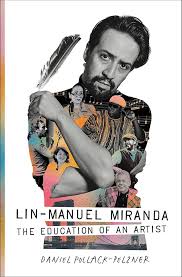
How did Lin-Manuel Miranda, the sweet, sensitive son of Puerto Rican parents from an immigrant neighborhood in Manhattan, rise to become the preeminent musical storyteller of the 21st century? Lin-Manuel Miranda: The Education of an Artist is his incredible story as never told before, tracing Miranda’s path from an often isolated child to the winner of multiple Tonys and Grammys for his Broadway hits Hamilton and In the Heights; a global chart-topping sensation for his songs in Disney’s Moana and Encanto; and the recipient of a Pulitzer Prize and a MacArthur Genius Grant.
Miranda’s journey is a testament to the power of creativity, collaboration, and cultural synthesis. He was not a musical prodigy, but an insatiable drive to create art and learn from those around him propelled him to fuse his Latino heritage with pop, hip-hop, and the musical styles of Broadway. His was a new way of telling American stories, and of speaking to new audiences.
Drawing on interviews with Miranda’s family, friends, and mentors—and many conversations with Miranda himself—Daniel Pollack-Pelzner delves into the formative experiences that shaped Miranda as an artist, from his early musicals in high school and college to the creation of his Broadway and Hollywood triumphs. With full access to Miranda’s inner circle, this behind-the-scenes origin story is sure to captivate his legions of fans and beyond.
Maybe it’s too soon to write a biography about LMM, but considering the breadth of his work and success in recent history, there’s a lot to probe right now, so why not get started? Especially as Pelzer gets intimate access from LMM’s partners, family and long-ago classmates, painting a picture of how his life shaped and molded his artistry.
Having to got to listen to Pelzner’s panel, I learned that he went deep, contacting classmates from lower school to college to gain insight to LMM. It’s not stalking if he got permission, right? The seeds were sown early from his abuelo encouraging LMM’s filmmaking aspirations to setbacks in leadership when he learns not to let his vision for the piece cost his friendships. Or using his break up to inspire an ill-fated college thesis that made everyone feel awkward.
It’s no secret that LMM has his heart on sleeve, but readers get to learn how his parents differing styles aided his creativity. His ability to feel his music, infuses it with passion and universality that has made him such a success.
Plus the famous anecdote of LMM reading Chenrow’s biography wasn’t the first time he learned of the famous duel. He did a re-enactment of the duel for a seventh grade project and got a low grade because the teacher thought the motivations of the two founding fathers was too simplistic. He got the very same note two decades later when he was setting it up onstage for Hamilton. Talk about deja vu, but that criticism led to The World was Wide Enough.
A major theme of this novel is criticism and growth. Each setback he had in high school from imposter syndrome to burnout led to LMM sponging the advice and aiming higher. He takes feedback and he tweaks until he gets it almost right. Nothing is ever truly perfect for an artist, but close enough. LMM’s willingness to learn and grow sets his art and him apart, absorbing and melding his medley of influences into cultural touchstones for the next generation.
Pelzner’s warm, passionate prose made it a compelling read, and I hope a few years from now we may get a sequel for whatever LMM does in the next decade.
A Different Kind of Power by Jacinda Ardern
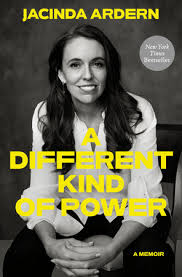
What if we could redefine leadership? What if kindness came first? Jacinda Ardern grew up the daughter of a police officer in small-town New Zealand, but as the 40th Prime Minister of her country, she commanded global respect for her empathetic leadership that put people first. This is the remarkable story of how a Mormon girl plagued by self-doubt made political history and changed our assumptions of what a global leader can be.
When Jacinda Ardern became Prime Minister at age thirty-seven, the world took notice. But it was her compassionate yet powerful response to the 2019 Christchurch mosque attacks, resulting in swift and sweeping gun control laws, that demonstrated her remarkable leadership. She guided her country through unprecedented challenges—a volcanic eruption, a major biosecurity breach, and a global pandemic—while advancing visionary new policies to address climate change, reduce child poverty, and secure historic international trade deals. She did all this while juggling first-time motherhood in the public eye.
Ardern exemplifies a new kind of leadership—proving that leaders can be caring, empathetic, and effective. She has become a global icon, and now she is ready to share her story, from the struggles to the surprises, including for the first time the full details of her decision to step down during her sixth year as Prime Minister.
Through her personal experiences and reflections, Jacinda is a model for anyone who has ever doubted themselves, or has aspired to lead with compassion, conviction, and courage. A Different Kind of Power is more than a political memoir; it’s an insight into how it feels to lead, ultimately asking: What if you, too, are capable of more than you ever imagined?
First I must state that I gained an interest in New Zealand for being the setting for Xena: Warrior Princess and Lord of the Rings. The fact that it also has only one fatal spider (apparently they sent the rest to Australia) is impressive, and they have so many cool desserts is awesome. Plus they were the first to give women the right to vote, free menstrual products, and environmental/gun reform. It sounds too good to be true.
So yeah, I decided to read about one of its youngest female PMs, and of course, learned, it’s not all sunshine and rainbows. She’s honest about the name-calling in Parliament, the daily grind during several crises during her term that led to her burnout, and the scrutiny of being in the public eye.
Hers is a typical memoir starting with several eye-opening anecdotes that set the stage for her morals and her desire to do more as she got into politics. As she has often noted, she didn’t think her type-more emotional, more caring, more follower -could be a leader. You had to have thick skin and air of ruthlessness to succeed. Some might argue you do, but she explains some of her thought processes behind her decision and the backbone it took not to divert for her convictions when everything seemed to be going to hell. There are heartwarming moments of building a family with the specter of optics always looming. Even though we know of some of the events she had to deal with-COVID, Christchurch, vax-deniers -the inside look makes the events new and I kept turning the page to find out what she would do next.
Although she decided to bow out of politics, I felt she was as honest as she could be in a memoir, admitting her mistakes, offering potential answers to the backlash afterwards and giving me a crash course on New Zealand political parties. She’s an admirable women, I think, doing the best in trying times, and showcasing an alternative way to lead.

In Hope in Action, Sanna Marin takes readers on the extraordinary journey of her trailblazing career and exemplifies a new kind of leadership. When she became prime minister of Finland at just thirty-four years old, Marin was the youngest world leader at the time, captivating international attention with her progressive ideas and decisive action in a crisis.
Marin’s story is one of resilience and hope. The first in her family to attend university, she broke barriers to become a highly respected role model for many young girls and women. Her term as prime minister saw historic milestones—she led Finland through the COVID-19 pandemic, and her government implemented reforms addressing climate change, social justice, and equality. She helped the country navigate neighboring Russia’s devastating full-scale invasion of Ukraine and Finland’s rapid joining of NATO—the swiftest entry for any country in the alliance’s history.
Through vivid retellings of her experiences, Marin shares how she overcame significant political challenges and how she coped with her personal life becoming public, as in an incident that sparked a media frenzy and prompted women around the world to express their support.
Hope in Action is more than a memoir—it’s a rallying cry. Marin urges the next generation of leaders to bring their full selves to the job. Her story is an empowering testament to the opportunities we have to effect real change.
Which brings me to another young female PM leading the world in trying times. This may be entitled Hope in Action, but I found it misleading. There’s not much hope in this. It’s more Work in Action. Marin writes that emotional intelligence and socialization are not her strengths. She prefers to let her policy speak for itself, and her foray into Parliamentary politics which involved making friends and alliances, it took finessing. She may have found her way in that sphere, but her writing has the same blunt, decisive tone as a debater.
She writes what she views are the causes and potential solutions to current issues plaguing the EU, and how it will affect the war in Ukraine, climate change, and so on with the certainty that she’s right and has the facts to back it up. I can see why her party rallied around her because she sounds like she knows what she’s doing and saying.
It’s not a typical memoir as she keeps her private life private. It’s the Finnish way she explains, modesty is important in their culture and what little anecdotes she offers are generalized. Rather we get full-in discussions on political parties, the evolution of the Democratic Socialists in Finland, and how her generation helped enact hat change, Finland’s partnership with Sweden to get into the EU, their relations with Russia and Ukraine, and the policies she helped champion.
I certainly learned a lot while reading this book like the Finnish emphasis on community value and progress so unlike American individualism, but the inspiration the summary is praising it for inspirational messaging is overblown. She makes it clear that this is how she moved through political sphere, and there are lessons you can glean from it, it is ultimately dependent on the individual. The chapter referring to the controversies of her term was probably the most personal, letting in a bit of humor, as well as a peek into the work-hard facade she has most of the book.
Finding My Way by Malala Yousafzai
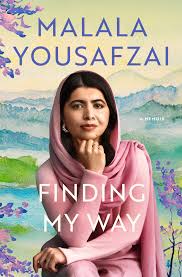
Thrust onto the public stage at fifteen years old after the Taliban’s brutal attack on her life, Malala Yousafzai quickly became an international icon known for bravery and resilience. But away from the cameras and crowds, she spent years struggling to find her place in an unfamiliar world. Now, for the first time ever, Malala takes us beyond the headlines in Finding My Way—a vulnerable, surprising memoir that buzzes with authenticity, sharp humor, and tenderness.
Finding My Way is a story of friendship and first love, of anxiety and self-discovery, of trying to stay true to yourself when everyone wants to tell you who you are. In it, Malala traces her path from high school loner to reckless college student to a young woman at peace with her past. Through candid, often messy moments like nearly failing exams, getting ghosted, and meeting the love of her life, Malala reminds us that real role models aren’t perfect—they’re human.
In this astonishing memoir, Malala reintroduces herself to the world, sharing how she navigated life as someone whose darkest moments threatened to define her narrative—while seeking the freedom to find out who she truly is. Finding My Way is an intimate look at the life of a young woman taking charge of her destiny—and a deeply personal testament to the strength it takes to be unapologetically yourself.
This book lives up to the hype, being relatable, vulnerable and honest about her life post-spotlight trauma of being shot in the head and held up as leader for female education.
Being a role model has a lot of expectations placed upon her. Not only in public scrutiny, but the religious threats still on her by the Taliban and cultural-specific gossip from extended family back home. While Malala felt honored by her role, she also felt stifled and fearful, unsure of being able to it. She was only 15 years old, she can’t be fully formed yet. Her time at Oxford allows her space to make mistakes, some of it is wanting to be like the other students, others were her way of trying to repress the trauma only for it to pop up when she has weed for the first time.
Malala bears it all from her interactions with others in the Desi community, to first crush to tangling her views on marriage as institution and her love for her current husband with the cultural expectations placed on them that she doesn’t want to fulfill. She touches on the subject of mental health, a huge stigma for her community and for her personally, bravely sharing her slow shift to acceptance. I do have questions of how she reconciles drinking and drugs with her religion as I thought it was forbidden, but I suppose that was too personal for her to get into.
She also discusses her anguish at the US withdrawal out of Afghanistan and the panicked response trying to help her partners in female education get out of there before the Taliban arrives, and the feelings of hopeless as the world seems to be going backwards.
Malala as an adult is as clear-eyed and true to her goals as she was as a teen. Perhaps wiser, and more cynical, but she has the strength of knowing herself better now.
We Will Be Jaguars by Nemonte Nenquimo
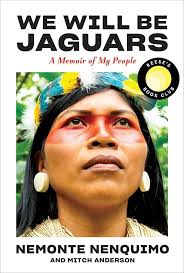
Born into the Waorani tribe of Ecuador’s Amazon rainforest—one of the last to be contacted by missionaries in the 1950s—Nemonte Nenquimo had a singular upbringing.
She was taught about plant medicines, foraging, oral storytelling, and shamanism by her elders. At age fourteen, she left the forest for the first time to study with an evangelical missionary group in the city. Eventually, her ancestors began appearing in her dreams, pleading with her to return and embrace her own culture. She listened.
Two decades later, Nemonte has emerged as one of the most forceful voices in climate change activism. She has spearheaded the alliance of indigenous nations across the Upper Amazon and led her people to a landmark victory against Big Oil, protecting over a half million acres of primary rainforest. Her message is as sharp as a spear—honed by her experiences battling loggers, miners, oil companies and missionaries.
In We Will Be Jaguars, she partners with her husband, Mitch Anderson, founder of Amazon Frontlines, digging into generations of oral history, uprooting centuries of conquest, hacking away at racist notions of indigenous peoples, and ultimately revealing a life story as rich, harsh, and vital as the Amazon rainforest herself.
This memoir reveals the ancestral life and heartbreaking changes to the Waorani tribe of the Ecuadorian Amazon. Once the uncontacted, the missionaries divided and weakened the community with greed. Nenquimo shares how her interest in the missionaries turned into shame of herself and desire to be like them, losing her way as she did so. The timeline is a bit blurry as they don’t use traditional calendars, Nenquimo is able to relate the sexual abuse, hypocrisy and confusion that surrounded her time at the missionaries and led to her break with the church that seeks to oppress her people and exploit her land. This lyrical style is engaging once when gets used to it, echoing the focus-in-the-present moment her people have. It may feel long at first, but I believe the background to her tribe, her family, and their ways allows readers to understand a little bit of their connection to their land and each other, and how the arrival of missionaries tore that thread of connection.
Personally, it picked up for me at part 2 when Nenquimo starts to piece together the arrival of the missionaries, the oil companies and how they all relate to the destruction of their way of life. Her work with activists bring a new sense of purpose, coinciding with her marriage and new child that help Nenquimo to heal from her traumas and understand what her grandfather meant long ago that she was to be a mother jaguar to her people, combining her knowledge of home and tribe to her new connections with the outsider activist circles in order to bridge the divide and allow their tribe be the ones propelling change.
 Rachel Reads & Reviews
Leave a comment