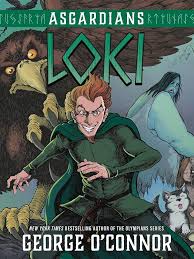
As night falls on Asgard there is one who does not dream. Loki, a trickster of epic proportions, has much to think on. He hearkens back to his challenge to the wolf Fenrir to break the strongest Dwarf-made chains. He remembers Thjazi, the jotunn in monstrous eagle form, and his pursuit of the apples of youth. And he worries he has fallen out of favor with his blood brother, Odin. Can he use his cunning and wiles to worm his way back in? Or, feeling spurned, will Loki choose to burn it all down?
Ah, Loki always steals the show as O’Connor notes in his Author’s Note. As the trickster archetype, it’s hard not to be entertained by his pranks, and when he receives his comeuppance for said jokes.
One can’t deny he always causes trouble, but the Asgardians tolerate them because they need him, and it’s that convenience that breeds resentment. As a jotun, Loki is always on the outside, and being used whenever the gods want starts to grind under his skin.
O’Connor does a great job in highlighting Loki’s isolation and the way the Asgardians create their own villain with how they use, and then disparage him. However, it doesn’t completely praise him as poor, misunderstood trickster god. He crosses a line that is hard to defend as he utilizes two innocent people rather than face the real gods he’s angry with because at heart, Loki is a coward.
Also, it is not stated within the text, but in the Author’s Note, I liked O’Connor’s insight into how both Odin and Loki are trickster gods, but because Odin is the head god, he is always within the status quo. His tricks save the day, and benefit him. Loki is the opposite in that his tricks cause the problem, and save the day (but probably causes another problem down the line) and often humiliate him in some way. He’s the bad side to tricks, and he has no where to go but further down the road of darkness. A self-fulfilling prophecy if you will.
Which brings me to the surprise secondary protagonist of the book, Frigg. She whose prognostication is greater than her husband’s, yet she tells no prophecies. Frigg knows all, but she is wise enough not to interfere because it is all pre-destined. It creates a compelling yet tragic arc, and I’m amazed how O’Connor adds depth to one of the hidden female figures of the Norse pantheon. Odin always overshadows her even though she’s more powerful, and it’s cool to see her get recognized.
I knew a few of the myths like Loki stealing Idunn’s golden apples, but the one involving Skadi’s marriage to Njord was hilarious. Initially, they seem disconnected, but they do build a sense of ominousness leading to Loki’s point of no return, and more importantly the end we were building toward-Ragnorak!
Honesty, that might be the one flaw to this book, and that it feels like too light, trying to fit in these last few myths before it comes to the big finale which is what O’Connor really wants to get to.
But now that he’s set the seeds I’m eager to see how it ends, and hope Ragnorak will be released soon instead of the three year wait between Olympians 11 and 12.
3 stars
 Rachel Reads & Reviews
Leave a comment