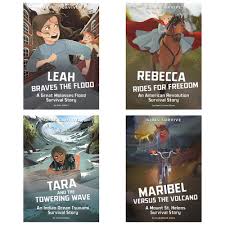
This batch of Girls Survive books focus on historical events I already know, and have been covered by Lauren Tarish’s I Survived series.
As I mentioned before, it is why I initially thought it was a rip-off riding on the coattails of the former’s popularity. It’s not entirely, but Leah Braves the Flood by Julia Gilbert bears several similarities to I Braved the Great Molasses Flood by Tarish. Both feature Italian immigrants reeling from the loss of their mother, and desire for home while remaining with their living relative who wishes to stick it out. Both want to pursue schooling and life beyond what’s expected of her. Both end up trapped in the flood and struggle in a small space to get out without suffocating themselves or their friend.
Still an enjoyable book, and the endings differ, but if you read them concurrently, the parallels are distracting.
Gilbert’s other book covering the Schoolchildren’s Blizzard, Maddy and the Monstrous Storm, was better in delivering a rootable story about the city girl transplant learning that she does have the hardiness and courage to survive the prairie.
Another interesting story in the bunch was Nikki Shannon Smith’s Charlotte Spies for Justice, introducing kids to the historical figures of Elizabeth Van Lew, Mary Bowser, and the Union spy ring conducted under the Confederates’ noses. It’s a cool bit of history that I think more people should know about, and I liked how Smith also introduces a gap in privilege and experiences between Charlotte and Elizabeth where Elizabeth is very careful of Charlotte getting involved because she’s a child, but as a former slave, Charlotte has already seen and experienced cruelty and this is a way for her to feel useful to help her people.
Smith’s other book, Noelle at Sea, tackles the Titanic which everyone knows. But did people know that there were two blacks on board? Taking a fictionalized account, Smith details how prejudice can have its grip even in the midst of disaster. Same with Veeda Bybee’s Lily and the Great Quake. Taking another famous event and flipping into to a WOC’s POV. Chinatown was not nearly as decimated by the San Francisco earthquake, but it was burned down when the majority white people decided that their section of the city was acceptable collateral to fight off the fire, leaving thousands of Chinese destitute.
But that does not always have to be the way. Salima Alikhan’s Emmi in the City, and Carrie and the Great Storm by Jessica Gunderson both feature the breakdown of prejudices with protagonists realizing these constructs are nonsense when it comes to surviving natural disasters, leading to the community to come together as equals- all human and all Chicagoians/ Galvastonians.
Speaking up, and helping those who need it is a major point of both of Natasha Deen’s novels, Marie and the Deadly Plague, and Millie and the Great Drought. They introduce the idea of interdependence, knowing when to ask for help and knowing when to give it. It’s something that is really needed these days. I will say Marie and the Deadly Plague was a bit slow for my taste as it featured Marie’s family and friends dying off one by one, and she doesn’t take much action until the last three chapters.
The other two books I read in this batch, Maribel Versus the Volcano by Sarah Hannah Gomez, and Rebecca Rides for Revolution by Emma Carlson Berne, were fine. The latter being a plucky patriot girl using her “I’m a girl” status to sneak through enemy lines has been done by authors as Avi, and Deborah Kent. Nothing I haven’t read before. Maribel’s story was a little more interesting because it featured an ADHD protagonist which I haven’t seen done much.
Now 11 more to go!
 Rachel Reads & Reviews
Leave a comment