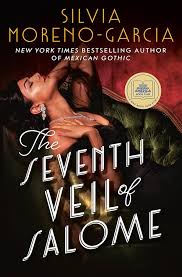
1950s Hollywood: Every actress wants to play Salome, the star-making role in a big-budget movie about the legendary woman whose story has inspired artists since ancient times.
So when the film’s mercurial director casts Vera Larios, an unknown Mexican ingenue, in the lead role, she quickly becomes the talk of the town. Vera also becomes an object of envy for Nancy Hartley, a bit player whose career has stalled and who will do anything to win the fame she believes she richly deserves.
Two actresses, both determined to make it to the top in Golden Age Hollywood—a city overflowing with gossip, scandal, and intrigue—make for a sizzling combination.
But this is the tale of three women, for it is also the story of the princess Salome herself, consumed with desire for the fiery prophet who foretells the doom of her stepfather, Herod: a woman torn between the decree of duty and the yearning of her heart.
Before the curtain comes down, there will be tears and tragedy aplenty in this sexy Technicolor saga.
While this has gotten a lot of stars and attention from celebrity book clubs, I was disappointed.
Perhaps it is because I’ve already read books similar to this exploring the golden age of Hollywood (a la Evelyn Hugo, or Kitty Carr), but this was another entry in this niche subgenre, and the story wasn’t as compelling.
It doesn’t help that while it is juggled between three POVs, Vera, Nancy and Salome, it is intercut with talking-head interviews of people. From the beginning, you know the ending is going to be a tragedy and so the talking-heads are supposed to heightened the suspense with its foreshadowing, but it stopped the narrative in its track.
Vera’s story was interesting as Moreno-Garcia explores the very timely issues that a Mexican actress would have dealt with in a racist/sexist industry. Belittling parts, constant come-ons, and demeaning insults from everyone. She is seen as uncivilized, uneducated and sexy, and when she turns down a man who tried to rape her, she is accused of being a savage spitfire, difficult, you get the idea. It’s timely too as those issues are prevalent today in different forms.
However, Vera herself was less interesting to me. She didn’t want to be an actress. Her more beautiful sister was supposed to be the family breadwinner and she only took the role thanks to the urging of her stage mother. It’s clear she didn’t want to be in the industry, so I didn’t understand why she put up with it for so long. Even for the money or for her romance with the trumpet player, her heart wasn’t into the acting and she was going to get fired with all the scandals surrounding her, so. . . she felt more like a passive character that just reacts to everything. Exactly what a female role was back then, I guess.
Nancy is the bad girl in the situation, and Moreno-Garcia delivers in a spiteful, mean-spirited, racist, bitter POV that was unpleasant to read. There were shades of vulnerability as readers see how unwanted Nancy is treated by her father, but it didn’t make-up for her behavior or the climax she orchestrated.
Finally, Salome’s POV is the only one set in Biblical times, unrelated to the movie. Rather it’s supposed to show how the “real” story went, and it’s not like what one reads in the Bible. Since I’m not interested in the Bible, it was a slog. Didn’t help that it felt like every Greek mythology reclamation book that has been published. You know, what I mean. Where the villain of the piece is shown to actually be empowered but trapped by patriarchal society. In this case, Salome was in love with John the Baptist but the hypocrisy of her family, and society in general led to the events of his beheading. I don’t know if it was a real dive into the Bible, and flipping the perspective to a new lens or totally fictional, but I wasn’t engaged.
I will say that the ending when the climax of the book’s tragedy is interspersed with Salome’s dance/beheading request was cinamatic. I could see it in my head just like a movie.
Otherwise, uninteresting characters and an unoriginal plot leads me to rank this to 2 stars. I only upgrade it to three because of the prose.
3 stars
 Rachel Reads & Reviews
Leave a comment