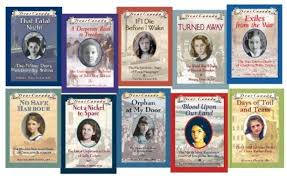
Much like it’s US counterpart, Dear Canada features the fictional diaries of pre-teens, and some teens during important moments in Canadian history. Since we have no education about events happening north of our borders, this was an educational primer for me. It was super interesting what events were the same, and what were unique to Canada.
For example, a majority of the books cover the 19th century just like the US counterpart, and focuses primarily about white girls with some notable exceptions. There were at least three books from the POV of an indigenous girl, one more than Dear America. These focused on uniquely Canadian indigenous experiences. For example, The Death of My Country by Maxine Trotter was about the battle on the Plains of Abraham, a pivotal victory for the British that led to the end of the French rule in Quebec. Of course, we know it is still primarily French in culture and language, but at the time it was the end of their world as they knew it.
This one nicely dovetails to another diary about another minority group in Canada, the Arcadians. In Banished from Our Home by Sharon Stewart, she details the harrowing, tragic expulsion of Arcadians from the native land by the British, many never to return or to get proper acknowledgement.
But back to the natives, The Northwest Resistance Diary of Josephine aka Blood Upon Our Land (I love how intense these titles are!), also by Maxine Trotter is about the resistance of Metis and natives against the Canadians/British attempts to steal their land. As one might guess, many of these end with tragedy with heavy emphasis on the natives’ attempts to maintain culture and peace against overwhelming odds. Trotter’s other book, her only non-native entry is Alone in an Untamed Land: The Filles du Roi Diary of Helene St. Onge. Filles du Roi is French for mail-ordered bride more or less, and even though you know this going in, it’s still so. . . so gross. I mean, I can accept that she has to marry an old man but Helene chooses her best friend’s father. Her best friend’s father, can’t she choose any other thirty year old man?
I digress.
Unfortunately, the third indigenous book, These Are My Words by Ruby Slipperjack has the potential to be interesting, but feels blunted. Dear America has a residential school diary too, but this one is set in the 1960s as apparently Canada didn’t close their schools until the 80s. The 80s! The Historical Note explains the impact of generational trauma and abuse kids endured at these schools, but the diary doesn’t bring that emotional response the way it did in the Dear America books (even though they were filled with inaccuracies I also had a clear idea that white people were heinous to Native Americans). I think it is because the protagonist, Violet, keeps her head down a lot of the time and doesn’t get in trouble. Therefore, we don’t feel consequences of the unwarranted or disproportionate psychological/physical/emotional abuse. Only whispers of it. Nor do we see how maladjusted Violet feels when she returns to the reservation because she doesn’t fit in with the community anymore. Lost potential there.
Anyway, there are several historical events that overlap with Dear America so it was interesting to see the Canadian side of it like With Nothing But Our Courage by Katherine Bradford shows what happens to the Loyalists when they flee after the Revolutionary War. Same with Whispers of War by Kit Pearson which covers the War of 1812.
Canada also had their own Gold Rush, a decade after ours in 1862 (insert HIMYM joke that Canada is always a decade behind the US) in A Trail of Broken Dreams by Barbara Haworth-Attard. Only theirs was arguably more rugged as several diaries attest to the extreme weather, and the struggle of early pioneers in Winter of Our Peril by Jan Andrews, and Where the Rivers Takes Me by Julie Lawson.
Lawson has another entry in the Dear Canada series covering the transcontinental railroad, A Ribbon of Shining Steel which was interesting but a little less exciting than the US counterpart by Lasky. This was mainly due to the fact that Kate, the protagonist, doesn’t travel alongside the budding railroad, seeing each track as it is put down. The novel takes place only in Yale, BC since it took over a year for the railroad to dynamite the mountains and lay track.
However, her best book in the series is No Safe Harbor. Set in the 1917, this Canadian tragedy is known as the Halifax Explosion. Two ships (one full of ammunition for WW1) collide and the resulting explosion flattened Halifax harbor. It was the deadliest bomb in history, until WW2. She does an excellent job depicting the horror of whole families killed in a blink, and the displacement, disfigurement, and grief of the survivors. It’s even worse when you realize some soldiers far away in Europe, survive battle only to find out that their family who was safe at home, died. Just tragic.
Haworth-Attard also has another book in the series that I prefer. That would be To Stand on My Own: The Polio Epidemic Diary of Noreen Robertson that details the paranoia of the polio epidemic as well as the relief felt by those looking for a cure when the vaccine was invented. It was a good book touching on disability, and ableism as well as a reminder about the importance of vaccines that the descendants of the today have apparently forgotten. Maybe if we didn’t have vaccines, we would appreciate it more. Just like A Sea of Sorrows by Norah McClintock which tackles typhus and anti-Irish sentiment in the 1800s much more poignantly than Barry Denenberg’s entry in Dear America.
Other overlapping historical events include those from WOC. A Desperate Road to Freedom by Karleen Bradford is the only diary from an African-American girl. Really, it’s the only one with African-Americans period. Canada is very white according to these diaries and though there was no segregation (that I know of), it seems unofficially segregated because they do not interact with each other. I just find it interesting since Dear America has several stories from African-American voices compared to Canada’s sole one. Nonetheless, this one features the harrowing journey of escaping slavery and becoming free in the North.
Bardford’s other book, A Country of Our Own: The Confederation Diary of Rosie Dunn is from the POV of an Irish-Canadian girl serving an upper-class family in government as they set to unite the Canadian provinces into one country. So basically the United Provinces of Canada aka Dominion Day. Which, fun fact is July 1st, three days before our July 4th.
The series did better in amplifying Asian voices though in their diaries about the Asian Exclusion Act, and the Japanese Internment. While Dear America features these events from the lens of their white protagonists, Dear Canada puts Asian voices at the center in An Ocean Apart by Gillian Chan, and Torn Apart by Susan Aihoshi.
Speaking of internment, did you know in 1914 as WW1 raged, Canada imprisoned Ukrainian immigrants in internment camps because of xenaphobia. Prisoners in the Promised Land by Marsha Forchuk Skypuch tells you all about it. I admit, I felt a little better as an American to know we didn’t do that. Anyway, much like the Japanese internment, this period of history was full of shame for those interned and is only now being recognized.
Other events US people might be familiar with, but will get to know the slightly different circumstances are immigration and child labor. Sarah Ellis deals with both of these subject, in A Prairie as Wide as the Sea, and Days of Toil and Tears. Sadly, in my opinion, I think Dear America did those subjects better. The topics of prejudice, and child labor are sanitized I think, and the novels drag on with mundane family stuff. I mean, it makes sense as they are diaries and not every day is filled with adventure, but I didn’t feel connected with the characters or feel that they had obstacles to contend with. Especially the immigrants were British. It’s funny Canada was founded by the British and yet they made fun of British immigrants.
Ironically, her shortest book, That Fatal Night, about the Titanic was the best as it may not detail the horror of the sinking ship, but it accurately depicts the denial, numbness and survivor’s guilt Dorothy feels after that night.
Not a Nickle to Spare by Perry Nodelman, as one might guess, covers the Great Depression in Canada. It’s funny, sometimes, because it’s hard to believe that $1 was a lot of money, but that’s just how cheap everything was back then. Or I suppose depressed if 5 cents was the difference between dinner and starving. It was unique too as it focuses on the Jewish section of Canada which was segregated from the gentiles.
Being the 30s, antisemitism was rampant and had a big focus of the book as well. The one detraction is that the voice of the narrator, Sally, was distracting. She sounded like a middle-aged mom, not an 11 year old. The author’s note explained he got a lot of inspiration from his mother’s stories of growing up in the Great Depression so that explains why Sally sounds like a middle-aged yenta. Still disconcerting to read.
Some uniquely Canadian events the series covers include Flame and Ashes: The Great Fire Diary of Triffie Winsor by Janet McNaughton and A Rebel’s Daughter: The 1837 Rebellion Diary of Arabella Stevenson by Janet Lunn. Perhaps it’s morbid, but I enjoyed learning about the great fire. Even though it was horrific (so horrific that Chicago, in sympathy sent a lot of aid), the themes of learning to stand together and build a new life was heartwarming. The 1837 Rebellion has a similar plot with rich girl experiencing a downgrade in lifestyle thanks to her father’s actions instead of natural disaster, but her story of learning to make something of herself was still uplifting.
Finally, I present the best authors in the series. The Kathryn Lasky, and Kristina Gregory of the Dear Canada series I suppose. Jean Little, and Carol Matas.
Jean Little would be my number one. Makes sense as she has forty years of experience. Her books are usually the thickest, focusing on large families, and the fun/secrets/squabbles they deal with. She focuses on a variety of topics, ones that require nuance of thought when it comes to war, and standing up against prejudice and stereotypes.
Her novels include All Fall Down: The Landslide Diary of Abby Roberts (focusing on the natural disaster of a landslide wiping away 2/3rds of a village in 30 seconds as well as dealing with the memory of a bad father, and prejudice against those with Aspergers and Native Americans); Brothers Far from Home: The World War I Diary of Eliza Bates and If I Die Before I Wake: The Flu Epidemic Diary of Fiona Macgregor (both tackle grief, war, shellshock, pacificism and prejudice): Exiles from the War: The War Guests Diary of Charlotte Mary Twiss (similar themes but more focus on displacement, and fear for loved ones abroad); Orphan at My Door: The Home Child Diary of Victoria Cope focuses on Bernardo Children aka English orphans sent to Canada for homes/work. Anne Shirley is one of the most famous, fictional instance of this program. Plus prejudice against lower-class, learning to get stand up for others, and child abuse.
They’re all so good, I don’t even have a favorite. They are consistently well-written with layers of character development and growth.
My other favorite writer in the series is Carol Matas. She’s a less prolific than Little, but her entries feel relatable to her teen protagonists. She gets how they might think, even in situations as varied as pioneering to WW2. She understands how they are questioning, grappling with injustice in the world, and their own flaws, and exploring new surroundings. Her books also have a more philosophical bent to when it comes to the hard questions about morality.
Footsteps in the Snow: The Red River Diary of Isobel Scott is unique because Matas shows how prejudiced Isobel is in the beginning. She thinks all natives are savages or child-like, she wants to uphold British ideas of being a lady. Most books in the series try to establish that their protagonists’ families are good by respecting natives and warning their children not to follow their prejudiced norms of society. Which is good, but I thought was unrealistic that the protagonist was always the exception. This book shows Isobel’s growth in realizing her prejudices were wrong and apologizing for them, and becoming more open-minded about others.
Turned Away: The World War II Diary of Devorah Bernstein and Pieces of the Past: The Holocaust Diary of Rose Rabinowitz both focus on WW2. Devorah’s a more typical home-front narrative, elevated by her questions on morality, God and Devorah’s subsequent guilt/grief in feeling happiness when she knows her family is suffering under Nazism in France. Rose’s story is set 1948, but has several flashbacks to her escape from the Warsaw Ghetto as she struggles with survivor’s guilt over being the only one in her family to survive, feeling like she will never find a family or home anywhere again. So many in her story except her to get over it by then and Matas depicts how psychologically complex it is to be a genocide survivor.
So there we go, a full read through of the Dear Canada series. It’s too bad that the US doesn’t have these in their libraries because they do what any good book does-expands the mind and expands empathy. Just because we don’t live in Canada doesn’t mean we shouldn’t get the chance to know about our neighbors. So if you say any Dear Canada book lots on ebay, do yourselves a favor and buy a few.
 Rachel Reads & Reviews
Leave a comment