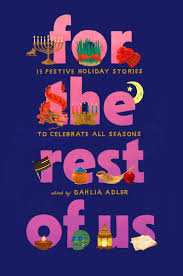
From Lunar New Year to Solstice, Día de Los Muertos to Juneteenth, and all the incredible days in between, it’s clear that Americans don’t just have one holiday. Edited by the esteemed Dahlia Adler and authored by creators who have lived these festive experiences firsthand, this joyful collection of stories shows that there isn’t one way to experience a holiday.
Is there anything better than getting to join your friends or loved ones in a holiday celebration? These authors bring you into their homes for their beloved traditions, sharing the warmth, trials and peace these celebrations bring.
Ah, but I did mention trials. Whenever family comes together, sometimes spats and hurt feelings are an unavoidable conflict. Especially when you’re trying to be yourself. Kelly Loy Gilbert deals with the generational divide and homophobia in “This is How It’s Always Been.” Olivia wants to bring her new girlfriend to Lunar New Year because she wants to share it with Laurel, and because part of her wants to know whether or not her family will accept her. But it becomes more than that as she realizes their non-acceptance isn’t going to taint her happiness or her self-esteem.
“A New Day” by Abdi Nazemian covers similar beats to Olivia’s story as his protagonist hides his boyfriend from his disapproving Maman to keep family peace on Nowruz (Persian New Year). An aim even more complicated by the dawn of COVID restrictions. While it has the same premise, the voice was funnier. I enjoyed both.
Another one I enjoyed was Aditi Khorana’s “The Return” where Lakshmi is obligated to educate her elitist classmates about Diwali, and finds the courage to call them out on their privilege and ignorance.
A really moving story I enjoyed was “Honor the Dead to Honor the Living” by Sonora Reyes. A girl with schizoaffective disorder tries to get her family to celebrate Dia de Los Muertos instead of burying the memories of family members who’ve died too soon. This was poignant one in discussing grief and her own fears about being forgotten as a shameful secret.
Another story I enjoyed was “Habari Gani” by Kosoko Jackson. It also deals with grief through eight emotive letters from son to his dead mother, sharing his feelings about Kwanzaa and how the memory of her life upheld the eight tenants.
“Merry Chrismukkah, Loser” by Katherine Locke was a lovely way to end the collection in classic rom-com standard as Noa and Jordan grapple with their unresolved feelings through numerous funny debates.
Those were my favorite stories, but there were other entries that readers will enjoy as the anathology covers a wide spectrum over the twelve months. For example, Valentine’s Day. Technically not an underrated holiday, but Laura Pohl puts a unique twist to it in “P.S. I (Don’t) Love You.”
Elis, a Brazilian exchange student, engages in a rom-com mishap of sorts when he sets out to get his best friend together with his crush so he’d can alleviate his jealousy over how focused his friend is over a crush and not their dwindling time together, and what it means for their friendship.
“Holi Hail!” by Preeti Chhibbier also deals with romance. Vritika has a multi dimension imagination trip that helps her to find the joy of Holi and letting go of grudges when her ex dumps her and moves on way too quickly.
“Eid Without a Plan” by Karuna Riazi, and “Hill Country Heartbeat’” by Candace Buford are more introspective.
The former deals with anxiety and procrastination as the protagonist faces as she tries to figure out what she wants during her gap year and planning Eid harvest festival in place of her grandmother. The latter features a girl’s homecoming to Texas and grappling with how things changed and blatant bigotry.
The two Jewish stories, “Elijah’s Coming to Dinner” by Natasha Diaz, and “Making Up is Hard to Do” by Dahlia Adler forgo romance to focus on friendship. Diaz’ story is similar to the Holi entry where a family prank war has Aviva realizing the love of her cousins and that she’s truly wanted in the family. Meanwhile, Adler’s Jewish year long story has two BFFs coming to forgive each other after a year of abandonment and estrangement, reflecting the holiday’s focus on forgiveness.
The only story I didn’t enjoy was ‘‘Tis the Damn Season by A.R. Capetta and Cory McCarthy. It focuses on the winter solstice, and with sprites like Puck, and Birch it’s bound to be more fantastical. But I was just confused.
4 stars. A nice anthology that brings more holidays to the forefront for all to enjoy.
 Rachel Reads & Reviews
Leave a comment