Thanks to the wonder of Hoopla (available to anyone who has a library card so hop on it), I’ve been given the chance to finish the rest of the Girls Survive series so let’s get to it.
This batch of books are historical events I already know of thanks to class/Dear America so I didn’t get any new insights to it, but they would be intense primers for kids just learning about history.
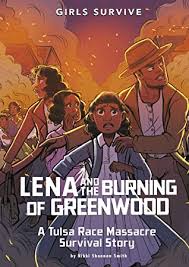
The two most impactful were Lena and the Burning of Greenwood by Nikki Shannon Smith, and Lucy Fights the Flames by Julie Gilbert.
The former may be more familiar to people as the Tulsa Race Massacre. Greenwood was the name of the black part of the town, the Black Wall Street of America at the time and as one can imagine, earned the ire of the whites by existing and successful. Smith did a good job of not only highlighting the sheer horror of the situation (it was literally a massacre, there is no downplaying that with Lena in fear of her family and entire neighborhood being killed by the whites looting their town or the bombs being dropped on them).
But it is not only tragedy, she puts emphasis on how they will rebuild, and the dignity of their community seeing them through. Nothing will make them cower or diminish their accomplishments, that would be letting the bigots win.
Lucy Fights the Flame gets a first-person POV of the Triangle Factory Fire. The Dear America book, Hear My Sorrow, on this subject only views the fire from the outside, witnessing helplessly as girls jump or burn to death. Lucy, an young garment worker is actually in the factory when the fires starts and Gilbert makes it a heart-pounding immersive experience, highlighting all the ways the unsafe factory conditions led to their deaths.
The other two books by Nikki Shannon Smith trails similar themes in her other books, Sarah’s Journey West, and Ann Fights for Freedom ie. the importance of family, a young girl learning about the bigotry of the real world and finding the courage she never knew she had in the face of danger. Sarah’s Journey West highlights the often forgotten black pioneers heading west for a new life during the Gold Rush which is admirable. But dragged a bit compared to her other stories. Can’t really blame her as it does sound like walking on the prairie trail was tedious in certain stretches. She also wrote a lot in the Author’s Note about how she wanted to emphasize how the Gold Rush and subsequent manifest destiny led to the displacement of Native Americans, but they were only present in one chapter, so if she wanted to emphasize it I wished she had put them in more.
Ann’s Fight for Freedom was a nice story, perfect for American Girl fans who wanted more action from Abby in her journey on the Underground Railroad as Ann takes charge of her family when her Dad gets captured mid-escape. I also enjoyed how Ann was distinct from her other protagonist in the series, being “an old soul” in a young body.
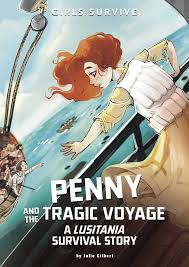
The two other Gilbert books I read focused on sea voyages: Constance and the Dangerous Crossing, and Penny and the Tragic Voyage. The former, Gilbert takes a more thoughtful tone befitting a young girl in the 1600s on the Mayflower. More concerned with religion and practicality of finding life in the New World although Constance gets to be the hero of the story, solving major problems in the historical narrative like when the mast was broken, suggesting a new Mayflower Compact and so on. Honestly, I’m not a fan of when the original character becomes the originator of historical events nor I’m a big fan of the 1600s so this book was meh for me.
Penny’s book was more interesting as it is probably the only lower grade historical novel focusing on the sinking of the Lusitania. It was just as tragic as the Titanic even though it featured less people because it was yet another example of how mitigating factors came to spell ruin. Set as WW1 was heating up, the passenger ship gets hit by German torpedoes and is widely believed to be the reason the US joins the war. False as the US joins two years later, but it did prompt widespread anti-German sentiment so people were more sympathetic to joining the war. I also learned that the British government had the opportunity to send help, but didn’t because they hadn’t wanted the Germans to know they decoded their messages. Horrible but such was the nature of war.
Next are books of more historical events I know, but specifically comparing it to their I Survived counterparts.
 Rachel Reads & Reviews
Leave a comment