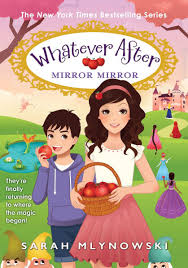
As I may have mentioned, besides being a year of historical fiction, I’ve also decided to dive into some nostalgia. Whatever After came out back in 2012, and I only got through the first seven books before dropping it. So it was interesting to see how the story evolved since I last picked it up.
The plot of the first book is: Once upon a time, my brother and I were normal kids. The next minute? The mirror in our basement slurped us up and magically transported us inside Snow White’s fairy tale.
I know it sounds crazy, but it’s true.
But hey — we’re heroes! We stopped Snow White from eating the poisoned apple. Hooray! Or not. If Snow White doesn’t die, she won’t get to meet her prince. And then she won’t get her happy ending. Oops.
Now it’s up to us to: Avoid getting poisoned
Sneak into a castle
Fix Snow White’s story
And cross our fingers that we make our way back home. . .
The rest of the series predictably follows the siblings as they venture into each fairytale, sometimes accidentally messing it up, sometimes intentionally and the new happily ever afters they prompt.
That’s the gist of what I remembered, but I should have kept going after book 7 because Mlynowski introduces an overarching mission for Abby and Jonah to rescue Maryrose (the fairy that sends them through all these fairytales) from her cursed mirror. Little by little, the cause of Maryrose’s curse, her greater family, and the reason why she sends Abby and Jonah to fairytales is revealed culminating in one big finale.
But I’m getting ahead of myself. The fractured fairytales are good too. For one thing, it introduces the original fairytales to kids that may only know the Disney versions and actively discusses the differences like in the Little Mermaid, and the Snow Queen.
While the first three books were about modernizing the fairytales like having Snow White get to know her prince, while Cinderella and Lana the Little Mermaid actively reject their princes in order to find their own passions, the formula differentiates the longer the series goes on. Mlynowski tackles themes such as what makes a good leader in Two Peas in a Pod pointing out Abby’s black and white thinking that a girlboss princess who seems superficially better than someone who may be quiet, but is competent. Once Upon a Frog touches on people being not who they appear, and touching how grief changes a person. Plus it really pulls off a twist villain. She deals with morally grey actions in Spill the Beans where she realizes that Jack, and her may be the villains of the giant’s story.
Which brings me to Abby’s subtle but consistent character growth. She started the series as a black and white thinker, a bit bossy and a control freak, but she starts trusting others, listening, and accepting that she doesn’t know everything. She becomes less rigid which is a naturally part of growing up in that age-range and readers will be able to relate to her. Jonah doesn’t get as much growth- though he does his action moments -existing mainly as comic relief.
She nicely balances these morals with the fun of classic fairytale characters being surprisingly modern and anachronistic. Also talking animals, so many talking animals that kids will enjoy. Sometimes I felt she bit off too much like in Seeing Red which deals with overarching Maryrose plot and the big bad wolf (who turns out not so bad) learning to stand up for himself, and a message about not underestimating old people, and the hunter that’s after the wolf- it got way too crowded.
But Mlynowski doesn’t limit Jonah and Abby going into fairytales. She touches on what trouble could happen when Hansel and Gretel try to take their place in the real world in Sugar and Spice, and really dives into that predicament in Liar, Liar when Pinocchio gets loose. She also mashes up fairytales in Good as Gold when the shattered mirror mixes up two fairytales, a plot device that fits in-universe and makes for an interesting story. Additionally, she has three super specials where Abby dives into famous novels-Wonderland, Oz, and Neverland.
I finished the last novel half an hour ago, and I feel like it was a sweet full circle moment. Not only do Abby and Jonah get to visit the story that started their adventure, just as a big life change hits them, but a cadre of villains forces them to team up with all the princesses and friends they helped before. I think it suffers from too much exposition with Mlynowski trying to fit everyone in while wrapping up the final threads, but I excuse it as it is the grand finale. There doesn’t need to be one more lesson in the last adventure, just closure and a wink at the reader, promising that turning the last page doesn’t truly mean the end.
 Rachel Reads & Reviews
Leave a comment