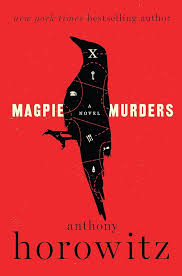
When editor Susan Ryeland is given the manuscript of Alan Conway’s latest novel, she has no reason to think it will be much different from any of his others. After working with the bestselling crime writer for years, she’s intimately familiar with his detective, Atticus Pünd, who solves mysteries disturbing sleepy English villages. An homage to queens of classic British crime such as Agatha Christie and Dorothy Sayers, Alan’s traditional formula has proved hugely successful. So successful that Susan must continue to put up with his troubling behavior if she wants to keep her job.
Conway’s latest tale has Atticus Pünd investigating a murder at Pye Hall, a local manor house. Yes, there are dead bodies and a host of intriguing suspects, but the more Susan reads, the more she’s convinced that there is another story hidden in the pages of the manuscript: one of real-life jealousy, greed, ruthless ambition, and murder.
First off, I’m very impressed by this novel because it’s basically two novels in one. A frame story that actually includes the frame and the outer story. The frame story is the titular Magpie Murders by the fictional Alan Conway featuring Poirot rip-off Atticus Pünd. It is classic Christie set in a quaint English village with its close-knit suspicious inhabitants. It follows the formula so my friend, and I sort of turned off our brains rather than solve the mystery. The whodunnit was well-done and made sense like any good whodunnit.
The more interesting part is how it intersects with the “real world” murder of its author which closely mimics the book’s events. Spooky especially since only two people have read the final draft of the Magpie Murders and he dies before they finished. So who is the mysterious third person who read it? Who wanted Conway to die?
Horowitz did a great job in making Conway so detestable that you can understand why the various people in his life would want to kill him. He’s a crank, super pretentious, and doesn’t even like murder mysteries. He thinks he’s meant to write better things and the Atticus Pünd novels are holding him back. He’s that guy, ugh. Plus he puts mean caricatures of everyone he knows in the books. Due to that last point, it makes the Magpie Murders eerie because you can draw parallels between the characters and their real-life counterparts, blurring the line of whether their motive to kill Alan is in kind or if he was adding a menacing fictionalization.
Susan, our intrepid narrator, and Alan’s editor is on the case because after a decade of reading mysteries, she has to find out the truth about Alan’s death. I enjoyed how she was able to comment on the tropes and suss out who may be the killer and who is the red herring. But as the novel points out, this is real-life so she doesn’t quite get it right away and when she does, she’s put in real danger. No accolades for saving the day here.
This was a fun novel, albeit confusing which was the main consensus between us. You’re engaged, but unless you’re writing everything done, you probably aren’t going to solve it because it’s the little casual remarks that are the big clues. Like we completely missed the real killer because how s/he was eliminated early on and never thought to believe they were lying.
Anyway, it was a good book which you’d expect from one of the head writers of the Midsomer Murders. I can imagine he felt very clever plugging in his show several times, and the BBC network.
 Rachel Reads & Reviews
Leave a comment