Bold, Brilliant, and Latine by Alyssa Reynoso-Morris and illustrated by Sol Cotti
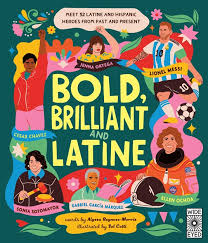
For the lower school set as it gives one page biographies of each Latino with emphasis on how they were a role model, and that kids can be like them too.
It has several well-known figures like Lin Manuel Miranda, Rita Moreno, Gabriel Mistral, Jenna Ortega, Frida Khalo, the Mirabal Sisters, Oscar De La Renta, Carolina Herrera, Marco Molina, Roberto Clemente, Rigoberta Menchúand so on.
But also introduced some new figures I haven’t heard of too. For example, Francisco Morazán, a politician from Honduras. In fact, in the mid 1800s, Nicaragua, Honduras, Costa Rica, El Salvador, Guatemala, Belize and Chiapas of Mexico was united in the Federal Republic of Central America, and he was president. He limited the power of the church, authorized divorces, legalized homosexuality and other reforms before they were rescinded when each became its own states.
Matilda Hidalgo was the first woman in Ecuador to vote. Scratch that, first woman in all of South America to vote, ushering female suffrage in Ecuador, and made many other firsts as first female doctor, first female Council member and so on.
Mario Vargas Llosa, Peruvian Nobel prize winner in literature for his magical realism novels, The Green House and The Time of the Hero.
Óscar Arias Sánchez, humanitarian and president of Costa Rica who kept peace in the region, diversifying its economy and winning the Nobel Peace Prize for ending foreign interference in the Cold War.
Evelyn Cisneros, first Latina prima ballerina in the San Francisco Ballet.
Francia Márquez, an Afro-Columbian activist who became VP of the country.
It covers a lot of people that if you’re a little versed in Latin American role models, you’ll already know, but it’s good for kids who are just learning. The art reflects that with a vibrant palette. But I still don’t get why Cotti made Rita Moreno blonde. She was never blonde in any of her roles.
Leyendas by Mónica Mancillas and illustrated by Isadora Zeferino
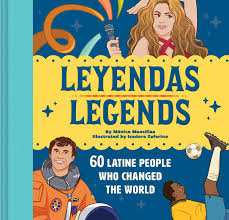
Since it has sixty rather than fifty two people, there is bound to be some overlap, but it did not stick to the usual historical figures. Rather it nicely balanced historical and contemporary, and was more in depth for the middle school crowd. Plus I like Zeferino’s art style more with its full colored lines.
While it has the usual suspects like Luis von Ahn, Celia Cruz, Mario Molina, Eva Peron, it has some fascinating underrated role models too.
Berta Cáceras, an Honduran indigenous activist who fought against the DESNA mining corporation, and was murdered for it. But for once, justice was served as her death led to the dissolution of the illegal dam/mine and the seven executives being convicted of her murder.
Máxima Acuña de Chuepe, another activist for Peruvian farmers against illegal mining whose case set precedent against corporate greed.
Jharrel Jerome, the first Dominican to win an Emmy for When They See Us, right after his star-making debut in the Oscar-winning Moonlight.
Maria Bueno, the Swallow of Sao Paulo who was basically the Serena Williams of the
Jean-Michael Basquiat was a Puerto Rican-Haitian artist who was basically the Andy Warhol of his day. Actually he was praised by Andy Warhol who admired his edgy, anti-establishment artistry.
Wilfredo Lam, a Chinese-Afro Cuban artist that brought African influences into his art, and into the Western world.
Walter Mercado, a Puerto Rican television personality who was the first person to have a show devoted to astrology, running for over 15 years.
Florentine López de Jesús, artisan of the Amzugo weaving style who revitalized and popularized her tribe’s art as part of Mexico’s cultural heritage.
Ruben Vives, the journalist that broke the Bell city corruption scandal and won the Pulitzer Prize for Public Service.
Both books have role models from almost every country in South America. Except poor Nicaragua and Uruguay. Surely, there must be some notable Nicaraguans and Uruguayans. Both books also have at least one Haitian role model which was surprising to me since I didn’t think Haitians were considered Latine since it was conquered by France and have lots of French roots as a result. Sure, it’s next to the Dominican Republic so perhaps there’s some crossover but I didn’t know it was a thing.
Nonetheless, both books will be a nice addition to any classroom.
 Rachel Reads & Reviews
Leave a comment