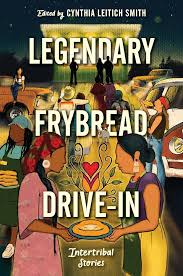
The road to Sandy June’s Legendary Frybread Drive-In slips through every rez and alongside every urban Native hangout. The menu offers a rotating feast, including traditional eats and tasty snacks. But Sandy June’s serves up more than it hosts live music, movie nights, unexpected family reunions, love long lost, and love found again.
That big green-and-gold neon sign beckons to teens of every tribal Nation, often when they need it most.
This was a fun anthology that captures the universality of growing up, with cultural specificity of being native in America.
It opens with Maybe It Starts by Kate Hart. This is one of my favorite ones as it shows three generations of women and how they feel about their tribal identity. The daughter wants to be connected to it while her mother pushes it away which one can see is a response to feeling too white to fit into the community and embarrassment over her mother’s tacky commercialization of it. In turn, one finds out the grandmother delved so deeply into the community because they were a family when she needed one. I loved intergenerational stories like these and how it mines the impact and different views one has to be indigenous.
Marcella Bell’s Mvskoke Joy tackles the intersectionality of black and indigenous identity when Chitto assumes African-American looking Sarah has no connection to the Mvskoke community. It points to the historical connection both communities have as there was often intermarriage yet strains of racism and colorism that still exist.
Another favorite was the story by Cynthia Leitich Smith. I read several of her stories already so I know it was going to be good, and Patent Red shows the messiness of an Elder. They are often seen as wise old figures, which is true, but Smith reminds readers that they are human too, prone to bad days and snap judgements, and that we all need to try to see past negative first impressions.
Heart Berry by Cheryl Isaacs focuses on two girls, Sela and Dawn, whose mothers desire them to be friends, but Dawn is annoyed at the pushing. She’s jealous of how perfect Sela is, her beautiful hair, and how she looks like what people think natives should be. It’s a nice story about conquering insecurity and her biggest critic is not other people’s impressions of her, but herself.
Angeline Boulley’s Jilly Bean and Jessa Jean, and The Rest Will Come by K.A. Cobell deal with family strife. The former has cousins reconnect where Jessa thinks Jilly has become a snob, she has to realize she can be come across as judgmental. While Cobell focuses on two very different brothers coming together at the pivotal “fork in the road” to discuss their estrangement.
My final favorite story of the bunch is I Love You, Grandson by Brian Young which is a moving piece on grief.
Most stories were in prose, but there were some experimental pieces like Game Night by Darcie Little Badger is all through online Dnd while Braving the Storm by Kaua Māhoe Adams is written in verse
But the two main themes run through all the stories, being native is not a monolithe, and that the community is there to lift you up, understand you, and help you when you need it most. Whether it be some advice from the many Elders who populate Sandy June’s Frybread Diner, having a good meal with friends, or travelling back to the past to understand the present because your heritage informs your life.
A sweet, thoughtful, magical read.
 Rachel Reads & Reviews
Leave a comment