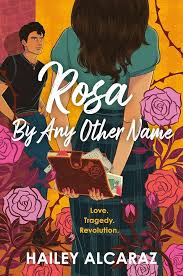
Rosa Capistrano has been attending posh North Phoenix High School to boost her chances of a college education and a career in journalism, thanks to the groundbreaking Brown v. Board of Education verdict for desegregation. But though she’s legally allowed to be there, it’s still unsafe for Mexican Americans. That’s why she’s secretly passing as Rosie, a white girl. All she has to do to secure her future is make sure her Mexican home life and her white school experience never intersect.
However, Rosa’s two worlds collide when her best friend Ramon and classmate Julianne meet and find themselves entangled in a star-crossed romance. Rosa is terrified about what their relationship could mean for her and them . . . and her worst fears are soon realized in an unspeakable tragedy. Rosa is thrown into the center of a town-wide scandal and her true identity is put in the spotlight. With the help of Marco, Ramon’s brooding and volatile brother whose passion ignites hers, Rosa must choose what is more important to her—protecting her fragile future, or risking everything to help her friends find justice.
Alcaraz does a lovely job in expanding the personalities of some of Shakespeare’s beloved (and underexplored) characters while updating it, so to speak, to a different setting.
Almost everyone knows Jim Crow, but we’re sorely uneducated about Juan Crow. The just as prejudiced but complicated issue of segregation in the West when it comes to brown folks. However, because Hispanic is not considered a race, the discrimination they experience is in the grey area and is not given much weight in law cases or history books. There are signs saying they’re not allowed, there are threats if they come t0o close, but legally integration was a allowed. No one followed it, but still.
Since Hispanics are white, they should be okay. But we all know that’s not true with the lazy Mexican stereotype that is also stealing jobs and threatening white women. Rosa lives in the grey as a white-passing girl, hoping to go to college and hiding her identity in order to get opportunity.
Rosa at the beginning is sheltered, and so alone. She knows she has to take this opportunity her father wants for her, she wants for herself, and thinks if she plays by the rules she can make it to college. But it also leaves her feeling isolated in her own community as she knows others like her sister, and her parents with their darker skin would never be seen without prejudice. She can be accused of putting on airs and feeling ashamed of them. But it’s not shame, but fear that drives her. Fear, and then anger.
That famous balcony scene. Oh it hurt to see how Alcaraz changed that romantic balcony into a tragedy. But it was to great benefit that she expanded Ramon and Julianne’s personalities to that of stupid, hormone-addled teenagers into- well still hormone-addled but they’re both romantic dreamers. Idealists that Rosa believes is threatening them all with their plan to speak for integration, but is also incredibly brave at the same time. They know it will be challenging, but they believe their love could be a beacon.
And it is, in a roundabout way. Their deaths break Rosa’s beliefs about the current system. She knew it was unfair, but she hadn’t truly realized the extent. The system was never made for her, even if she played within it.
Alcaraz did a wonderful job in descriptive writing, bringing readers back to the 50s with the can-rollers in the hair, references to lace and crinoline, and the casual sexism, racism and homophobia of the day hidden behind polite smiles turned into sneers. Yet the content was poignant as she delves into the consistency one needs when getting into activism. Knowing that it isn’t one big tragedy that can change mind, but thousands of action, words, and planning in the aftermath that helped create a movement.
What’s more, the emotional labor it takes in order to continue the fight is another theme as Rosa struggles with her PTSD and feelings of guilt, and grief in not helping Julianne and Ramon more. This emotional taxation is shown in different ways from Rosa to her father’s experiences after WW2 and that of Marco, Ramon’s older brother.
Obviously standing in for Mercutio, Marco has all the anger and desire for justice, but no idea what to do with it. I thought their first interactions of a good girl untrusting of the town bad boy was cliche, but Alcaraz evolved the relationship over time in demonstrating that Marco’s vengeful anger was hurting him as much as the cause, and couldn’t be quickly resolved with love.
The only downside I thought was the lack of exploration of having Rosa’s white-passing is seen by others in her community (besides Marco who sees it as shameful), not just the white community. Also it can feel slow at times in the beginning before the tragedy strikes.
Nonetheless, it’s a good story that more people should read. Not only to learn about Juan Crow, and western US integration, but for the themes that are relevant to real life like activism, police brutality, and the power of storytelling and using one’s voice in making change.
4 stars.
 Rachel Reads & Reviews
Leave a comment