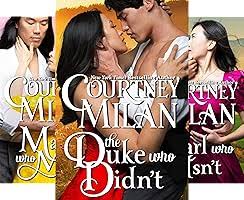
Courtney Milan does it again! I wrote in my ranking for Milan’s Turner trilogy that Milan is a rare romance author who nixes the miscommunication trope that plague so many couples. Rather she subverts the status quo and has the couple communicate like mature adults while maintaining the suspense of internal/external forces threatening their coupledom. It can be done without making them idiots! And she does it again here in her Wedgeford Trials trilogy. Wedgeford is a small, forgettable village where England’s oriental community gravitate to be able to forget their pasts, and a safe haven from a prejudicial society.
But for such a small village, there are quite a few secrets and nobles abounding.
1. The Marquis Who Mustn’t: This was such a good book. I have to start with that because I won’t be able to state it enough. Kai is the son of a swindler. Naomi is the daughter of a plain innkeeper. Both fear that they’ll end up following in their parents’ footsteps, and neither can deny the attraction between them even though they think it will never last. It doesn’t help that they meet under the guise of a fake engagement so they both had agreed for it not to last. Of course, it doesn’t, but I love how Milan keeps communication honest (well as honest as a fake engagement can be) and because they’re in on the same lie, they feel more free to express themselves with each other. Furthermore, I adore Kai and Naomi’s separate journeys in realizing that they’re not their parents. While Naomi finds out she had misjudge her mother and comes to love the things she inherits from her, Kai learns to shut down the insecure voice that tells him he’s unworthy all of his life, and that he should pay for his father’s sins. I know I’m understating it’s greatness. It was just so good.
2. The Duke Who Didn’t: Jeremy, the half Chinese duke of Lansing technically owns the town of Wedgeford. However, as he despises the idea of owning the people who took him in and made him feel wanted unlike the rest of snobbish English society, he has decided to keep his true identity and wealth a secret. Unfortunately, that will be a big problem as he’s expected to marry soon. Marry a proper white duchess so his mother’s taint can die out. But Jeremy has other plans to marry his childhood friend, Chloe, if only he can convince her his feelings are real. Jeremy was a delightful MC full of jokes and cheer that I wish was more prevalent among the brooding dukes. But he has his sad reasons as he needs to appear unthreatening as possible to the rest of the Lords so he may be accepted despite his mother. However, Chloe was the real star of the show with her fight to start up her father’s sauce business, get revenge on those who defrauded him, and learn to accept help as well as her true origins. The only reason it gets second is because it took awhile for me to get a grasp of what century they were in. They mentioned dukes but the village was so isolated and had its own rules that it felt it could have almost been modern times and it took me out of it.
3. The Earl Who Isn’t: Being an earl has more problems than it’s worth. At least that it’s in Andrew’s mind. He doesn’t want the responsibility nor potential of becoming like his spineless father. Not to mention the threat it would pose to Wedgeford if the English find out there’s more than one Asian lord. There would be riots than they’re being fouled up from the inside. Just as Lily experienced when she wanted to join the suffragists only to be told that their ranks were closed to women of color. Between the noble intrigue of Andrew trying to conceal his true identity and outwit his father’s homicidal family, the plot kept me engaged. But I most admire the neurodivergent lead, Lily, who I think would have been autistic in modern parlance. Another rare MC in the genre, but Milan writes a stirring arc for her in realizing maybe she’s not the one who is at fault for not instantly getting the subtle nuances of social niceties. It doesn’t make her unlikable, she’s fine as she is. Moreover, it helps that the bluntness, the honestly, the singular passion she has for printing and suffrage are what Andrew likes about her, and he never once thought her odd. It was such a wholesome relationship. The only reason it comes last is because I enjoyed Jeremy’s lightness more and The Marquis Who Musn’t was simply too good.
 Rachel Reads & Reviews
Leave a comment