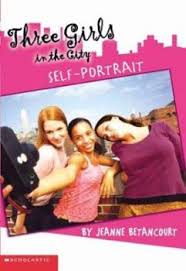
Horse girls may be more familiar with Jeanne Betancourt for her popular Pony Pals series, here she takes a different slice of life approach with, as the title says, Three Girls in the City.
The premise is as follows: NYC, 2002. Three 13 year-old girls meet at a summer photo Carolyn, fresh from Wyoming, motherless and scared; Joy, who has everything plus a bad attitude, and Maya from Harlem, strong, proud and surprised to find herself liking these 2 mismatched girls. Just as these 3 discover they’re friends despite their differences, Carolyn’s father decides to send her back ‘home’ to Wyoming. Then, in her first flush of street-smart confidence, Carolyn gets scarily lost on the subway – and it’s Joy and Maya who find her – and show her dad that New York City is the home they’ve been looking for.
There’s still horses, but there’s more than that. Taking place after 9/11, it casts a shadow on the cast and setting with numerous references to it, and other recent events. Joy, in particular, seems to have PTSD from seeing the towers fall from her bedroom windows. Carolyn’s father is said to be always overprotective, but I sense his concerns over how dangerous NY is may also stem from that event.
It’s a slice of life that is thoughtful, can get heavy sometimes. It touches on topics like child abuse, AIDs, eating disorders and creepy men, not in depth but enough to show that this is in the periphery of their lives. Yet there’s lightness that balances it too. Much like life. It commits to the realism in depicting the confusing mix of adolescent feelings in trying to figure out a sense of style, where you fit in with your friends, happy one moment, sad the next, moody etc.
There also doesn’t feel like there is a set plot despite each book summary. The events in each chapter don’t build to a climax or a traditional three-act structure because life is not as simple as that. It goes day by day so sometimes plot threads feel left unresolved or overlooked, I see it as demonstrating that life doesn’t have clear conclusions to problems. A conversation with parents can resolve everything because the girls are realizing at the juncture of their lives, they can’t trust their parents to have all the answers, sometimes they’re the problems. They’re taking steps to figure things out on their own.
Additionally, it stopped after four books which seems to have been the plan, but a lot of things were left open-ended or to be picked up later, and as someone who likes conclusions in her stories, it made me want to know more.
I enjoy how each girl and her family life feels distinct and you can see subtly maturity in each. Carolyn becomes less fearful of meeting strangers and the cosmopolitan city of New York. She advocates for herself with her father and becomes more independent.
Joy is the most moody with her turbulent divorced parents, but she even sees the benefits of letting friends see her vulnerabilities even though she worries Maya and Carolyn are closer to each other than her.
Maya is the most adjusted of the three, I think, but even she learns about how to navigate a changing friendship with her bestie, Shana, who seems to dislike that she’s friends with white girls now.
My nitpicks are tiny: The POVs is third person omniscient between the three girls, not chapter by chapter, but by sentence to sentence sometimes which was confusing when I first began reading. The font doesn’t allow for italics nor does the author put quotation marks to distinguish internal thoughts which makes it hard to distinguish between internal thoughts and stuff said out loud.
Also since it’s focused on the photography class, most of the story takes place in their free time afterschool, but I am a little curious to what they’re school life is like. Especially as Joy repeatedly mentions the snobbish mean girls in her private school that have obviously given her an inferiority complex, and the fact that Maya and Carolyn go to school together. I expected more drama could be wrung from that.
Otherwise, this is a great time capsule to 2002, and a grittier NY with such cool “new” technology like digital cameras and photoshop. Yet the struggles of growing up remain unchanged.
 Rachel Reads & Reviews
Leave a comment