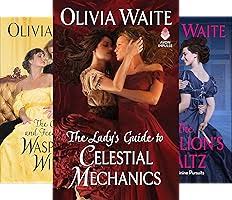
To continue the journey of historical romances with non-traditional leads, Waite’s Feminine Pursuits trilogy celebrates women loving women, and the their fight for rights and respect in their occupations. It’s also interesting as these can be read as stand-alones rather than a trilogy. Sure, characters pop up from other books but it is not very noticeable. Plus it’s very supportive women helping women which we love to see.
- The Hellion’s Waltz: The final book in the series may be the shortest, but it’s the sweetest and has the best balance of character arcs. Maddie, the slightly amoral weaver sticking justice to con-men, and Sophie, the straitlaced, modest pianist are darling together. Both have big hearts, but Maddie almost becomes a martyr for her cause, not seeing that she can depend on her friends instead of protecting them all the time. And Sophie doubts herself, her judgement, her beauty, her talent, but her time with Maddie not only opens her eyes to the fact that sometimes you must resort to swindle to obtain justice. But that she is wonderfully talented and should seize her chance to shine. It’s perfectly romantic, and gives wonderful insight to London’s industrial age and how it started the mistreatment of the labor force (especially the female labor force in weaving which is considered unimportant even though WE ALL WEAR CLOTHES) by capitalists. Also custom-designed instruments are surprisingly interesting.*
- The Lady’s Guide to Celestial Mechanics: The first book in the trilogy stuns as it focuses on the widowed Catherine St. Day’s invitation to one Mr. Muchelney to translate a work of astronomy for London’s scientific society. Mr. Muchelney is dead, but his daughter, Lucy, who did most of the calculations for his work is eager to take the job. She needs to take her mind off of her girlfriend marrying someone else. This book worked in delving into Catherine’s complicated feelings. Her husband was emotionally abusive and she has no interest in putting herself under the thumb of another in marriage so a fling with Lucy should be easy. No financial constraints or contracts to bind them, but love gets in the way. The conflict is interesting as Catherine is so insecure about not having a talent, and being placed second to someone else’s scientific pursuits. Just in general, feeling inferior because she’s more of an artistic brain. So it was wonderful to see her overcome these fears as well as her fears about being a good partner to Lucy and coming to their own arrangement that solidifies their love for each other even though they can never be open. But it is second because Lucy’s arc is more vague. She has to stand up for herself against the all-male scientist brigade but Catherine undoubtedly gets more depth in their relationship. Also there is a point where Lucy states that her feelings for Catherine are different from her ex-girlfriend because she (the ex) was selfish, expecting Lucy to revolve around her. But it comes out of the left field as we don’t get much insight to their relationship beforehand. I will say that Lucy schooling the scientists at the end was a big “You go, girl” moment.
- The Care and Feeding of Waspish Widows: Much as above, the widowed Agatha Griffin gets the bulk of interesting character development from finding second love after the death of her beloved husband to her maternal struggle of fearing for her radical son’s future and his love life. Also learning to live again as she used her work as an engraver to push down her feelings of loss and grief. Perhaps it’s because Catherine and Agatha are older (and you so rarely see middle aged romance protagonists) but they’re in different places in their lives compared to young heroines and have different challenges. It’s just interesting! Penelope is almost middle aged, happily married to her brother’s lover (whose conveniently away on a waler with said brother) so she can freely bee-keep and sleep with whomever she wants. But even though she’s content, she’s lonely not inspiring the same level of love. Perhaps she isn’t capable until Agatha. Much like Lucy, her arc feels less-defined. There’s a bit about learning to stand up for herself but eh, Agatha was just more fascinating as a character. I do appreciate how Waite has her novels are set within months instead of the space of days or a few weeks. It makes Agatha and Penelope’s friendship to love more real. This also has the most atmosphere as it deals with the timely politics of a small town fiercely involved in the divorce of King George and Queen Charlotte and what it means for noble women in divorce. It touches on censorship, morality brigades, and the hypocrisies of rich white women feminism. Plus lots of technical research on bee-keeping and print-engravings. It made the town come alive, but also slowed the book so it felt longer than needed even if I enjoyed the Christmas Eve ghost story. So this comes last. Also the cover for this one is atrocious. It’s like bad photoshop, the model on the cover looks like she belongs in a modern day office, not a regency romance!
*Sidenote. There is a reoccuring character, Mr. Frampton who is a scientist that is basically inventing the future computer. I think he’s an expy of Charles Babbage. Much like Babbage, he is having trouble figuring how to compute it. Naturally, I thought by the third book with Maddie’s weaving skills and punch-card system and Sophie’s musical technique, they’d give him the idea of how it could be done. Much like how Ada Lovelace did that for Babbage in real life. But it didn’t happen! It felt like a set up with no follow-through. Then again, it was a minor part of the book, but it bothered me.
Now on a semi-related subject. I realized as I was reading this series is that it’s all bi x lesbian. Makes sense as Waite says she’s bi. But I think all of the queer books I’ve read (which take with a grain of salt is like four authors.) it’s always bi woman x lesbian. This trilogy. Ashley Herring Blake’s Bright Falls trilogy. The only lesbian x lesbian I’ve read was Herrera’s An Island Princess Starts a Scandal.
On the other side of the coin, in the mlm, Alexis Hall’s Paris Ballincourt and Boyfriend Materials is all gay x gay men. Two out of three couples in Seducing the Sedgewicks is gay x gay man. Only one bi man x gay man.
If I put my little social psychology cap if I may, I have a theory.
Let’s be honest, a majority of romance readers are straight women, me included. Correct me if I’m wrong, that’s like the first thought when it comes to the demographic. So perhaps the bi woman x lesbian is popular because even though it’s not the point of the book, the bi woman is more palatable. Like she could be interested in a man which makes her relatable to readers even though it’s not the point of the story.
But if that’s the logic, why wouldn’t there be more bi men so the readers can imagine the protagonist is still interested in woman even though it’s not the point of the story.
Well there’s a phenomena of women fetishizing gay men just as men objectifying lesbians. Something I simply don’t understand when it comes to either gender. It’s gross to me. But back to the point, maybe it plays to the wider perception that bi women are palatable and bi men are rare or a “stop to gay town.”
So comment below. Should there be more bi men in romantic fiction? More bi man x man, bi woman x bi woman, bi x bi in general? (Lyla Lee made an adorable bi guy x bi girl couple in I’ll Be the One)? Are there more lesbian in fiction than I realize?
Well it’s pride month in June so it’s some food for thought. Comment below!
 Rachel Reads & Reviews
Leave a comment