I finally got my hands on this Scholastic series for our Northern neighbors. Much like the My Name is America books, this male-focused line tackles the journals of young men at important historical junctures in Canadian history. It seemed to be short-lived as there were only thirteen novels, but they were a rollicking ride.
Unlike the sister Dear Canada series or the American version, this does not read like any actual journal. It is set in novel form with chapters, a prologue and epilogue rather than journal entries. The only one that is in journal form is the Blood and Iron novel.
I’ll admit that because I was reading the My Name is America series in conjunction with this one, the return to novel form felt jarring. The authors also tended to drop readers right into the middle of the action, so unless the protagonist had a very distinctive voice, I found it hard to connect with them when they lost loved ones. I also had trouble understanding the broader context or lead-up of the situations they were in. I suppose that may have been because I am American. Canadian readers probably knew the historical context of some of these events like The Siege of Hong Kong or the War of 1812, but I was lost during the first three chapters.
But I wanted to read these books so badly precisely because I wanted to learn new parts of history. That’s why my Top 5 are ones that I hadn’t known before. Warning that most involve the 20th century since I do like that period more and that six of the thirteen focused on the two world wars.
1. Behind Enemy Lines: WW2 by Carol Matas- This book is probably a more straight-forward WW2 narrative with the protagonist getting shot into enemy territory, joining the resistance, getting put into a concentration camp, wondering about the depravity of human nature and if good can still exist? It’s predictable in some ways, yet it’s moving all the same. I especially enjoyed how it got into topics the other WW2 books didn’t get into like the collaboration between the Vichy government and the Nazis, the treatment of Jews which was largely rumored and disbelieved until the protagonist sees it for himself in Buchenwald.
2. Shot at Dawn: WW1 by Jon Wilson- This book was interesting in showing the slow but inevitable destruction of the protagonist’s black and white, romanticized worldview of war as his best friend turns into “a coward’ in battle and he experiences the horrors of No-Man’s Land. This was a very interesting book as it deals directly with shell-shock with all the era’s ignorance of the condition which the protagonist exhibits until he experiences shell-shock himself. It also revealed the damaging extent of the desertion among the troops that 1,000s of Allied soldiers were executed by their fellow men for desertion. I thought the number was a little much since they could have used those men to fight but no. It’s just bloody and depressing all around.
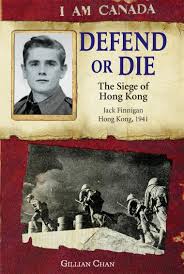
3. Defend or Die: The Siege of Hong Kong by Gillian Chan- I was super excited about this one because in WW2 narratives, I never heard about the fighting in China. Turns out it is because the British were trying to keep a hold of their British colony which proved disastrous for the Canadian reserves stationed there. This went back and forth between the protagonist’s time in a Japanese POW camp (which did not adhere to the Geneva convention which Chan shows in all its brutality) and the events leading up to their capture on Christmas Day which was another exercise in futility. It’s amazing how much angst is piled in these books with every WW2 ending in a POW camp.
4. A Call to Battle: The War of 1812 by Gillian Chan- This gets number four spot because of how strong the voice of Alexander McKay was as a hotheaded, patriotic boy desperate to prove himself a man. Plus I learned about the Canadian side of the War. Like I knew we (the US) were fighting the British, but I didn’t know we tried to take over Canada too. Just as that war cemented the US’ feelings of camaraderie between states, this war also cemented Canada’s feelings of being connected to the British empire.
5. Brothers in Arms: The Siege of Louisbourg by Don Aker- I knew a little about this part of specifically Canadian history because of the Dear Canada book on Arcadian expulsion. That helped to ease me in because it jumps into how the British and French are enemies, the Arcadians have already been expelled and now the tiny village of Louisbourg is about to be destroyed. It’s heart-pounding as it opens with a message given by the French generals that they’re not going to surrender and will let the British kill all the civilians rather than give up their honor. He continues from there in describing the fatal mistakes the generals made leading to their ultimate defeat. It spoke a lot to the French ideas of pride and honor associated with dying on their feet and so on. My one nitpick is that he makes one mistake in that an earlier chapter he refers to his fiance’s father dying from the bombardment, and in the last chapters the father-in-law is alive again so we can see his death in real time.
While these were my top five, there are others I have to give special mention to like Sniper Fire for focusing on the Italy campaign that gets overshadowed so often by D-Day and the Western Front narratives. Sink and Destroy, and Fire in the Sky focuses on the specifics of naval battle and air warfare in WW2 and WW1 respectively. Gets very technical for all those who are into descriptions of ships and planes. Sink and Destroy was also the most depressing. Graves of Ice: The Lost Franklin Expedition was the most haunting as a combination of Stranded and the Donner Party.
Also a funny side note but so many of these characters were Irish or Scottish. I had no idea they had such a large population but then again, many of them emigrated from the UK so I guess I shouldn’t have been so surprised.
 Rachel Reads & Reviews
Leave a comment