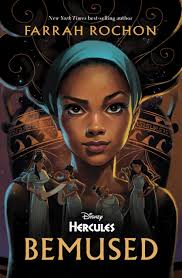
The Muses narrated Hercules’s story. Now, they’ll narrate their own “gospel truth.”
Living in a quiet seaside village with their overprotective mother, teenaged sisters Calliope, Clio, Melpomene, Terpsichore, and Thalia are talented performers with no audience. If Calli had her way, she’d pursue her dream of writing epic stories in the city of Thebes. But family comes first, and as the eldest, she’d never leave her beloved sisters behind.
Then, following a disastrous public music performance, their mother reveals a shocking secret: she is Mnemosyne, the Goddess of Memory, and for nearly two decades, she’s been on the run from the gods of Mount Olympus, desperate to keep her daughters safe from their machinations. Before she can share more, she is kidnapped . . . and though the girls don’t know it yet, the villain pulling the strings is none other than Hades, fiery God of the Underworld.
Under Calli’s leadership, the sisters embark on a journey to save their mother and to learn more about their own divine origins. But the path ahead is filled with mythical trials and tribulations, and they’ll need to rely on both their individual talents and the strength of their sisterhood to ensure that they ascend from “zeroes” to “heroes”–or more accurately, heroines.
If you know me, Hercules is my favorite Disney movie so of course, I had to get my hands on this while bopping around to “Zero to Hero” stuck in my head. It did help that Rochon sprinkled plenty of references, not only by mentioning that title, but little quotes that they said in the movie like referring to them as “goddesses of inspiration and proclaimers of heroes.”
But they haven’t reached that stage yet.
Rather Rochon starts at the very beginning, before their creation, with the intriguing hook of their mother, Mnemosyne, on the run after erasing the gods’ memories in order to keep her girls’ safe.
The novel alternates between four POVs, Calliope or Calli as Rochon refers to each muse by a nickname for the tricky Greek names. Calli is the leader everyone recognizes but is suffering from major oldest child syndrome. She wants to go to the big city, Thebes (cleverly remiscent to NY with its dirty streets filled with people wanting to make it big), and become a writer, yet she feels constrained by duty to stay home and help her sisters that don’t seem to know how to be make decisions without her.
She has a nice arc, fighting resentment with worry when her mother is kidnapped, and betrayal when the truth about their creation is revealed. Mnemosyne had kept the girls secluded from every village they moved to, and warned them from sharing their creative talents to the world. They never understood the warning, but Calli had begun to worry that maybe her epic poems were not good enough and that it was her mother’s way of letting her down gently.
Her arc is very relatable and the journey she takes with her sisters to rescue her mother allows her to see her sisters through a new lens as each comes into their talent, trusting that they’ll be able to handle themselves yet she doesn’t have to leave them in order to find herself. Rather she realizes how much she wants them by her side and that they’re stronger together.
Rhee, short for Terpsichore (Muse of Dance), takes the second POV. She’s the one who has always known what she wanted to do, and her talent, but felt unable to pursue it openly because of her mother’s rule. Naturally, she’s who feels most betrayed by their mother’s secretiveness of their origins and how it affected their lives with the constant moving around. Although those feelings are colored by her own burgeoning wish to create her own dance studio and falling in love with the olive-grower, Sivas.
This was predictable in that Rochon is primarily a romance author so it makes sense that she’d throw in some of the genre she is best-known for. Rhee has her own variation of wanting to break free of the sister group only to realize she needs them by her side more than she thought.
It wasn’t a bad POV because Rhee is spunky and energetic and has a distinct voice that is pleasant to read, but also felt like she was used as a catalyst for more conflict and to move the plot along. I think I’d be more forgiving if each of the sister had their own POVs so it felt like each had their own development from their own eyes, instead of Calli taking a bulk of it with Rhee taking the romance/conflict part.
Rather the other POVs are taken up by Hades and Mnemosyne. Hades’ is definately necessary exposition and plot-catalysm so readers can understand his plans for domination and give another view of Mnemosyne’s time on Mt. Olympus. Plus he’s funny as expected from yelling at his anguished shades to “Make better choices!” or his preoccupation with his hair being cooler than Zeus’. While the movie was very anachronistic with greek versions of current pop culture references, this novel plays the setting very straight exempting for Hades and Thalia’s dialogue which works as it is best used for comic relief.
Mnemosyne is the most interesting as she has a more negative view of Zeus than we see in the Hercules’ movie and tv show. Much more accurate to the myths of Zeus being hot-tempered, vengeful and grudge-holding. He allows her mercy from being imprisoned like her brothers after the War, but she views her time on Mt. Olympus as a different prison as he constantly reminds her that he’s watching her and she should be grateful for his ‘kindness.” He’s the villain of the piece and I truly enjoyed the mystery surrounding her broken deal with Zeus, her abrupt escape and her fugitive lifestyle.
But the denounment of his villainy felt a bit sudden and uncathartic though, but Rochon had emphasized throughout the story of the fickleness of the gods’ tempers so it does makes sense that after a decade his temper may have cooled toward Mnemosyne’s behavior.
Actually, all the gods are portrayed as more fickle and less benevolent which I appreciate with its accuracy. The only goddesses that Mnemosyne truly bonded with were Athena and Artemis who treated her with kindness, giving her willingness to sacrifice those good connections to keep her daughters safe more emotional weight.
She possibly has the most character development as she realizes that her secrets, her hiding and her sense of self-preservation had endangered her daughters as much as saved them. It was selfless yet selfish, keeping their talent to herself. Plus I love that most of her chapters are flashbacks as it literally plays into her powers as goddess of memory.
The other sisters get their own chapters to shine, highlighting the strengths of each of their gifts that the sisters hadn’t been able to appreciate before. Clio may sound pretentious, but her historical knowledge and curiosity for more information makes her a great problem solver. Mel can be overdramatic, but she’s also intensely empathetic and can connect with people. Thalia doesn’t take things seriously yet her humor allows people to forget their worries for a little bit and find strength to continue. Arts as a whole are wonderful tools for bringing joy, imagination and entertainment to people.
It brings inspiration, I mean a good piece of art/song/dance has been used as inspiration in war, politics, love, societal rules, but have you ever heard of a calculator inspiring the same? Think about it.
Anyway, each sister gets a chance to shine, but I found I wanted more of them especially Mel as she is easily sensitive and her talent is not as evident as the others. Same with Thalia, her arc was learning when to be funny and when to be serious and it fell a little flat. She’s always funny which I can’t complain, but doesn’t feel like it followed through on the mini-arc potential.
Plus as a lover of Greek mythology, I loved how she includes other mythological trivia such as Mnemosyne’s caginess regarding her fellow Titans’ brutality. She never goes into detail which is good because there’s not a YA or child-friendly way to describe them. Let’s just say the Olympian gods’ fickleness and tempers are the lesser of two evils.
The Muses perform the story of Apollo’s defeat of the Python and as the paton of the arts, he is a big fan of them and soon becomes their patron. Plus Circe appears as a obstacle for hire for Hades who couldn’t care less for his flaming theatrics. So do the Sirens (the real greek myth version of human heads and bird bodies instead of the mermaid-one people usually envision) and Rochon spins her own version of the Sirens vs Muses myth.
This is a nice blend of Greek mythology with Disney mythology with strong themes of sisterhood and motherhood, and the importance of the arts in a delightful origin story.
4 stars and that’s the gospel truth!
 Rachel Reads & Reviews
Leave a comment