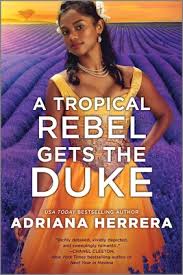
Physician Aurora Montalban Wright takes risks in her career, but never with her heart. Running an underground women’s clinic exposes her to certain dangers, but help arrives in the unexpected form of the infuriating Duke of Annan. Aurora begrudgingly accepts his protection, then promptly finds herself in his bed.
New to his role as a duke, Apollo César Sinclair Robles struggles to embrace his position. With half of society waiting for him to misstep and the other half looking to discredit him, Apollo never imagined that his enthralling bedmate would become his most trusted adviser. Soon, he realizes the rebellious doctor could be the perfect duchess. But Aurora won’t give up her independence, and her secrets make her unsuitable for the aristocracy.
When a dangerous figure from their past returns to threaten them, Apollo whisks Aurora away to his villa in the French Riviera. Far from the reproachful eye of Parisian society, can Apollo convince Aurora that their bond is stronger than the forces keeping them apart?
Some spoilers under the cut.
The final Leona-Aurora Montalban, I’ve been waiting.
The relationship between Apollo and Aurora has been filled with tension since the beginning. Although readers didn’t know what interaction sparked Aurora’ ref’s biting disdain and Apollo’s amused banter, we all knew they were going to fall hard.
That’s why it was a delight when the prologue opened with Aurora giving into her desires for once and demanding a one night distraction. All the readers must laugh at her naivety and Apollo’s belief that he can move on after their secret night of passion.
To be fair, they both have complex schemes to take care of. Apollo’s detested father died so now he must contend with a bride hunt and his continued ambition to topple the House of Lords’ racist foundation. Aurora’s secret clinic is gaining attention and losing funds but there are so many who need her help. Yet there is no one helping her, and she’s self-destructive enough not to help herself.
While Herrera’s volatile back and forth makes a believable enemies to lovers; (Enemies on Aurora’s side as she sees the idle aristocracy as an institution to hate on sight and Apollo’s choice to join the ranks and ignore how the other lords mistreat their people is awful. Apollo’s always been intrigued by her) They truly have a lot in common.
Apollo’s desire to not only push his way through to the richest, whitest, elitest aristocracy, but be better than them and rub their noses that not only do they have to sit next to him but bow to him is something he’s always wanted. But it is also exhausting because it requires him to never make a mistake as he being a black man means the stakes are higher and he is representing his entire race. Plus it’s not just the racist but the “progressive” aristos who are happy to boast about their abolitionist grandfather or feeding urchins yet they still thrive off their inherant privilege and aren’t doing much work beyond boasting.
Fortunately, he thrives in this sort of arena, focusing and decimating a goal. Unfortunately, that no longer is enough as he begins to fall for the brave, outsoken, selfless Aurora. While he’s representing their race, she’s out saving lives without recognition and with strength that even he doesn’t have.
He always needed someone to recognize his achievements, Aurora doesn’t and he wishes she would be kinder to herself because she becomes everything to him.
Aurora, as I said, is outspoken and stubborn. Angry at times, and while that can be tolerated in a man (even if Apollo has to contend with racist “savage” comments), it isn’t tolerated in a woman, and she’s tired. She’s tired of that but she’s uncompromising in who she is. She won’t make herself or her opinions small to make someone else feel more comfortable and with Apollo, she’s met her match. He can be overhanded, but he gives as good as he gets and the chemistry is just sizzling. He calls her Fiera for a reason, and it’s for fighting spirit as much as their wanton antics together. Gotta love these workaholics finding some leisure in their lives.
They don’t start with friendship, but they have respect that makes their bond incredibly strong even as they fight their feelings.
Aurora’s story is potentially the most emotionally complex if only because of how deep her shame is. She was groomed by a pedophile, Phillip Caryle, and got an abortion when she was fifteen, and her family blamed her. Not in just in the “You’re asking for it” but because she’s not her mother’s daughter. She’s her aunt’s daughter. The daughter of her father’s mistress/her mother’s sister and her mother reveals this in the most traumatic way that it’s her whorish genes winning out.
Before that the entire family has been emotionally distant and neglectful and it all makes sense, but the whole situation gave Aurora trust issues and major insecurity that she will never be enough.
The shame’s related to the last line tbh, not the abortion. Throughout the story, Aurora maintains she’s never regretted what she did and works so hard so other women have that choice and aren’t hampered by financial/physical dependence on an abusive man.
But back to the emotional issues, I appreciate that Apollo realizes his feelings more quickly than Aurora and starts a campaign to win her over and assure her that the bride hunt is over. He doesn’t want a dollar princess, he wants her. She’s not traditional duchess material, but he’s trying to dismantle the aristocracy with his presence so she can join him and keep her awesome job as secret women’s clinic doctor. But he comes to realize that he can’t do all the work when she needs to find self-love for herself.
Aurora’s realization that she can’t keep love and other people at a distance is a bit cliche, but at least Herrera has the self-awareness to nod at it and make a joke.
But the most compelling is how honest they are with each other when they can’t (particularly Aurora) can’t be honest with their friends.
Plus, as with the other novels, Herrera highlights some very cool historical facts like the origins of Brazilian-Angola capoeria fighting style.
The importance of midwives in the medical field and how the professionalization of it by male doctors not only made it much more unsafe for women, but delegitimized midwifery which was a primary female space.
Also there’s a character who is a Vietnamese widow that owns a lavender farm (it has other flowers too but there’s a scene in the lavender fields that is simply so romantic) and operates a land commune for other women to create businesses and offers a solution to Aurora’s pharmacy problems. Her name is Phmong, she’s super cool, and I wish she had her own book.
Argentinian feminist radicalists and their contributions to reproductive justice and health and the underground female network working to subvert and sometimes break the law to help other women. Also so many Latinas working for reproductive justice in the late 1800s that no one gets reads about.
Just so much cool stuff and my history nerd self is loving all of it!
However, there are a few minuses. Perhaps it’s because I’ve been waiting so long for the book, and I built it up in my mind. Perhaps it’s because the first two blew me away so now I have higher standards. But. . . .
The intense bond between Apollo and Aurora leaves other characters and their relationships to the protagonists to the wayside.
The Leonas, Luz Alana and Manuela, their bond does not feel as tight. Of course, Aurora has been hiding her work from them so she has been keeping her distance out of emotional insecurity and not wanting to drag them into her illegal business activities. But when they do appear, it is primarily to nudge her closer to Apollo. They know about her past with Phillip but when he comes back into her life (dating Apollo’s beloved aunt, le gasp!), they don’t have a conversation about it. Nor does she ever tell them about her secret women’s clinic.
A part that was so emotionally fulfilling in Manuela’s book was Luz Alana and Aurora both apologizing for not truly seeing the pain under her happy demenour. I wished there had been a similar scene when Aurora admits that’s she been working herself to the bone almost as penace for her childhood and never being enough. But there isn’t. She never tells them on the page. They have a fight, but that’s told rather than shown. Their friendship feels flat.
Apollo’s banter with Evan and Cora also feels like an archtype. You know how in romance series that the protagonists from previous books become the love-happy Greek chorus in the sucessive books to push the couple together. Cora and Evan do that here, and while it’s entertaining it feels somewhat out of character for Cora.
She and Apollo have a cool friendship because there’s so alike, but I find it hard to believe that she has mellowed so much that she would only inquire about his love life and not how he’s treating the shares she gave to him in the previous book or crushing some racist misogynists.
Also I mentioned Phillip Caryle returned. After his grooming and emotional abuse of Aurora, he dates Apollo’s aunt to strike at Apollo’s niece, Julianna with similar results. It’s harrowing and brings a lot of guilt to Aurora as she didn’t reveal who he was at the time, possibly saving Julianna. Luckily, Herrera doesn’t do the tired trope of Apollo blaming her, but I almost feel there’s a missed opportunity in Aurora and Julianna talking survivor to survivor about the effects of grooming and how it was never their fault.
Plus Phillip gets away with it. Like almost every other villain gets their commuppence in this series except him. Sure, Apollo vows to hunt to the ends of Europe to get him (and we know he’s good at that, see his dead father) but it just doesn’t happen. Not even a tiny mention in the epilogue. Like where’s the cathartic justice?!!!
Which I also have complaints about Aurora’s brothers who neglected and sided against her when she was fifteen. They return after cutting her off to control her purse strings, but she refuses to give them the satisfaction. They have an epic fight, and Aurora doesn’t talk to them again. Ramon, the oldest is a total cabron, but there seemed to be hope for Octavio and Sabastian to have a potential relationship with her, and it’s implied in the epilogue, they do. But there’s no other interaction with them in the book.
Manuela was similarly ambushed by her parents in her book. But she got a second interaction where she was able to confront her parents with their treatment of her and close the doors on her terms. Aurora didn’t get that and I wanted at least Sebastian and Octavio to say how wrong they were and recognize that they were wrong.
Additionally, Aurora’s cousin, Antonio, who was in the previous two books is just gone. Even though he lives in Paris as an engineer. It would ruin the whole Aurora is isolating herself in her work and no one is recognizing that angle, but it feels like he was accidentally forgotten.
Speaking of family, Tia Jimena is a big reason for Apollo’s continued pursuit of one-upping the aristocracy and the mastermind of the bride hunt. Her desire to top the aristocracy got annoying especially as it was clearly grating on Apollo’s potential happiness.
While there is a good reason for it, in trying to prove their race is just as good and better than the white colonizers and for her sister’s memory, she was so pushy about it, it almost felt like she had a more sinister motive behind it. Or like she wanted the privileges so bad that she was willing to participate in the system and she’s not called out on her behavior.
Then there’s a Lord Ackworth who is a thorn in Apollo’s side as an unrepentant racist/xenaphobe (despite hypocritically marrying a foreigner) and assaulter of women. He causes trouble and gets dealt with but then he appears one more time in the last chapter. Like literally on the third to last page of the chapter. He’s lost everything and seems to be on a nervous breakdown, waving a gun and vowing revenge. It’s a repeat of Luz Alana’s situation with her former trustee only it’s two pages long. It’s so sudden, and so unnecessary, I don’t understand why she added that in the last chapter.
It’s also compounded that the compromise for Aurora and Apollo’s relationship is the exact same one as Cora and Manuela’s. So ripping off situations from the previous two books makes it feel like the author didn’t know how to give Apollo and Aurora a conclusion unique to them and their romance.
Finally, in the first 100 or so pages, Aurora says she wants “to commit violence” a lot and while I’m sure old-timey people said in their old-timey way, it reminded me too much of a slang term and it just took me out of the story.
So yeah, Aurora and Apollo have a fantastic relationship, but it feels like other elements and characters got a short shift at the same time, making this a three star instead of five out of five.
Overall, this is an excellent series blending Dominican heritage, Latinx history, European history with timely topics (as depressing as that is), feminist characters and amazing romances with emotional exploration and spice in the sheets. I can only hope Herrera will return to this genre soon.
3 stars
 Rachel Reads & Reviews
Leave a comment