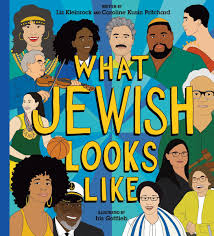
Too many Jews have been told: “You don’t look Jewish!” It begs the question, “What does Jewish look like?” Well, there are over fifteen million Jews in the world, which means there are more than fifteen million ways to look and be Jewish. It can look like setting out menorahs on tribal land, adding kimchi to the seder plate, organizing for change, and living out loud.
Shining a light on Paralympians and chefs, anthropologists and activists, dancers and dreamers, the individuals in these pages represent a range of identities. But they are threaded together by one unmistakable truth: Their lives, work, and commitment to Jewish values have changed our world for the better. These bold profiles and inspiring everyday stories come together to create a tapestry that beautifully reflects the multifaceted essence of the Jewish people.
This delightful kids book highlights the diversity of the Jewish experiencr by grouping the people into six chapters based on different Jewish values like tikkun olam, courage, unique value of every person, to save a life, hope and creativity/self expression.
There were a few famous people, but this was an educational book in that it introduced me to many I didn’t know. Some were famous people who I didn’t know were Jewish like Harvey Milk, Sammy Davis Jr., Naomi Wadler and Daveed Diggs. Others were people I simply didn’t know, but should be celebrated like:
Raquel Montoya-Lewis” First indigenous (Pueblo of Laguna trube on her father’s side) person to serve on the Washington Surpreme Court, and before that had been the chief tribal judge for the whole region.
Marlee Matlin: One of the first deaf actresses onscreen, winning an Academy Award at 21 for Children of a Lesser God. As someone with hearing loss, I must thank her for writing to President Ford and testifying to Congress of the need for closed captioning in entertainment.
Charles McDew: A convert to Judiasm, you may know him for being the founder of the SNCC, Student Nonviolent Coordinating Committee. He didn’t want to lead the sit-ins, but had been inspired by Hillel’s famous quote, “If not me, who? If not now, when?” and the rest is history.
Angela Warnick Buchdahl: From having to defend her Jewishness to her all-white synagogue, Angela rose through the ranks to becone the first Asian American cantor and rabbi, pushing against racism and bias within the community.
Victor “Young” Perez: Grew up as one of four kids in the improvished Jewish Quarter of Tunis, he grew up to become the World Flyweight champion in boxing. Unfortunately his career was cut short when he was sent to Auschwitz where he bravely smuggled soup to his fellow prisoners. It was ultimately shot on a death march weeks before liberation.
Uri Ben Baruch: Leader of the Ethiopian Jewish community, Beta Israel, and continuously wrote to Israel about the urgency for immigration due to government discrimination. Facing distrust and jailtime by the emperor, his persistance paid off and in 1973, Ethiopian Jews were granted right of return and tens of thousands immigrated to safety in Israel.
Michael Twitty: Another convert, Michael found community in a Sephardic synagogue and used food to explore his identity and roots, creating Koshersoul food and the Southern Discomfort Tour which explores how racism influenced Southern cooking.
Ofra Haza: Fought against the Ashkenazi bias of the Israeli music scene by making a hit album based on Yemeni street songs of childhood. She brought Mizrahi to the mainstream, getting sampled by Madonna and singing “Deliver Us” in the Prince of Egypt.
Ruby Myers: In the early days of Bollywood, Hindu and Muslim women weren’t allowed to perform onscreen so Baghdadi Jews were often cast instead. Ruby started in silent movies, and took a year off to learn Hindustani so she could participate in talkies, and made her own production company, Rubi Pics.
Not only does it introduce young readers to people who’ve helped change the world for the better, inspired by their faith but it also gives definitions to ethnoreligion, antisemitism, and the diasphora. Which leads to a whole host of new definitions like Ashkenazi: The Russian-Polish Euros in NY you see on TV.
Sephardic: Those who were expelled from the Iberian Pennisula.
Mizrahi: Those in Middle East like Iraq, Yemen, Iran. Ex: the Bukharan Jews.
Asian: TCochin Jews in India, Kaifing Jews of China date to 900 BC and WW2 refugees went to Shanghai, and the Tamil Thattar Jews of Sri Lanka.
African: Ethiopian Jews, and the Lemba Jews of Zimbabwe who both claim to be one of the lost tribes of Israel.
Latin America: Include converso Sephardics that fled the Spanish Inquisition, and those who fled the Holocaust. A lot of Ashkenazi went to Cuba. Moroccan Jews went to Peru and Brazil and were known as Amazonian N.
The book also offers sideboxes that widens the lens of the Holocaust that occurred in Europe as well as North Africa in Morocco, Algeria, and German-occupied Libya and Tunisia. A 1947 pogram killed 82 Jews in Yemen, so Israel launched Operation Magic Carpet, mass immigrating fifty thousand people aka the whole population.
I’ve often heard that the Jewish and African-American community are tied together, but this book educated me that in the 20th century, when German-Jewish intellectuals struggled to get jobs in the rise of Hitler, historically black colleges offered them jobs and saved them from deportation.
And fun fact, there had been Jewish quotas in universitoes but Yale alumni overturned them because they needed Jews on their basketball team. As always sports wins.
The book also highlights important programs that work to fight for social justice and educate and support marginalized members of the community such as the National Council of Jewish Women, Jews of Color, Keshet and Kamochah.
My one nitpick is that the book was created to dispel the idea that the only Jews are Ashkenazi Jews, and they were successful in highlighting African, disabled, LGTB, Sephardic and Mezrahi Jews, but I kinda wanted to learn more about the Asian Jew community and important figures from that history. I suppose it might be hard if there are no translated resources and this is a elementary book so I’ll simply have to research on my own.
Anyway, a good book to educate kids about Jewish communities around the world, and give them a new host of heroes to follow.
 Rachel Reads & Reviews
Leave a comment