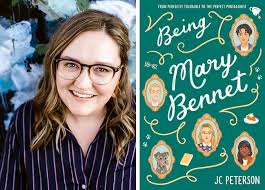
J.C. Peterson is the YA and adult rom-com author for bookish readers. Her novels include Being Mary Bennet, and Lola, At Last. She graciously took the time to answer my questions about Pitch Wars, P7P and what she has coming next. Enjoy!
1. You got your start with PitchWars, what did the mentor program entail?
PitchWars was such a wonderful, gratifying experience. I had taken a break from all writing after I had my younger son and applied to PitchWars on a whim, so when I was accepted into the mentorship program, I went from zero writing to living and breathing fiction in a heartbeat.
PitchWars involved deep developmental edits with my mentors, Carrie S. Allen and Sabrina Lotfi (who are literal angels). They were so thoughtful and insightful about my work and really helped me bring the novel up a level. It was hard, but so much fun at the same time!
It helped that Carrie and Sabrina were endlessly encouraging and were always there to hype me up. PitchWars ended in the big pitch event with agents, which was stressful. But from that, I signed with my agent Amy Bishop-Wycisk and we sold my debut novel Being Mary Bennet just a couple months later.
2. Best advice you got from your mentors?
Carrie and Sabrina were so talented at helping me see the bigger picture in my writing. I don’t want to say that I’m all vibes, but I tend to be very voice-y in my writing; they helped me keep that voice while also making sure every scene moved the plot forward. I think I really developed my skills in tension and pacing because of them.
3. Did your work in journalism aid you in your foray to fiction?
Absolutely! I think journalism helped me write one hell of a lede and kicker. But more than that, being a journalist first meant that I knew how to take criticism. I’m not precious about my work; I put a lot of stock in the collaborative effort of writer and editor working together to make a piece of writing better.
4. Who are some of your authorial inspirations? Do you find yourself trying to emulate their style or do you just want to evoke the same emotions from your readers?
I developed my voice and style as a journalist (I had a column, so I could play with my “author voice”), but I definitely want my readers to get the same feeling in my work as I get when I read my favorites. I love the work of Elise Bryant, Rachel Lynn Solomon, India Holton, Steven Rowley, and Sarah Hogle.
5. Favorite Jane Austen book and why?
Okay, honestly, it’s a tough call! My favorites are “Sense & Sensibility,” “Persuasion” and “Pride & Prejudice.” But I always return to P&P because it was the first Austen I read when I was a teen and just fell in love. The way Jane Austen could so precisely characterize people and hide a sharp turn of phrase in politeness — ugh, it’s just the best.
As an adult, I find I’m most drawn to “Persuasion” because it’s sadder and filled with more longing that really feels like it’s coming from a woman who has known and lost love. And when Anne reads that letter from Captain Wentworth, I mean … it doesn’t get any better than that.
6. What was it about Mary that captured your attention to create a modern day book exploring her?
Haha well, I realized, quite suddenly, that I was more Mary than Lizzy. She’s awkward, bookish, desperate to say the “right” thing but can’t quite find the words or timing. I mean, she’s a complete mess hiding behind propriety. That, to me, is everything you need for a great character arc.
I re-read P&P when I was first brainstorming Being Mary Bennet and realized Mary barely has any lines in the original text. She’s just there on the sidelines to be the example of what you don’t want to be. Poor Mary! So I decided it was high time she get her own story.
7. As much as the book focuses on Marnie and her adorable romance, the Barnes family plays a big part too. Can you describe the development of the family dynamics?
Just like the Bennets inform so. much of who Lizzy is, I knew it had to be the same for my modern-day Mary. Messy family dynamics are something I love to write because it feels so real — these people who have known you from the very beginning can love you so much and yet annoy the heck out of you in the same day.
As far as exactly who the Barnes are, I tried to think of today’s “landed gentry” and kept coming back to Silicon Valley as a unique way to explore American aristocracy. I didn’t want them to be Old Money East Coasters, necessarily, but people who have clout and yet still are surrounded by characters who are grasping for more fame/money/influence (ahem, Hayes).
8. Marnie loves P&P, and this book is a pseudo-founded on P&P, how did you balance the metaness of the premise?
It was hard! I remember a lot of discussions during PitchWars and with my agent and editor about how it all works. In my head, Being Mary Bennet, for the most part, takes place after the events of P&P. In the end, it takes some suspension of disbelief to just go with it — I hope the way I interpreted the characters is interesting enough to work.
9. In another literary connection, Marnie’s love interest Whit, often calls her “Anne-girl”. What was the moment in development that made the romance click for you or did you have it planned from the beginning?
Oh, Anne of Green Gables. Anne was my first literary love and probably the character I’m most similar to, in real life. I always knew that I wanted Whit and Marnie to have that first spark of connection over Anne. I love trivia and lesser-known facts (or, lesser-known in the U.S., at least), so I’d known for years about the popularity of “Akage no Anne,” which was a Japanese anime version of the novels. I
t seemed like a great entry point for Whit to understand the enduring love people have for Anne, and therefore understand Marnie on a deeper level. That moment where she assumes he’s making fun of her because of it but realizes he’s sincere … it says a lot, to me, about how Marnie is programmed to see the world and the ways Whit can upend that.
10. Now you’re focusing on Lydia or Lola Barnes as she finds her own path. What was it like in finding Lola’s distinct voice that’s a bit more wild than bookish Marnie?
Oh man, I looooooved writing Lola. I never planned on focusing on Lola after Being Mary Bennet, but as I was writing and editing, any time Lola sauntered onto the page I’d be so dang excited to write her voice. She showed up fully formed to me, and I couldn’t walk away from her.
Personally, I am really outdoorsy and love to hike, camp, just be in nature, so Lola’s journey in Lola At Last to find peace within herself in nature was a very personal story.
Also! Okay, so in P&P, Lydia is held up as a cautionary tale — her moral character wasn’t strong enough to resist Wickham and she will subsequently suffer an unhappy, unsuccessful life because of it. But, like, she’s a child when that all happens! She’s 15, and she’s preyed on by an adult.
So I wanted to give my modern-day version of Lydia a chance to make mistakes (so many mistakes) but not let it destroy her life. Because people should be able to make mistakes, learn from them, and grow a little. If we’re expected to be unchanging and perfect, to spring into existence with zero flaws and never put a foot wrong, I mean … that’s unattainable and, frankly, more robotic than human. Whew, okay, I’ll get off my soapbox.
Anyway, I adore Lola At Last and wish more people would discover it without writing it off because it’s about Lydia Bennet.
11. What is coming next for you and your work?
I’ve been turning my focus to adult rom-coms recently. Much like with Being Mary Bennet and Lola At Last, I’m always drawn to flawed women who build a better life for themselves without sacrificing the core of their identity. Add in jokes and cute love interests and quirky side characters + settings, and it’s been so much fun to explore writing for an adult audience!
Learn more about Peterson and her works on her website and other relevant social media: https://www.jcpetersonwrites.com/
 Rachel Reads & Reviews
Leave a comment