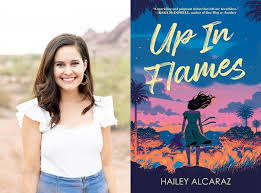
Hailey Alcaraz is the author of Up in Flames and the upcoming Rosa by Any Other Name. She graciously took the time to answer my questions and talk about her love for retellings, the impact of the Chicano Civil Rights Movement and more about her upcoming work. Enjoy!
1. Let’s start simple, what were some of your literary inspirations when you were young?
My mom is actually an author; her name is Erin Quinn, and she published her first book shortly after I was born. Growing up with a writer, I always saw writing a book as something that I could do. I knew it took a lot of work (my mom raised us, worked full time, took college courses and wrote several books throughout my childhood; to this day, I don’t understand how she did it!), but it always seemed like a realistic, attainable thing. Not to mention, she always encouraged me, helped me revise my work, and exposed me to a variety of books and writing opportunities. The example she set for me was beyond inspiring.
2. You’ve mentioned that Gone with the Wind, in particular, inspired Up in Flames, how did that come about?
Retellings are one of my absolute favorite genres (I’ve been a fan ever since Lion King came out in the 90’s). Gone with the Wind is also a complicated favorite of mine. I loved so many of the characters and the history and the complex portrayal of love — but obviously, it’s a problematic book and the criticisms of it are more than valid. But I spent a lot of time puzzling over what a modern Scarlett O’Hara would like. In the book, she has some traces of feminism (albeit, white feminism) but I’ve always wanted her to take it a step further: to acknowledge her privilege and the errors in her ways and do so much better.
So Up in Flames is my version of that. A stubborn, resilient young woman of privilege who has her world turned upside down and becomes a revolutionary in her own way on the path to recovery. I hesitate to call it a true retelling because Gone with the Wind is so flawed and has so many harmful messages, but critiquing and modernizing many of the themes and tropes in that book was definitely how my story started.
3. As your debut book, did Up in Flames remain relatively unchanged from first draft to final page or did you have to exercise/include new plots/characters?
The opening scene and the final scene are pretty much the only ones that remained relatively similar. Everything else got pretty significant shuffles through the various revisions. Readers might be shocked to find out Ruby was actually even a little less likeable in the early drafts; my editor wisely advised she get toned down in places.
4. Up in Flames deals with climate change, immigration, displacement alongside personal challenges of growing up and becoming a better person-how did you balance all these threads?
The first draft was about 10,000 words longer than the final book was — so it was certainly a challenge. Something I feel really strongly about–especially in young adult literature–is that every relationship should teach my character something. Each one serves a purpose, even the ones that are trainwrecks. So tying everything back to that question of what Ruby is learning from each person, each interaction, definitely helped make sure everything came together in the end. The advice that every scene serves a purpose towards your plot is a tried and true one, and it can be difficult, but it’s helpful to keep in mind.
5. Your book about the damage of wildfires feels particularly relevant in these times. How did your personal experiences influence your depictions in the story ?
My husband is in the fire service, so the damage and risks of fires is something that is a regular part of our lives. His department was very helpful in researching this book. My husband answered countless questions, and set up interviews for me with his department’s wildland crews.
8. What was your favorite scene to write? Or one that was particularly challenging?
The one that was challenging is a bit of a spoiler, so I’ll share my favorite! Anything where Ruby and Remy were flirting or butting heads was fun. In particular, the night Remy takes Ruby to the gala was a blast. So many of their rougher traits come out to play, and you get your first hints of the journey they’re both about to embark upon with their privilege and identities.
7. What most do you want readers to take away from Up in Flames?
It’s never too late to do better–to start learning from those around you and being more conscious of your privilege and biases. Just because you are flawed, doesn’t mean you aren’t worthy of growth and support. So many people get hung up on how “unlikeable” Ruby is (way more people than I anticipated) and I really struggle with this because I don’t think girls are often given the leeway they deserve to be messy and complicated. So I hope young people see her and feel inspired to keep showing up, flaws and all, in their own personal journeys–keep messing up, keep learning, and keep srtiving to do better.
8. Your upcoming novel, Rosa by Any Other Name, is a historical fiction set in the burgeoning Chicano Civil Rights Movement. Since it’s a woefully underrated part of history class, can you give some basics to readers what that means for your protagonist Rosa?
My book follows Rosa during her senior year of high school, shortly after Brown v. Board of Education mandated integration (though, as the book mentions, school segregation was actually banned in Arizona about a year prior).
Regardless, integration was not straightforward or easy anywhere–Phoenix included. I never learned about Mexican schools when I took history classes here in Arizona, but Mexicans students were often funneled into different classes or “schools within schools” with subpar learning conditions, on the basis of language differences, though it didn’t matter if these students spoke English or Spanish, as you can imagine. And despite the progress school integration implied, racial discrimination was still rampant and varied vastly across ethnic groups.
My book focuses on the Mexican experience and how they were often not seen as “colored” but also not seen as white, and how that often made things really unclear and dangerous for them. They were often living by a set of unwritten rules that rarely worked in their favor. Rosa’s story follows her as she navigates these hurdles in the wake of tragedy and encounters a variety of people with perspectives on what progress for Mexican Americans looks like.
9. Since this is a Romeo + Juliet or I should say, West Side Story retelling, it’s easy to guess Ramon, Julianne, and Rosa are Romeo, Juliet and Rosalind, will Rosa have her own love forbidden interest to navigate as well?
So glad you asked this! YES! In my version, Rosa does have a rivals-to-lovers, best friend’s brother, romance with my broody, rebel-with-a-cause take on Mercutio. He’s Ramon’s brother (rather than cousin like in Romeo and Juliet) and they have some push and pull tension over their differing ideas on how to create change in their community. Their romance is one of my favorite parts about this book.
10. Three tropes to describe Rosa by Any Other Name?
1. Forbidden romance x 2
2. “Stay away from him, he’s trouble” (Is that a trope? I think it is — anyway, we’ve got a ton of it!)
3. Nicknames as flirting
11. Any other news you’d like to share?
I’ve got a couple projects in various stages of development that I’m hoping to share more about soon! Feel free to follow me on Instagram at @alcarazbooks or subscribe to my newsletter here.
 Rachel Reads & Reviews
Leave a comment