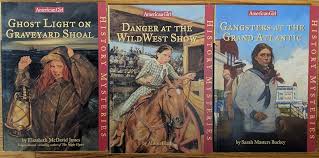
The second half of the series gets a little bit darker. The mysteries involve dangerous individuals whose actions are not explained away as a misunderstanding or bitterness. Often there is real hate or greed motivating them, and they have the weapons to back them up if others get in their way. There is more exploration of darker subjects like war, PTSD and indigenous genocide and the girls have to realize that the world is not always a fair or just place. Thus the second half of the series is always one I look forward to when I reread it. It has so many good books.
Riddle of the Prairie Bride by Kathryn Reiss: Prairie life in the late 1800s was difficult without a full family to take up all responsibilities and chores. Ida Kates papa has sought a mail-order bride complete the homestead. When she arrives, why doesnt this bride look or seem like what was expected? Ida Kate investigates this mysterious woman.
I believe this is the one that made me return to the series over and over even though Hoofbeats of Danger was the first book I read in the series. This had a nice blend of romance of convenience combined with the clustraphobic horror that the bride isn’t is who she says she is, but Ida Kate has no where to go in the middle of the prarie to escape her.
Circle of Fire by Evelyn Coleman: In 1958, Mendy puts herself in danger when she discovers that the Ku Klux Klan is planning to bomb the Highlander Folk School in order to disrupt a visit from Mendy’s hero, Eleanor Roosevelt.
When I was talking about dark, this is the book I’m talking about as Mendy learns and faces off with the KKK. It’s an age-apropriate primer to racism and the consuming evil that is racial hate and how it changes a person, both the hater and the one that bears the brunt of it. Mendy is no longer innocent about the ways of the world, but she is also stronger than she first thought, and takes refuge in her own actions and Roosevelt’s words that she’s not going to let them make her feel inferior.
Enemy in the Fort by Sarah Masters Buckey: In 1754, with her own parents taken captive, twelve-year-old Rebecca must confront her fear and hatred of the Abenaki when a boy raised by members of that tribe is brought to the fort at Charleston, New Hampshire, just before a series of thefts occurs.
Here’s another age-apropriate primer into racial prejudice when two years after her family’s kidnapping by the Abekani naties, Rebecca must welcome a former captive into her home, Isaac. But Isaac is more native than English, and Rebecca can’t understand why he wants to return to his Abekani family. She views him with the same suspicion the rest of the fort holds against him. Rebecca might be a little more unlikable than other protagonists because it takes her so long to shed her prejudices but I admire the realism and the slow evolution of her views.
Mystery on Skull Island by Elizabeth McDavid Jones: In 1724, twelve-year-old Rachel and her friend Sally discover a pirates’ hiding place on an island near Charles Town, South Carolina, and they suspect it may be connected to the woman who will soon become Rachel’s stepmother.
Just as New Orleans provides a melting backdrop of eniromental beauty and disntinctive characters, South Carolina is another contender of a state that should have more romance novels. Specifically pirates as Jones uses the history of pirates in SC’s ports and the tensions between citizens and merchents wishing to make a quick buck off the illegal activity.
Whistler in the Dark by Kathleen Ernst: It’s 1867. Twelve-year-old Emma Henderson is mortified when Mother takes to wearing a Reform Dress–hideous bloomers! Worse, Mother has accepted a newspaper job in wild, far-off Colorado Territory. But even Emma can’t imagine just how badly things will go in Twin Pines. From the moment she and Mother step off the stagecoach, it’s clear that someone doesn’t want them there.
This is one of the ones is less dark, but a solid mystery and details the beginning of the feminist movement through fashion (or unfashion as bloomers were practical but not pretty) and one girl’s journey to realizing her mom might have a point with the whole suffrage nonsense.
Mystery at Chilkoot Pass by Barbara Steiner: At the start of the Klondike gold rush of 1897, while traveling through Canada with her father, uncle and friends, twelve-year-old aspiring author Hetty tries to determine the identity of a thief.
Alaska is such a beautiful yet harsh state and Steiner does a wonderful job in depicting the grit and strain it took to climb the trail through Alaska/Canadian wilderness. I felt exhausted just reading about it. A good mystery too, but this one takes the take in transporting a reader to the time and place.
The Strange Case of Baby H by Kathryn Reiss: In the aftermath of the 1906 San Francisco earthquake, twelve-year-old Clara finds a baby left on the doorstep of her family’s boarding house, and sets out to unravel the surrounding mysteries.
Do you ever look into houses and imagine the occupants that live in there? Maybe it’s just the writer in me, but the refrain is that “No one knows what was occuring in any house when the quake struck.” That’s certainly true for Clara and her family when a baby ends up on the doorstep. It’s a girl dressed in boy’s clothes with her hair shaved off. All very suspicious and one can see the braery and the opportunism that arises in people when chaos strikes.
Danger at the Wild West Show by Alison Hart: Twelve-year-old Rose sets out to prove her brother’s innocence when he is accused of shooting a politician during a Wild West show performance in Louisville, Kentucky, in 1886.
Another ‘horse’ book with a bit of “not like other girls” to boot, but I warmed up to this one after reading it for this review. It’s not about the horses so much as Rose learns the glorification of the Wild West show she participates in, and the real consequences it has for her Sioux friends with the pushing of the Dawes Act in Congress.
Gangsters at the Grand Atlantic by Sarah Masters Buckey: In 1925, after witnessing the violent actions of some gangsters, twelve-year-old Emily accompanies her older sister on a trip to a luxurious hotel on the New Jersey shore but worries that the gangsters have come to the same hotel. Includes historical notes on the time period.In 1925, after witnessing the violent actions of some gangsters, twelve-year-old Emily accompanies her older sister on a trip to a hotel on the New Jersey shore but worries that the gangsters have come to the same hotel.
I’ve mentioned before that I love the 20s. While Mystery of the Dark Tower focuses on the “modern” times and artistic creativity of the 20s, this one deals with the gangsters that are also emblematic of the era. While Emily stays at the resort, I enjoyed the ostentious riches she gets to experience for the first time in contrast to the dirty liquor it’s built upon and her solid investigative work in figuring out whether the notorious Mr. M is in the city to snuff her out.
Ghost Light on Graveyard Shoal by Elizabeth McDavid Jones: In the late nineteenth century, twelve-year-old Rhoda investigates her suspicion that a wrecker may be luring ships to their destruction on the Virginia barrier island where her father is Keeper of a U.S. Lifesaving Station. Includes historical notes on the United States Life-Saving Service.In the late nineteenth century, twelve-year-old Rhoda investigates her suspicion that a wrecker may be luring ships to their destruction on the Virginia barrier island where her father is Keeper of a U.S. Lifesaving Station.
This is a nice blend of ghost story with mystery while hihlighting the bravery of the early surfmen (who were folded into the US Coast Guard in the 1900s).
Betrayal at Cross Creek by Kathleen Ernst: In the deep forests of North Carolina’s Cape Fear River Valley, the brewing Revolution feels very far away to Elspeth and her fellow Scottish immigrant neighbors, but when Elspeth’s grandfather and cousins finally march off to fight on the British side, Elspeth is left alone to protect her grandmother.
This is another one of the more serious books in the lot that dives into Scottish history and it’s effect on the Revolution, ie. the Highlanders that joined the Loyalists. The Highlanders had already fought the British in 1745, and were brutally slaughtered, jailed, evicted etc. as punishment for their uprising so the Scots settled in the colonies want no part in the rumbling revolution. But both Patriots and Loyalists want them on their side and are willing to engage in threats to do so.
Elspeth’s grandparents still keenly feel the trauma of ’45 and don’t want to be dragged in. Some want to fight the British because they agree with the Patriot’s reasoning, others join the Loyalists because they know what it’s like to lose to the British and don’t want to face punishment again. Elspeth’s American friend doesn’t understand why they’re not willing to pick a side, but that’s because “she doesn’t truly know what war is.” This book is a very relevant to today in depicting the trauma and consequence of war through generations.
 Rachel Reads & Reviews
Leave a comment