I have discussed this a little bit in my historical fiction pages but as I’m rereading this for the first time in years, I thought I’d go a little more in-depth with my thoughts.
For those that are not in the know, History Mystery was a 1997 spin-off of Pleasant Company’s very popular American Girl collection of books. While American Girl has six books dedicated to each girl in a specific time period within the 7-9 age range, History Mystery was for middle readers who wanted more excitment in their historical tales.
22 tales in the series, each book was a stand-alone, and the historical periods were more varied. The end of the Wild West, the San Francisco Earthquake, War of 1812, you get the idea. The twelve-year old protagonists tend to come from more perilous circumstances and must contend with gamblers on the run and the deceit of adults around them with their wits and skills.
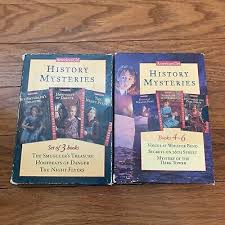
So here are my random thoughts on the first half of the series.
Smuggler’s Treasure by Susan Masters Buckey: Sent to live with relatives in New Orleans during the War of 1812, eleven-year-old Elisabet determines to find a smuggler’s treasure to ransom her imprisoned father.
New Orleans is just a fascinating place to set a story, in history and modernity. It helps that it’s such an important piece of land and trading point with its blend of English, Spanish, and French culture. Also it has that dashing devil-may-care anti-heros like privateers, the Brothers Lafiette, pirates, gamblers, and more trying to make their way in the world and make their riches. I think more historical romances novels should be set there. I know NY is considered to be the center of industry but come on, a wayward duke can head down to New Orleans to romance a Creole heiress with her own standing and respect.
Hoofbeats of Danger by Holly Hughes: In 1860, eleven-year-old Annie asks Pony Express rider Billy Cody to help her find the person responsible for sabotaging her favorite pony Magpie.
This one was the first book I read in the series way back when I was 7, but that’s the biggest distinction I can give it. Others in the series are more exciting and I simply don’t have that special spark that connect horse girls to all horse paraphelia.
The Night Flyers by Elizabeth McDavid Jones: In 1918, caring for her family’s homing pigeons while her father is away fighting in World War I, twelve-year-old Pam comes to suspect that a mysterious stranger in her small North Carolina town is a German spy.
This one is one of those books where you wish the story continued. It’s very much a wish fulfillment to be a kid and be a master pigeon-master whose skills are vital to the war effort.
Voices at Whisper Bend by Katherine Ayers: In their Pennsylvania town in 1942 twelve-year-old Charlotte and her classmates collect scrap metal for the war effort only to have it disappear from the school basement.
A classic WW2 story that does an excellent job in tackling prejudice for the middle school set as Charlotte faces ugly anti-Italian and anti-German sentiment around and confront her own prejudices.
Also in seeing the patriotic solidarity roused by propaganda, I see that WW2 may have been the last war where the people were united to help the war effort. I don’t think that would happen today. Not simply because war is bad and such, but the idea of US people today accepting rations when some can barely accept masks during a pandemic, that’s a laugh.
Secrets on 26th Street by Elizabeth McDavid Jones: In New York City in 1914, eleven-year-old Susan encounters a mystery through an independent-minded female boarder and becomes involved in the growing suffrage movement.
While the original American Girl series and school classrooms discuss the basics of the suffrage and women’s rights, this is one of the few novels that tackle the importance of working-class women in the cause and the specific fears and troubles that made them wary of the upper-class women who did not understand the issues relevant to them.
Mystery of the Dark Tower by Evelyn Coleman: In 1928, Bessie Carol Coulter travels to New York City with her father and brother, leaving behind her mother at their rural North Carolina farm, which leads Bessie to believe her parents are splitting up, but she soon finds out that something quite different is in the works.
I love the 20s, and Harlem was the hoppingest place in New York back then as they say. I enjoyed seeing the vibrancy of the city and the African-American community as Bessie sees the opportunities and technology in the city that she’d never believe back home. It also dealt with intercommunity tribalism between the African-Americans toward the immigrants from the West Indies and the divide between generations.
Trouble at Fort La Pointe by Kathleen Ernst: Suzette Choudoir has spent each of her twelve summers at La Pointe Island on Lake Superior, where Ojibwe people camp by the French fur-trade fort. It is 1732 and if her papa wins the trappers’ competition, the prize will let him stay with his Ojibwe family year-round instead of wintering in far-off Montréal with the other French voyageurs. But a troublemaker sabotages the competition, and Papa. Only someone who’s both Ojibwe and French can figure out what’s going on — someone like Suzette.
This was a good novel tackling the prejudice of being biracial or Métis in this case with Suzette learning to accept and embrace both sides of her instead of feeling that she must choose. I wish that there’d been more discussion between her and her mother who was also Métis and thus might provide some guidence to her daughter or tell her own experiences with her identity. Same with Suzette’s friend, Gabrille, another Métis, because it felt wrong that there were several Métis around her yet Suzette acted like she was the only one who was dealing with the difficulties of two identies and not being accepted by either side.
Under Copp’s Hill by Katherine Ayers: In 1908, eleven-year-old Innie joins the library club at a settlement house that serves immigrant families of Boston’s North End, but when items and money disappear from the settlement house, Innie’s past as a troublemaker puts her under suspicion.
Aa lovely book showcasing the Wednesday Girls. It was a popular program in the 1900s where young immigrant girls were educated, earned a living and assimilated to America. My grandmother had some of the pottery created by a Wednesday Afternoon girl. That’s beside the point, I enjoyed Innie’s story as she and her friends learn to reconcile what they’ve been told at home about sticking to ‘their own kind’ and becoming part of the new ‘American’ girl, shedding some of the old values of the old country to become part of the new.
Watcher in Piney Woods by Elizabeth McDavid Jones: In 1865, while helping her family keep their Virginia farm going through the end of the Civil War, twelve-year-old Cassie meets a Confederate deserter and a Yankee prisoner of war and tries to discover who has been stealing from the farm.
Another Civil War story that tackles it from a new angle. Not of the antebellum plantation owners or slaves escaping to freedom, but the rural Southerners. Cassie’s family don’t have any opinions on slavery, probably because they don’t know any black people in their neck of the woods. They’re just isolated farmers, and the Civil War is an invasion from the North without provocation. This is an example of how big events like war fade in the face of each family’s story.
Shadows in the Glasshouse by Megan McDonald: While working as an indentured servant for a Jamestown glassmaker in 1621, twelve-year-old Merry uncovers a case of sabotage.
Plymouth Colony gets all the attention in history books but did you know Jamestown was populated by Italians in the race for America to corner the cristello glassware from the glass-blown wars among English, Germans, and Italians? It was, and it’s one of those cool facts that I love to learn about. Also glass-blown items are simply beautiful and I’m glad the artistry hasn’t died out.
The Minstrel’s Melody by Eleanora E. Tate: In 1904, twelve-year-old Orphelia follows her dream by running away from home to join an all-black minstrel show headed for the Saint Louis World’s Fair, and learns about her family’s troubled past in the process.
New Orleans is cool, but I also believe there should be more books set at World’s Fair. Chicago World Fair, the St. Louis World Fair, the Paris Exposition, you get the idea. It’s such a spectacle with so many countries and diverse people congregating together, imagine the stories to be told.
Outside of that, I enjoyed this sensitive depiction on the history of minstrel shows. The demeaning origins as well as the way black performers, particularly WOC, reclaimed it for their own. Plus the mystery was great too.
 Rachel Reads & Reviews
Leave a comment