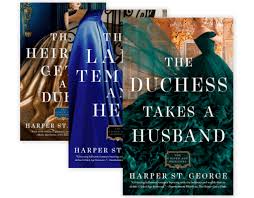
The last romance series of the year brings the former colonies to its English roots with the Crenshaw family touring England for a vaction. Unbeknowst to the girls, the true intention behind the trip is for their social climbing parents to marry them off to entitled gentlemen.
Well, August and Violet aren’t going down without a fight. They’ve seen the cold, brutal marriage betewen their best friend and her stuffy, 50 year old husband and they will do anything to avoid that fate. They have work and other dreams to accomplish first.
But what if the men they’re pushing away may be the happiness they’re chasing all along?
1. The Duchess Takes a Husband: The final book in the series was actually a surprise as St. George initially envisioned this as a trilogy but fans desperately wanted to know Camilla’s fate. You see, Camilla’s marriage to the Duke of Hereford at the ripe age of 16 while he was in his late 50s was awful. Partially based on the marriage of Consuela Vanderbuilt who supposedly cried as she made her way down the aisle.
It was truly a marriage of convenience. . . for Camilla’s parents. He gets the money, they get the social status and Camilla’s choices/life is taken away as she’s isolated and scorned in England for being American. Meanwhile Hereford continually isolates, verbally abuses and derides her as inferior. Thankfully, Hereford’s dead here and Camilla is content to be a widow of some independence even as Hereford’s nephew tries to continue his uncle’s tactics of controlling her pocketbook. She only has one wish. . . to experience sex. The good, loving kind with someone she likes and trusts.
Enter, Jacob Thorn, second son and rapscallion who is a bit wary of this friends with benefits arrangement Camilla is proposing as internally, he has deep fondness for Camillla. Fondness that blooms into love as these things do which Camilla is hesitant to reciprocate after her experiences.
This one gets number one because of how St. George writes of the slow burn between Camilla and Thorne and how she gracefully navigates Camilla’s trauma. She doesn’t realize it’s trauma but all the verbal abuse and marital rape that she thought was okay, well it’s not and she deserves so, so much more than how Hareford treated her. This book is almost more about Camilla regaining her confidence (finding pleasure in her sexuality, finding a cause to champion, finding her self-worth that she is no longer compromising to please someone who doesn’t have her best interests) than about the romance.
But Thorne does have a good storyline too as he seeks to also find his place outside of being the second son, to find that he’s also a capable businessman and that shed his fears that he’ll have the same obsessive, destructive love as his father.
It’s just so good and unique in how she touches on these heavy topics and make such messy people that you want them to find love and acceptance in each other and they do!
2. The Devil and the Heiress: Violet wishes to be a writer even though her parents consider it a hobby at most and would be scandalized if she published. Especially since it’s vaguely reflects and comments on their real life society friends and hypocrisies. It’s also an outlet for her attraction to Lord Leigh or the devilish seducer, Lord Lucifer in her novel. An attraction she gets to experience first hand when Leigh offers to help her escape the clutches of an unwanted marriage by taking to an artist residency in Scotland.
In reality, Lord Leigh has more mercenary ideas in mind. He’s going to use the trip to convince and possibly seduce her to elope with him! He’s the devil indeed but he has to do this in order to save his property and his younger sisters from the financial ruin his father left them all in (he gave all the money to his mistress, yikes!)
But the runaway road trip softens both Violet and Leigh that love becomes the true goal of Leigh’s plans. I enjoyed seeing the complicated evolution of Leigh’s goals. While he did respect Violet, he didn’t truly see her as her own person until this trip and it pricks his conscience as it rightfully should that he backs out of his original plans. It’s what makes it even more heartbreaking when Violet finds out the truth because even though Leigh is no longer trying to manipulate and seduce her, he never planned to tell her his original plans. And Leigh feels too guilty to defend himself.
Usually in these romances, it feels like the force of their love makes the characters accept the apology and gloss over the betrayal. Here, St. George really makes Leigh work to prove he has changed and that he means to change for the better. His apology is proportionate, and the actions he takes directly address his faults and it’s worth it. I also enjoy how organic the relationship progressed despite the short time together, another thing that’s hard to pull off but I rooted for them so much.
3. The Lady Tempts an Heir: Maxwell is the eldest Crenshaw and as the only son, it’s his children that will carry on the Crenshaw name. So when his father has a near-fatal heart attack, it spurs the patriarch to manipulate his son to get married. Maxwell doesn’t want to be a pawn to his father’s plans so he hatches a fake engagement with Lady Helene in order to subvert Mr. Crenshaw’s greed. Only the real feelings between them make the arrangement becomes more painful.
The big issue of this book is motherhood and the hypocrisies surrounding women’s roles in it. A woman’s duty is to give birth but if she does it before marriage or without marriage, she’s an immoral whore never to be helped to by polite society. Or if she’s unable to have children, she’s a failure to be pitied. Helena feels both ends of the spectrum acutely as she heads up a charity for unwed mothers and it is a big part of why she’s reluctant to seal the deal with Max. She doesn’t want the children issue overshadow and spoil the love they have for each other now.
I enjoy how Maxwell and Helena were true equals, provoking each other in arguements in lieu of the simmering sexual tension between them. They’re both experienced in the ways of the world and that makes the bedroom scenes much more hot but also the communication much more honest which is refreshing. Plus you got to love the compassionate patronness and a industrial man with actual morals regarding worker’s compensation and safety (That’s how you know it’s fiction, lol). The only reason that this is third is because I felt some of the pining in the third act to go on too long.
4. The Heiress Gets a Duke: The first book of series does a great job in setting up the characters especially the boderline detestable Crenshaw parents. St. George does an excellent job in highlighting the feelings of betrayal on August’s part when she finds out her parents’ plan. This is doubly hurtful as her father allows her to work with him, acknowledges that she’s just as business savvy and good with numbers as any man, but wants her to give it up as soon as she gets married and proceeds to spitefully ignore all of her advice in front of male collegues in order to teach her place.
At least Evan respects her but it takes awhile for them to find a place of mutual love without compromising August’s personhood, and for Evan to really realize what she’s losing in the bargain. It’s a good book but pales in comparison to the above ones.
 Rachel Reads & Reviews
Leave a comment