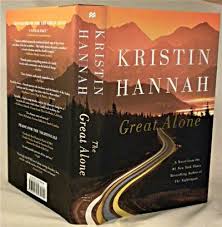
Ah the great Alaskan wilderness, a place to reconnect to nature.
Or in Hannah’s novel, a place where family demons come to tear them apart with no chance for help in the middle of a blizzard. Aka a nightmare in my thinking.
After years spent as a prisoner of war in Vietnam, Ernt has returned greatly changed. When an old army buddy passes, giving him the cabin in the Alaskan wilderness, he jumps at the chance for a new life.
But for Ernt’s wife, Cora, and daughter, Leni, the change brings a personal hell. The isolation, the lack of electricity, the orney town residents miles away, that’s nothing compared to living with Ernt whose controlling and violent outburtst grow more and more dangerous.
Narrated primarily from Leni’s POV, with a few chapters from other characters, Hannah’s story is amazingly realistic and raw as she described the toxic power of love and family. Honestly, it was a bit depressing because Hannah piled on the abuse, physical and emotional as the story went on. It was hard to see light at the end of the book. Even when there were happy moments, it would soon be overturned by another tragedy out of their control.
I know this is all very vague but I’m trying to keep this spoiler-free.
I can talk about Ernt. You can probably guess that a combination of PTSD and alcoholism that he’s become abusive since ‘Nam. I’ve never had to experience it but Hannah created a character that was more monster than man. I found it hard to believe in Cora/Leni’s assertions that he had been “good” before the war because we never get to see any sort of goodness or moment of sympathy from him that he realizes that he’s wrong or lashing out because of his PTSD. He just gets worse and worse.
But I suppose it makes sense because people stay in abusive cycles out of belief that the person will change or they truly feel sorry and won’t do it again. But the way Cora clings to it almost felt like a Stockholm Syndrome degree. Until one big moment that was awesome, but also backfires on her because “men gotta stick together.” Honestly, Cora had it the worst throughout the book and I felt so bad for her.
Leni was a good POV as Hannah does an excellent job in painting the imagery of 70s Alaska in its beauty and its freezing awfulness (That was my friend’s biggest compliment to the author. Really good descriptions). I just wished that in Hannah’s choice to have other POVs there had been more from Cora just to get more of a sense of her thinking than just through the lens of teenage/adult Leni.
Other non-spoilery characters I can talk about are Tom who is a good friend and boyfriend to Leni especially under the dramatic circumstances when weaker ones would have left Leni to fend for herself. And Marge is that cool aunt who would totally teach you how to hunt and skin a moose. She was cool and I wished there was more of her. Hannah couldn’t because the point is how isolated Cora and Leni are, but still.
My friend enjoyed it a lot especially the ending which is not one of those neatly wrapped happy endings because like I said before this book is heavy on the realism and real life is not happy. It’s layered, complicated and messy and if you enjoy those sorts of family dramas, you’ll be sure to enjoy this.
 Rachel Reads & Reviews
Leave a comment